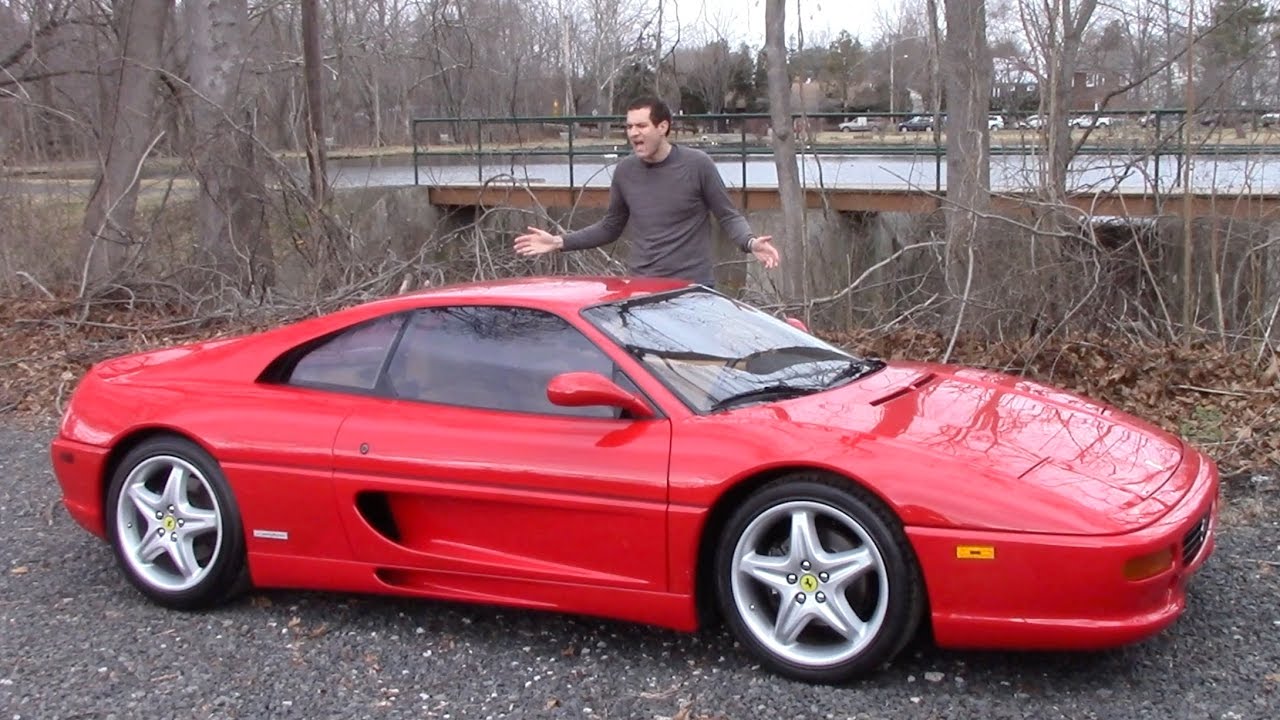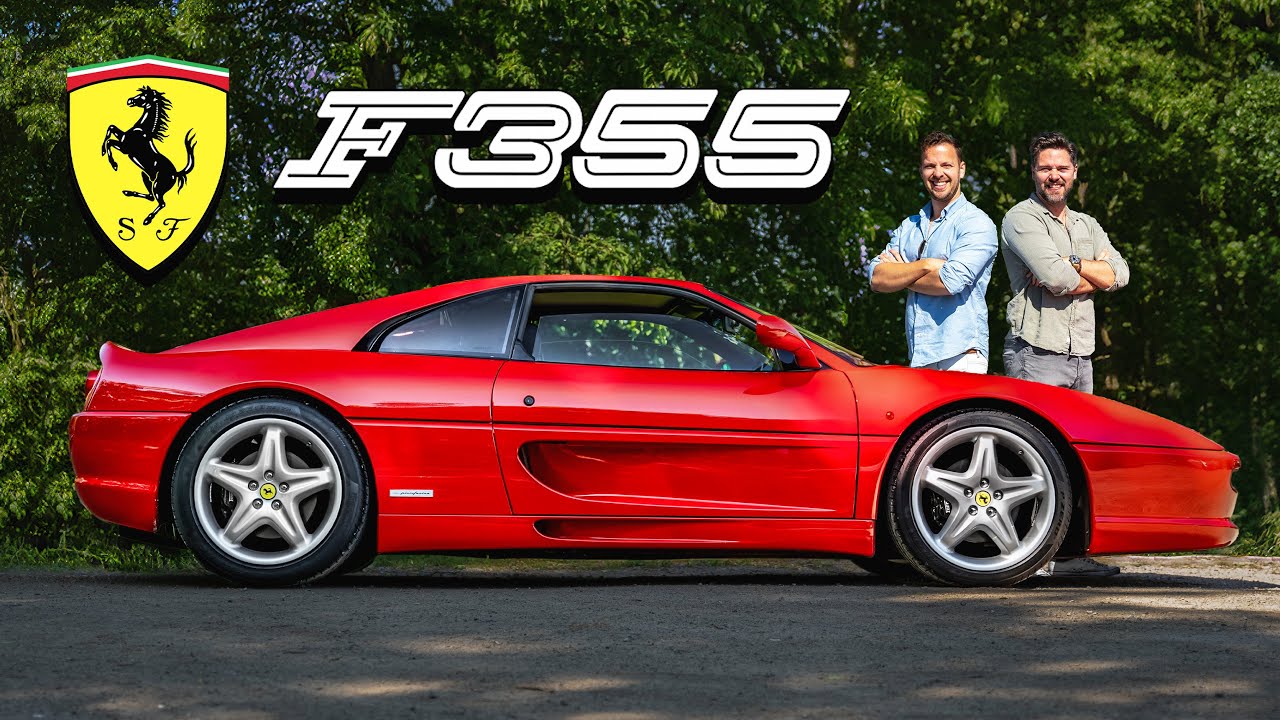
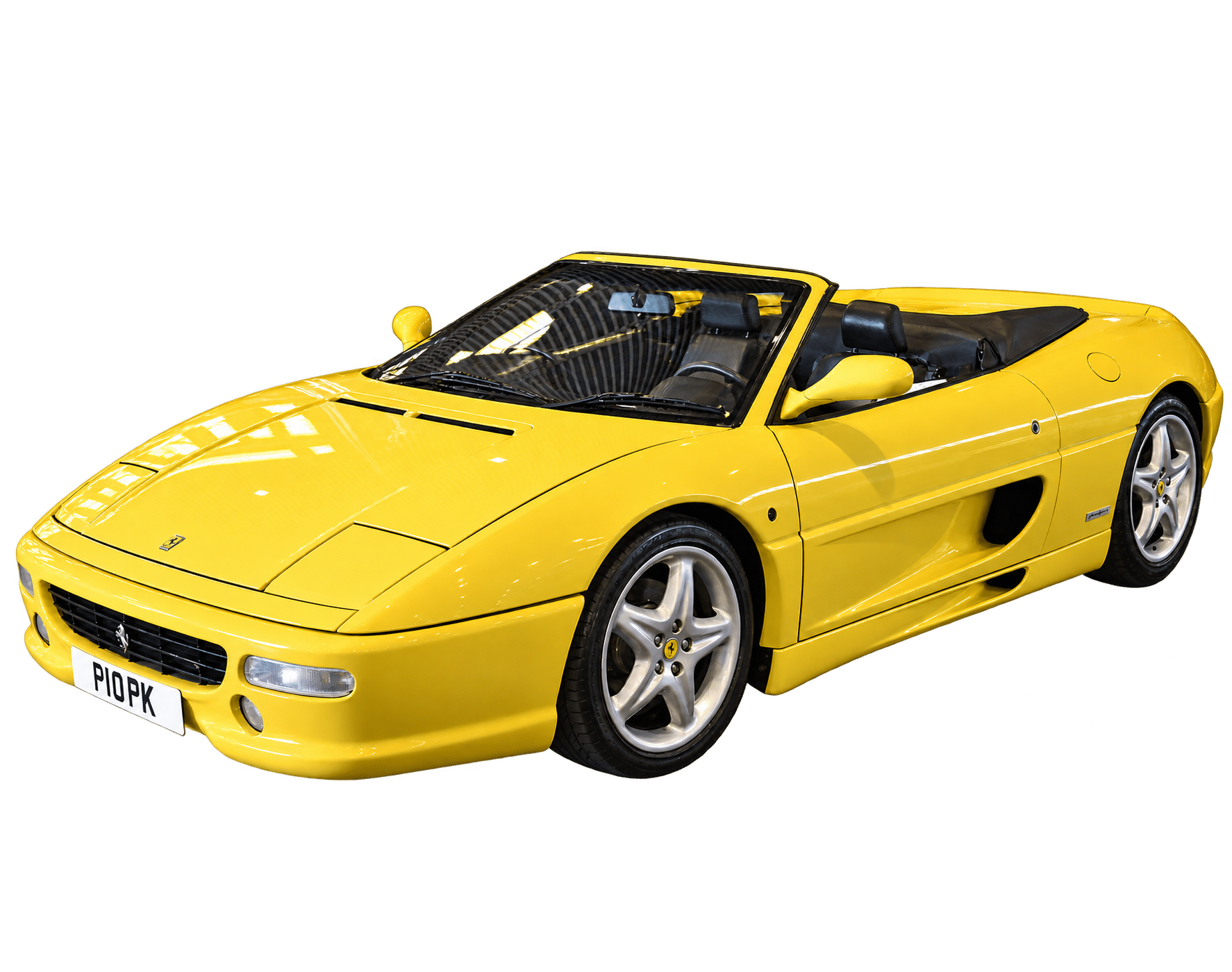
The Ferrari F355, produced from 1994 through 1999, marked a major turning point in Ferrari’s mid-engine V8 sports-car lineage. Developed as the successor to the 348, the F355 combined dramatically improved performance, more sophisticated aerodynamics, refined handling and one of the most celebrated naturally aspirated V8 engines Ferrari ever produced. Its 3.5-liter, five-valve-per-cylinder engine delivered 375 horsepower at 8,250 rpm, giving the car extraordinary performance and a distinctive high-revving exhaust note.
The F355 was offered in three principal body styles: the Berlinetta coupe, GTS with removable roof panel, and Spider convertible. Ferrari also introduced the F1 electrohydraulic transmission in 1997, bringing Formula One-inspired paddle shifting to a production road car. A limited-production F355 Challenge version was developed for Ferrari’s single-marque racing series, while the rare Serie Fiorano marked the end of Spider production.
Today, the F355 occupies a particularly desirable position in Ferrari’s history. It combines classic Pininfarina styling, relatively compact dimensions, pop-up headlights and traditional mechanical controls with performance that remains impressive. Manual-transmission examples are especially sought after, while the Challenge and Serie Fiorano versions appeal to collectors interested in the model’s racing heritage and limited-production variants.
Development and Design
The F355 was introduced in May 1994, replacing the Ferrari 348, which had received criticism for its demanding handling and relatively modest performance compared with contemporary competitors.
Ferrari’s engineers substantially revised the 348’s basic architecture, focusing on engine performance, chassis balance, aerodynamic efficiency and everyday usability. The resulting car was considerably more refined without sacrificing the mechanical character expected of a Ferrari.
Styling was developed by Pininfarina, with the design led by Maurizio Corbi. Although the F355 retained the general proportions of the 348, its bodywork was smoother and more integrated, with rounded surfaces, revised side intakes and a distinctive rear treatment.
The F355 abandoned the 348’s prominent side strakes in favor of cleaner bodywork and more conventional side air intakes. Pop-up headlights, a low nose and a compact passenger compartment preserved the classic appearance of Ferrari’s mid-engine sports cars.
The design also incorporated extensive aerodynamic development, including a carefully shaped underbody and rear diffuser. Ferrari emphasized both downforce and reduced drag, improving high-speed stability.
Aerodynamically, the F355 was one of the first production cars to feature a fully faired underbody with a rear diffuser to generate functional venturi-effect downforce without requiring a large rear wing.
The 3.5-Liter Five-Valve V8
The F355’s most important mechanical feature was its 3,496cc naturally aspirated V8, designated Tipo F129.
The engine featured a 90-degree cylinder-bank angle, dual overhead camshafts and five valves per cylinder, for a total of 40 valves. Three intake valves and two exhaust valves per cylinder improved airflow and allowed the engine to operate efficiently at unusually high engine speeds.
Output was approximately 375 horsepower at 8,250 rpm and 268 lb-ft of torque at 6,000 rpm. The engine’s redline approached 8,500 rpm, making it one of the highest-revving production V8s of its era.
Ferrari also incorporated titanium connecting rods, sophisticated engine management and a relatively high compression ratio to achieve exceptional specific output.
The F355’s engine character differed substantially from that of the earlier 348. Power delivery was progressive, with increasing urgency as engine speed rose, accompanied by a distinctive mechanical sound that became one of the model’s defining characteristics.
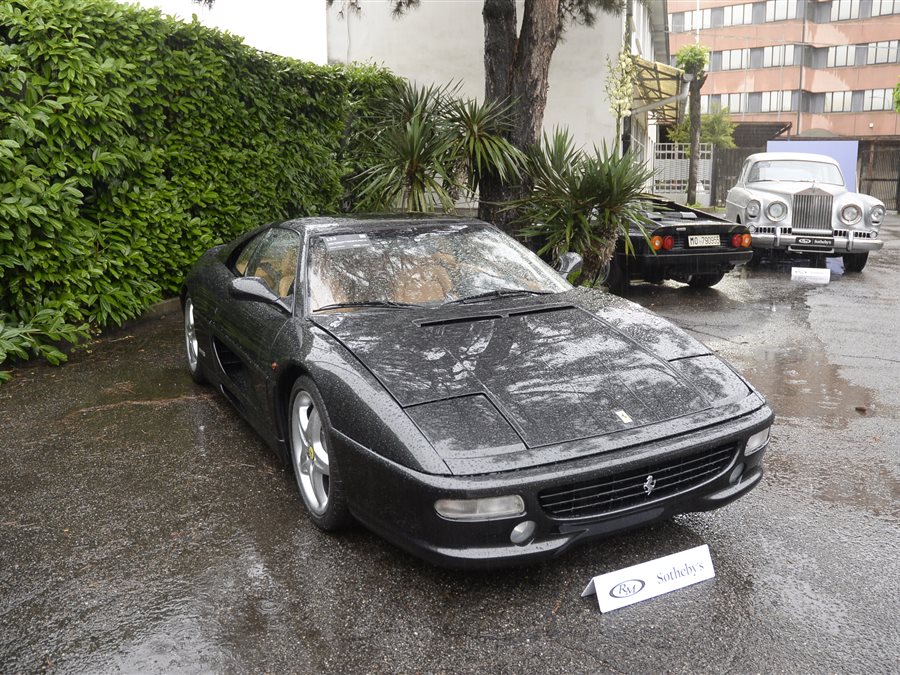
1995 Ferrari F355 Berlinetta, from an auction in Milan on May 22nd, 2025
Ferrari F355 Berlinetta: 1994–99
The F355 Berlinetta was the original fixed-roof coupe and the most structurally rigid version of the range. Its closed body provided the strongest connection between the front and rear chassis structures, contributing to precise handling and reduced body flex. The Berlinetta was initially offered exclusively with a six-speed manual transmission, operated through Ferrari’s traditional open metal shift gate.
For 1997, Ferrari introduced the optional F1 electrohydraulic transmission, creating two distinct Berlinetta configurations. The Berlinetta’s combination of relatively low weight, structural rigidity and high-revving V8 made it particularly attractive to drivers interested in the F355’s sporting capabilities.
Today, manual Berlinettas are highly desirable, especially when they retain original paint, factory equipment and complete service records.
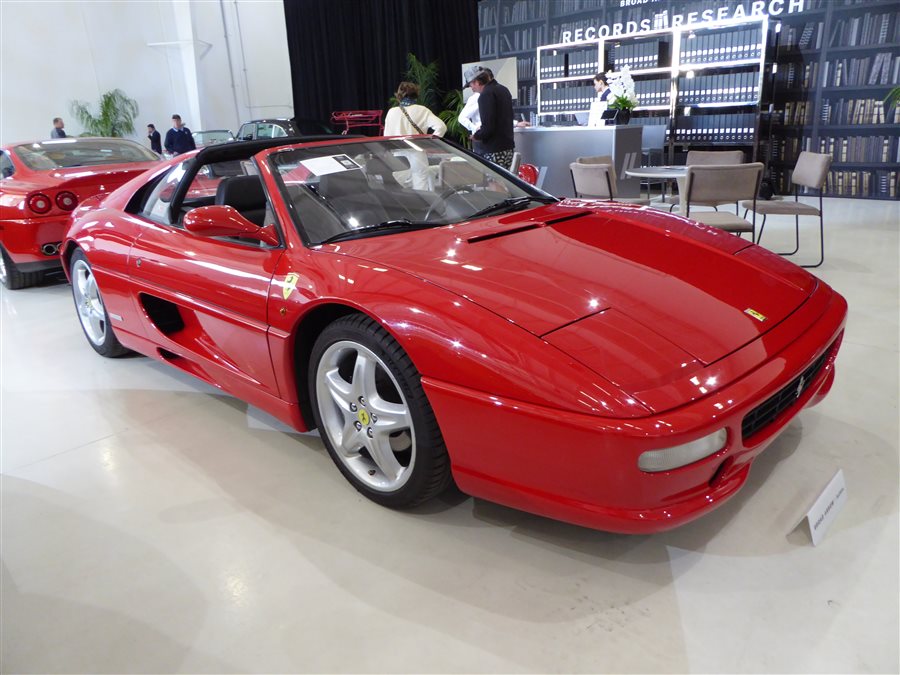
1994 Ferrari F355 GTS Targa, from an auction on August 14th, 2024
Ferrari F355 GTS: 1994–99
The F355 GTS combined the Berlinetta’s basic body structure with a removable roof panel, providing open-air driving without the complexity of a full convertible top.
The GTS followed a tradition established by the 308 GTS and continued through the 328 and 348. Its removable roof panel could be stored behind the seats, allowing the car to be driven in either closed or open configuration.
The GTS offered a compromise between the Berlinetta’s structural rigidity and the Spider’s open-air experience. Although slightly less rigid than the fixed-roof coupe, it retained excellent handling characteristics. Like the Berlinetta, the GTS was available with the traditional six-speed manual transmission and, later, the optional F1 system.
The GTS has become particularly attractive to collectors because it combines the classic Ferrari Targa configuration with the F355’s high-revving V8.
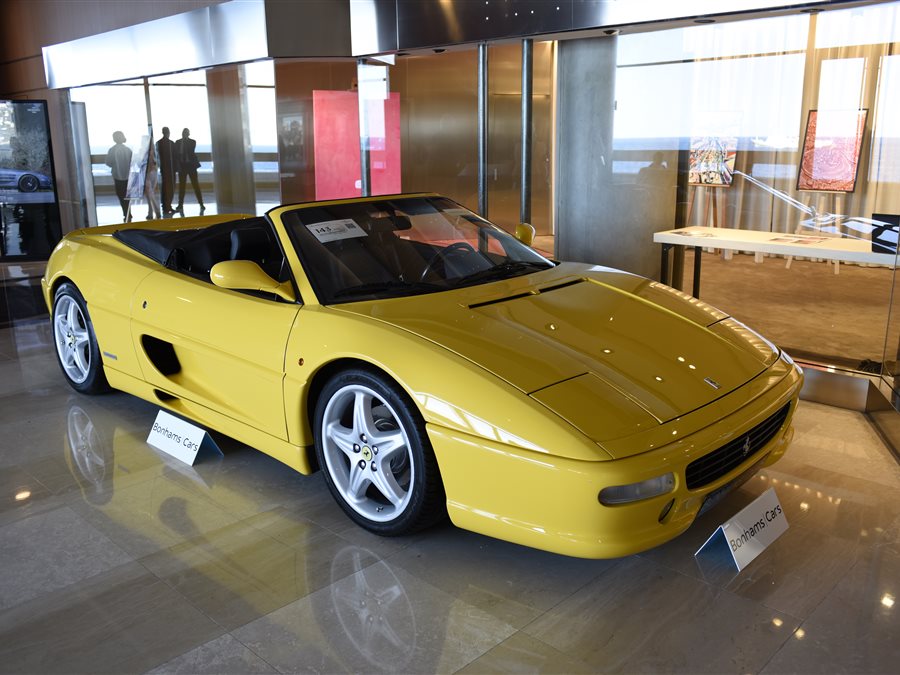
1998 Ferrari F355 Spider, from an auction in Monaco on April 24th, 2026
Ferrari F355 Spider: 1995–99
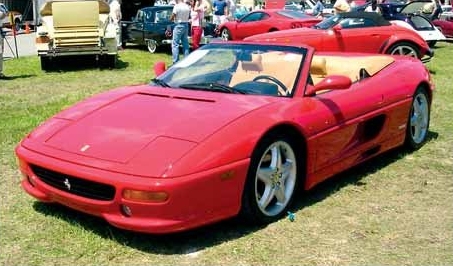
The F355 Spider debuted in 1995, adding a full convertible to the range. The Spider featured a power-operated soft top, making it more convenient for open-air driving than the removable-roof GTS. Its body structure incorporated additional reinforcement to compensate for the absence of a fixed roof. This increased weight and introduced some additional body flex compared with the Berlinetta.
The Spider retained the same 3.5-liter V8 and performance characteristics, although acceleration and handling were marginally affected by its greater weight. The convertible’s styling was carefully integrated into the F355’s bodywork, preserving the car’s proportions with the roof raised or lowered.
The Spider became particularly popular in the United States, where open-top Ferraris have traditionally enjoyed strong demand.
The Six-Speed Gated Manual Transmission
The F355’s original transmission was a six-speed manual gearbox, operated through Ferrari’s traditional polished metal shift gate. The gearbox was mounted transversely behind the longitudinally positioned V8, continuing the basic drivetrain arrangement introduced with the 348. The gated shifter required deliberate movements, particularly when the transmission was cold. Once warmed, it provided precise mechanical engagement and a distinctive driving experience.
The manual transmission is now one of the F355’s most desirable features because later Ferrari models increasingly adopted automated gearboxes. Manual Berlinettas, GTS models and Spiders are all sought after, although individual values depend heavily upon condition, mileage, originality and documentation.
The F1 Transmission: 1997–99
For 1997, Ferrari introduced the F1 electrohydraulic transmission as an option on the F355. The system used a conventional six-speed manual gearbox with an electronically controlled clutch and hydraulic shift actuators. Drivers selected gears using paddles mounted behind the steering wheel.
Unlike a modern dual-clutch transmission, the F1 system operated a single clutch and interrupted power delivery during shifts. The technology was closely associated with Ferrari’s Formula One program and represented an important milestone in the company’s transition toward electronically controlled transmissions.
When functioning correctly, the F1 gearbox provided rapid shifts and a distinctive driving experience. However, it required careful maintenance and could be less smooth than a conventional automatic during low-speed driving.
Clutch wear, hydraulic-system condition and electronic calibration are particularly important when evaluating F1-equipped cars.
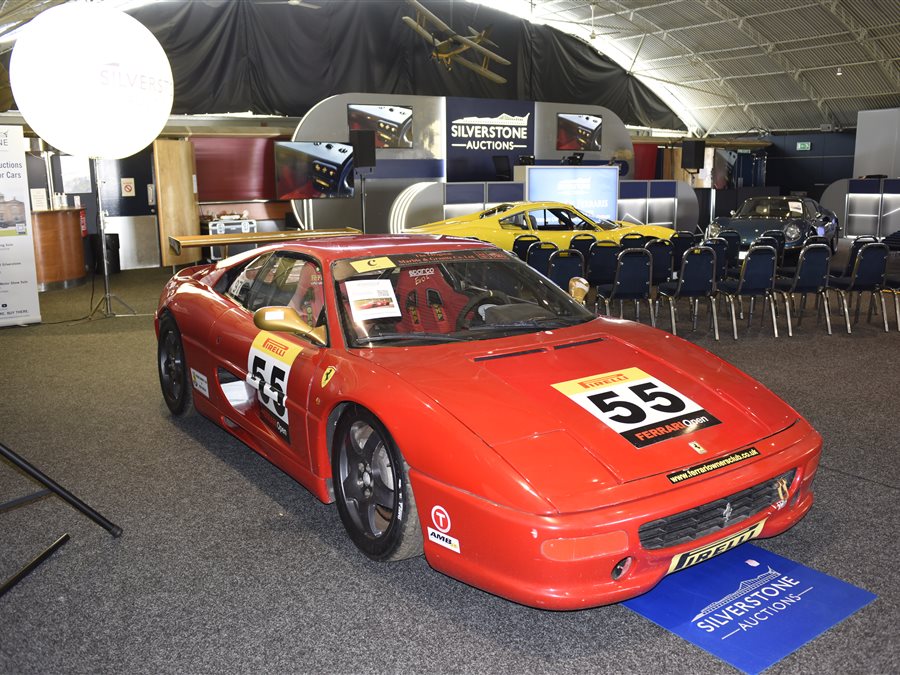
1998 Ferrari F355 Challenge coupe, from an auction at Silverstone on June 4th, 2022
The Ferrari F355 Challenge
The F355 Challenge was developed for Ferrari’s single-marque racing series, which had previously used modified 348 models.
Introduced during the mid-1990s, the Challenge program allowed owners to compete in professionally organized racing events using specially prepared F355s. Early Challenge cars were generally based on production Berlinettas and modified using Ferrari-supplied competition equipment. The package included a roll cage, racing seats, harnesses, upgraded brakes, revised suspension, lightweight exhaust components and other safety and performance modifications.
Later Challenge cars were supplied in more complete competition configurations, reflecting the development of the racing series. The F355 Challenge retained the basic 3.5-liter V8 architecture, although exhaust and engine-management changes could affect output.
The Challenge cars were not intended to be conventional road-going sports cars. Their specialized equipment, competition history and limited production make them a distinct collector category.
F355 Challenge Production and Variations
F355 Challenge production is generally estimated at approximately 100–110 cars, although exact totals are difficult to establish because of differences between factory-prepared cars and production Berlinettas converted using official Challenge kits. Early examples can differ substantially from later cars in equipment, suspension specification and interior configuration.
Some Challenge cars were subsequently converted for road use, while others remained dedicated competition vehicles. Authentication requires careful examination of factory records, original chassis specifications and competition documentation. A genuine Ferrari-sanctioned Challenge car with documented racing history is considerably more significant than a standard Berlinetta modified to resemble one.
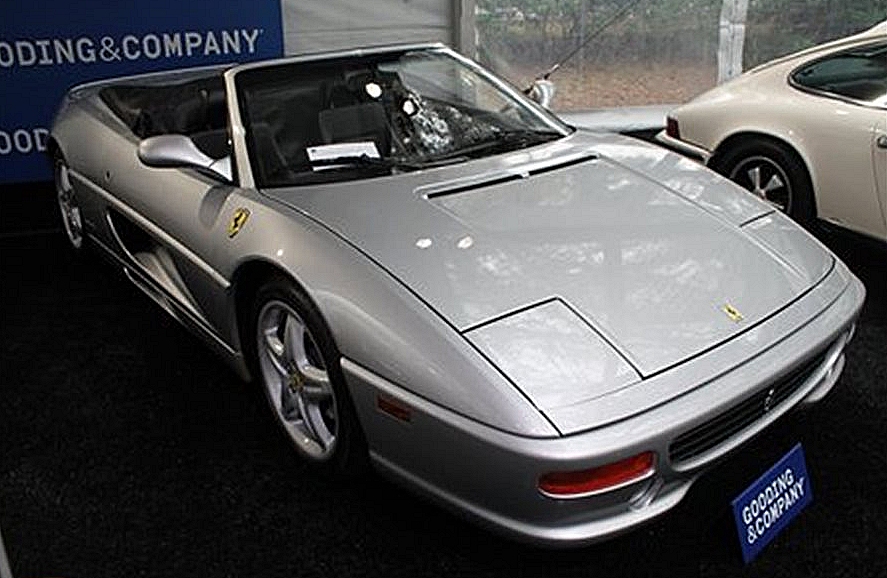
1999 Ferrari F355 Serie Fiorano Spider, from an auction on Amelia Island on March 13th, 2015
The F355 Serie Fiorano: 1999
The F355 Spider Serie Fiorano was a limited-production special edition introduced in 1999 to commemorate the end of F355 production. Named after Ferrari’s Fiorano test circuit, the Serie Fiorano incorporated a selection of performance-oriented components and distinctive trim. The package included revised suspension, lowered ride height, upgraded brakes and other chassis enhancements inspired by the F355 Challenge program. Exterior and interior details distinguished the Serie Fiorano from standard Spiders, including special badging and trim combinations.
Production was limited to approximately 104 examples, primarily for the U.S. market. 100 official units were allocated to the United States (74 F1 paddle-shift, 26 6-speed manuals), plus 3 units for Europe and 1 unit for South Africa, bringing the exact total to 104 units.
The Serie Fiorano is among the most collectible road-going F355 variants because of its limited production, distinctive specification and position as the final development of the model.
The F355’s Chassis and Suspension
The F355 used a steel tubular chassis with independent suspension at all four corners. Its suspension incorporated double wishbones, coil springs and electronically controlled dampers, allowing Ferrari to balance handling precision with acceptable road comfort.
Compared with the 348, the F355 featured revised suspension geometry, improved weight distribution and more sophisticated electronic damping control. These changes significantly improved handling stability and predictability, particularly near the limit of adhesion.
The F355 was widely praised for its balance and steering response, helping restore Ferrari’s reputation for producing exceptionally engaging mid-engine sports cars.
Steering and Brakes
The F355 featured power-assisted rack-and-pinion steering, providing a lighter and more manageable driving experience than some earlier Ferraris. The steering retained substantial feedback, allowing drivers to place the car accurately through corners.
Four-wheel ventilated disc brakes provided strong stopping performance, with anti-lock braking available as part of the car’s modern electronic systems.
The Challenge and Serie Fiorano variants incorporated upgraded braking components appropriate to their more performance-oriented roles.
Brake condition is important when evaluating an F355 because replacement components can be expensive, particularly on specialized versions.
Performance
The F355 was one of the fastest production sports cars of its era. Ferrari quoted acceleration from 0–100 km/h in approximately 4.7 seconds and a maximum speed of approximately 295 km/h (183 mph). These figures placed the F355 ahead of many contemporary rivals, including the Porsche 911 Carrera and several other European sports cars.
The F355’s performance was not defined solely by acceleration. Its high-revving engine, precise steering and improved chassis balance made it particularly rewarding on winding roads.
The car’s relatively compact dimensions also contributed to its agility, distinguishing it from larger grand touring Ferraris.
Engine-Out Belt Service
One of the most important ownership considerations is the F355’s timing-belt service requirement.
The V8 uses toothed timing belts to drive its camshafts. Ferrari’s prescribed maintenance schedule requires periodic belt replacement, and the F355’s engine installation generally necessitates removing the engine and rear subframe assembly to perform the service properly. This makes major maintenance significantly more expensive than on many contemporary sports cars. A comprehensive engine-out service typically includes timing belts, tensioners, seals, fluid changes and inspection of related components.
Buyers should verify the date and scope of the most recent belt service rather than relying solely on mileage. An F355 with overdue major maintenance may require substantial expenditure immediately after purchase.
Exhaust Manifold Failures
The F355 is known for problems involving its exhaust manifolds, commonly called headers. The original manifolds can develop cracks or leaks because of high exhaust temperatures and thermal cycling. A leaking manifold may produce ticking noises, reduced performance or abnormal exhaust temperatures.
In severe cases, exhaust leaks can contribute to damage elsewhere in the exhaust system.
Replacement manifolds are available from Ferrari specialists and aftermarket manufacturers, but repairs can be expensive. Buyers should inspect the exhaust system carefully and review records for previous manifold replacement.
Valve Guides and Engine Wear
Early F355 engines are associated with valve-guide wear, particularly on certain production years. Some engines used valve-guide materials that proved less durable than expected, potentially leading to excessive oil consumption and reduced compression. Ferrari revised the specification during production, but individual engine condition is more important than model year alone.
A pre-purchase inspection should include compression and leak-down testing when appropriate, particularly if there is evidence of oil consumption or unusual exhaust smoke. Repairing worn valve guides requires substantial engine work and can be extremely expensive.
F1 Transmission Maintenance
The F1 gearbox introduces additional maintenance considerations beyond those of the conventional manual. The hydraulic pump, accumulator, actuators and electronic control systems must operate correctly for reliable shifting. Clutch wear can be accelerated by frequent low-speed driving, poor calibration or aggressive use.
A diagnostic inspection should include clutch-wear measurements, hydraulic-system condition and verification of proper gear engagement.
The F1 system can provide enjoyable performance when maintained correctly, but repairs require specialized knowledge and equipment.
Convertible Top Problems
The F355 Spider’s power-operated convertible top is mechanically and electronically complex. Hydraulic components, electric motors, sensors and control modules can deteriorate with age. Problems may include incomplete roof operation, hydraulic leaks or failures of the seat-positioning system associated with roof movement.
Repairs can be expensive because access to certain components is difficult and replacement parts may be scarce.
Buyers should verify that the roof operates smoothly through its complete cycle and that all related electrical systems function correctly.
Other Common Problems
Additional concerns include aging cooling-system components, electrical faults, deteriorated engine mounts and suspension wear.
The F355’s interior can suffer from the well-known Ferrari sticky-switch problem, in which soft-touch coatings deteriorate and become unpleasantly tacky.
Leather dashboards may shrink or distort after prolonged exposure to heat and sunlight.
Suspension dampers and electronic control components can also require attention as the cars age.
Although the F355 is fundamentally a robust sports car when properly maintained, deferred servicing can quickly become expensive.
Understanding the Major Ferrari F355 Variants
- F355 Berlinetta (1994–99): Fixed-roof coupe with 3.5-liter five-valve V8 and six-speed manual transmission, later available with F1 paddle shifting.
- F355 GTS (1994–99): Targa-style version with removable roof panel, combining coupe-like handling with open-air driving.
- F355 Spider (1995–99): Full convertible with power-operated soft top and additional chassis reinforcement.
- F355 F1 (1997–99): Berlinetta, GTS or Spider equipped with Ferrari’s electrohydraulic paddle-shift transmission.
- F355 Challenge (1995–99): Competition-oriented version developed for Ferrari’s single-marque racing series, featuring specialized suspension, brakes and safety equipment.
- F355 Spider Serie Fiorano (1999): Limited-production final-edition Spider with performance-oriented suspension, upgraded brakes and distinctive trim.
Important Sales Reviewed by SCM Experts
In each month’s issue for the past 38 years, SCM’s analysts have reviewed 5 to 7 significant cars sold at auction, and discuss what options, history, or details made that particular more or less valuable. They give their expert opinion on the market for these cars, and whether this car was well bought or well sold. If you’re thinking of purchasing a Ferrari F355, you’ll likely find these profiles critical in helping you make the right decision. Each of the following is an article from our print magazine on a Ferrari F355 sold at auction.
 1997 Ferrari F355 SpyderThe press loved the car, the people loved the car and customers had to get on a waiting list to buy it This is truly a beauty, in iconic Ferrari red with camel leather interior and matching boot, and a black automatic convertible top. The legendary engine is a 3.5-liter V8 producing 375 horsepower, with […]Read more
Cars For Sale
Quick links to listings for this make and model online:
Books on the Ferrari F355


Note that as an Amazon Associate, we earn from qualifying purchases of the above books.
Past Auction Sales – Ferrari F355
Average Ferrari F355 Sale Price by Year from SCM’s Platinum Auction Database:
Includes sales listed as Ferrari 355, Ferrari F355 GTS, Ferrari F355 Spider, Ferrari 355 GTB, Ferrari 355 GTS.
Ferrari F355 Sales from SCM’s Platinum Auction Database:

Barrett-Jackson
Condition: 3+
Sep 10, 2026
$198,000

Gooding Christie's
Condition: 2-
Aug 14, 2026
$588,000

Bonhams Cars
Condition: 3+
Apr 24, 2026
$121,219

RM Sotheby's
Condition: 1-
Feb 27, 2026
$257,600

Sotheby's Motorsport
Condition: 2
Sep 11, 2025
$107,100

Broad Arrow Auctions
Condition: 1-
Aug 13, 2025
$337,750

Bonhams Cars
Condition: 2-
Jun 29, 2025
$115,052

RM Sotheby's
Condition: 2
May 22, 2025
$188,578

Bring a Trailer
Condition: 3
May 12, 2025
$93,975

Sotheby's Motorsport
Condition: 2+
Feb 5, 2025
$80,325

Broad Arrow Auctions
Condition: 2
Aug 14, 2024
$156,800

Cars & Bids
Condition: 3
Jun 13, 2024
$73,150

RM Sotheby's
Condition: 2+
Sep 15, 2023
$207,827

Barrett-Jackson
Condition: 2-
Apr 13, 2023
$66,000

Broad Arrow Auctions
Condition: 2-
Aug 18, 2022
$196,000

Silverstone
Condition: 2-
Jun 4, 2022
$88,322

Silverstone
Condition: 3
Jun 4, 2022
$83,377

GAA Classic Cars
Condition: 2+
Feb 24, 2022
$213,300

PCarMarket
Condition: 2+
Jul 1, 2021
$140,000

Silverstone
Condition: 2-
Jun 5, 2021
$84,313

Silverstone
Condition: 2
Jun 5, 2021
$127,265

Barrett-Jackson
Condition: 2
Mar 20, 2021
$93,500

Artcurial
Condition: 2-
Feb 5, 2021
$235,682

GAA Classic Cars
Condition: 2-
Jul 23, 2020
$70,200

Silverstone
Condition: 2-
Feb 22, 2019
$116,802

Russo and Steele
Condition: 2-
Jan 16, 2019
$79,200

RM Sotheby's
Condition: 1-
Dec 8, 2018
$114,800

Leake
Condition: 3
Nov 15, 2018
$62,000

Barrett-Jackson
Condition: 1-
Sep 27, 2018
$71,500

Silverstone
Condition: 2-
May 17, 2018
$107,928

Silverstone
Condition: 2
May 17, 2018
$127,715

Silverstone
Condition: 2-
May 17, 2018
$100,913

Russo and Steele
Condition: 3+
Jan 17, 2018
$66,000

Barrett-Jackson
Condition: 2+
Jan 13, 2018
$77,000

Bonhams
Condition: 2-
May 21, 2017
$78,421

Bonhams
Condition: 2-
May 21, 2017
$177,411

Barrett-Jackson
Condition: 2
Jun 23, 2016
$53,900

Bonhams
Condition: 1-
Jun 5, 2016
$82,500

Barrett-Jackson
Condition: 1-
Jan 25, 2016
$82,500

Silverstone
Condition: 2
May 23, 2015
$128,445

Barrett-Jackson
Condition: 2-
Apr 19, 2015
$59,400

The Branson Auction
Condition: 3
Apr 18, 2015
$62,100

Silverstone
Condition: 2-
Mar 28, 2015
$107,102

Silverstone
Condition: 2+
Mar 28, 2015
$96,225

Gooding & Co.
Condition: 2+
Mar 13, 2015
$198,000

Barrett-Jackson
Condition: 1-
Jan 10, 2015
$55,000

The Branson Auction
Condition: 3
Oct 18, 2014
$47,520

Russo and Steele
Condition: 2
Jan 15, 2014
$75,000

Barrett-Jackson
Condition:
Apr 4, 2012
$74,800

Auctions America by RM
Condition: 2+
Sep 29, 2011
$45,000
See all 85 sales in SCM’s Platinum auction database: Ferrari F355 · Ferrari 355 · Ferrari F355 GTS · Ferrari F355 Spider · Ferrari 355 GTB · Ferrari 355 GTS
Forums & Communities
Popular Videos about the Ferrari F355