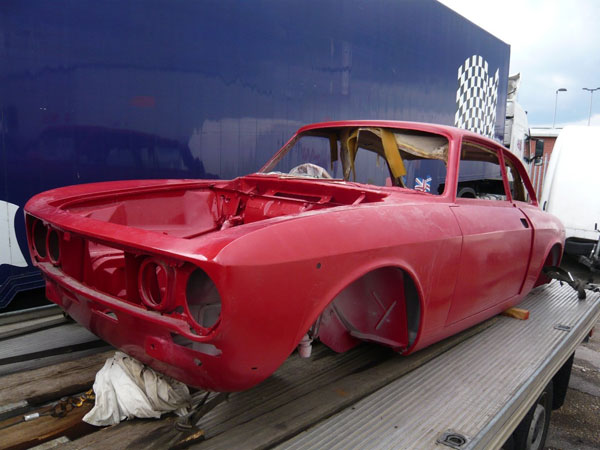
This car sold for $12,294 (£7,705), including buyer’s premium, at the Bonhams National Motor Museum, Beaulieu sale on September 10, 2011.
When Executive Editor Allen gave me this assignment, I was a bit taken aback. I wondered what I might be able to say about this car and transaction that wouldn’t take less than two minutes. Serial production car, in pieces, not all of which may be there, sells for arguably greater than the cost of purchasing said pieces individually at a swapmeet. A good buy? You don’t have to have a brilliant expert’s vast market experience to say, “I don’t think so…” But let’s get beyond this simplistic reaction and look at something a bit bigger here.
First, the car itself. The Alfa Romeo 105 series coupes are very desirable, usable cars, with great looks, a terrific twin-cam engine and a responsive chassis that makes them fun to drive. They also have a parts availability that makes them easy to own.
In the progression from the first Giulia 1600 GTs though to the final 2000 GTV, many consider the 1750 as the pick of the litter. In the place of the quirky “step nose” detailing of the early cars and the fussy chromed grille of the later cars, it has a smooth hood line and a simple, elegant mesh grille with headlights and driving lights in bold relief.
A scary, unfinished restoration
We all know that barn finds are big in the market these days, and Bonhams always does a stout job of selling them — often for huge sums at this auction in particular, which is held at one of the world’s largest swapmeets. There’s something about walking around all day among heaps of odd, gently rusting bits that makes almost any collection of parts seem like a viable restoration project. Add to that the singular predilection of our U.K. friends for tackling projects that would send most enthusiasts in the U.S. and Europe screaming in the opposite direction.
This Alfa was not a barn find at all, but rather that even scarier creature, the partially done, abandoned restoration. A very good, and quite usable, GTV can be bought in the U.S. in the high $20k range, and the best sell for $40k.
So why would someone choose to pay $12k for a project that may or may not be complete? You could never pay a shop to finish this car and hope to be in a sane, or even reasonable, place financially.
To get the back story on this car and a feel for what the bidders may have been thinking, I turned to Bonhams’ Managing Director, International Group Head Motorcars, James Knight for some insight. James was also the auctioneer at the session and had this to say: “I’ve always believed a started, but not finished, car is one of the hardest cars to find a buyer. I’ve likened it to a surgeon taking over from an operation, not quite knowing how good/bad the previous surgeon’s work has been and not knowing whether to undo any of that first operation as it may have an impact on how well the second surgeon’s work can be — and whether the patient will be fixed correctly!”
The journey might be the reward
The Alfa had been given to a restoration shop to do, and the owner, frustrated with the progress or lack thereof, took the unfinished car back. It then sat in his garage untouched for more than a decade until he passed away a short time ago. With no real clue as to the quality or quantity of work done, a professional restoration shop would almost certainly want to start completely over again.
However, Knight astutely pointed out that for a DIY restorer with limited funds, this car would be viewed as offering a head start from scratch. Any work done would be a positive, and with the shell stripped and painted, it was easy to get an idea of the structural state of the car. In addition, its current state offered a choice of restoration to street, rally or all-out racing trim.
It is true that for many of us, especially in the U.K., the process can also be the product. Hours, days, weeks, months and years of long nights and weekends in cramped, drafty garages are what some live for. And then, the pride of driving a car you’ve brought back to life with your own hands trumps convenience or logic.
As a rally or race car, it could be a viable consideration, as the level of finish and detail can be held at a much lower level than that needed for a street restoration. It was reported that the car sold to a U.K. phone bidder. One hopes they actually saw all the bits…. In any case, the estate of the seller came away firmly in the “lucky” column.
(Introductory description courtesy of Bonhams.)