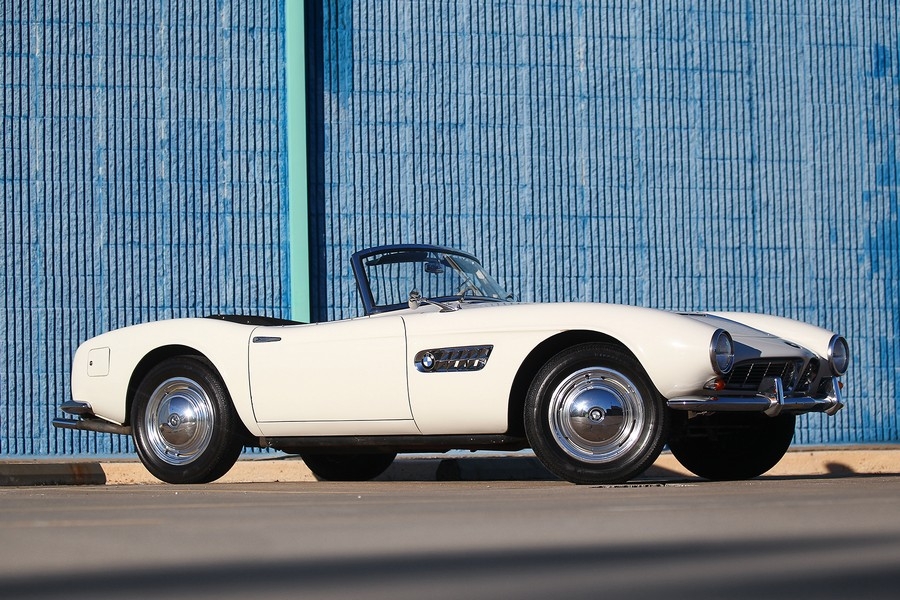
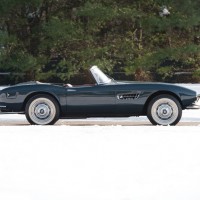
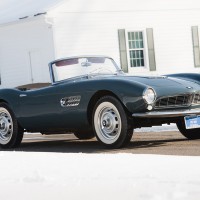
1958 BMW 507 chassis 70134, Lot 21, sold for $1,815,000, including buyer’s premium, at Gooding & Company’s Amelia Island sale on March 7, 2014. 1958 BMW 507 chassis 70156, Lot 152, sold for $2,420,000, including buyer’s premium, at RM Auctions’ Amelia Island sale on March 8, 2014.
I wrote a profile of a 1957 BMW 507 for the February 2008 SCM (German Profile, p. 58). It was of a car sold at the RM London sale in October 2007. It sold for a healthy $893,104 (£1.00=$2.056), which at today’s exchange (£1.00=$1.681) would have been $730,152. In that piece, I wrote about how the 507 came to be at the behest of legendary importer Max Hoffman, and how his well-chosen target price of $5,000 was doubled. The 507 and sister 503 2+2 coupe and cabriolet had no association besides the blue and white roundel.
The BMW 507 was a failure when new — but it was a glorious failure, as so many great beauties in history have been. Nevertheless, the 507 has achieved blue-chip status as a collectible automobile because of its stunning looks, rarity, and driving experience — in that order. Not that there’s anything wrong with falling for a car for its loveliness — as Lorelei Lee so truthfully declared in “Gentlemen Prefer Blondes”: “Don’t you know that a man being rich is like a girl being pretty? You wouldn’t marry a girl just because she’s pretty, but my goodness, doesn’t it help?”
Appraising very similar cars
A trained professional appraiser begins a credible value opinion with an object’s attributes of value. These are the factors that make a particular object of interest more — or less — desirable to the market. They can, and usually do, include the presence of original driveline components — especially the engine — original body panels, factory-installed performance options or rare accessories, certain colors, and of course, condition and provenance.
These individual attributes are very important when comparing two very similar objects —say, two 1958 BMW 507 Series II roadsters that sold on the same weekend — and determining price differences.
The whole can indeed be greater than the sum of its parts when it comes to selling cars at auction. Impressive results from the sale of many single-owner car collections happen over and over in collector car auctions around the world. This “power of collections” is especially potent when the collection is well-curated. This can make the provenance attribute take on vastly enhanced weight in determining value.
Two similar cars, two different collections
We have two BMW 507s from two very different collections. RM Auctions featured cars from the late Malcolm Pray. He was very well known in the vintage-car world, and he showed his cars at all the top concours in the country. Pray owned his BMW 507 since 1972.
Gooding & Company didn’t identify who owned the collection of BMWs in their tent, but a quick Google search found the cars had been recently owned by a fellow well known in BMW circles. This man had also been a long-term owner of his 507, and it had been shown at many marque events and featured in several periodicals.
So let’s go through a comparison of the attributes of value of each of the cars and try to find the $605,000 difference in value between the two 507 roadsters:
They are both Series II cars, which is the more desirable model for its enhanced creature comforts and more power. No difference there.
The RM car was finished in dark gray, which was arguably more dramatic than the white of the Gooding car, but BMWs have always looked good in white. A draw there. The Gooding car was fitted with its original engine, which the RM car was not. But the RM car did come with the original, to be installed by the new owner. Here, a slight advantage to the Gooding car.
The RM car came with the very cool factory hard top and was also equipped with center-lock Rudge wheels. The mounting points for the hard top had been removed when the car was restored in the 1990s. After speaking to dealers and collectors — as well as looking at previous sale results — I estimate that $125,000 to $150,000 might be the spike for those goodies. Points for the RM car.
In terms of condition, they were, by my observation, a bit similar. The RM car was a very nicely maintained older restoration, showing some age but very presentable and drivable. The Gooding car was reported to have never been apart for restoration but simply maintained as necessary, and it had a wonderfully original, used-but-cared-for feel. It was reported to have date-code stamped wheels, and the original interior was nicely patinated. Both would be an excellent base for a no-holds-barred total restoration if that was the new owners’ plans. I count this as a slight advantage to the Gooding car.
Pray’s provenance is key
We finally come to provenance. It is certain that Malcolm Pray’s connection to the car helped push up value for the RM car. The 507 had the benefit of the halo of the Pray Collection and extensive iconography with its well-known, long-term owner.
The Gooding 507 did not have that benefit, having been presented somewhat anonymously. It also was the star of Gooding’s Amelia Island lineup of BMWs. It was the proverbial “best house in the neighborhood.” The Gooding car certainly had a “halo” role as relates to many of the other cars in that unnamed collection of BMWs, such as the 700s, 1600GT and so on.
With the notable exception of a handful of models, led by the 507 and 328, BMW has not featured significantly in the collector car consciousness. This sale at Gooding has certainly helped to elevate that awareness, and it will be interesting to see what happens when the next few BMWs come to market.
There is little doubt in my mind that the attributes of value show clearly that — putting aside possible testosterone exuberance in the bidding at RM — the collection aura of Malcolm Pray was responsible for the $450,000 differential not covered by the hard top and Rudge wheels.
It is doubtful that the new owner of the RM 507 could realize a similar differential when selling. What is not in doubt is that after many auction sales hovering at the $1m range — and the $1.65m achieved at RM / Sotheby’s in New York last year — the 507 is firmly and deeply in the upper $1m range. It’s time for us to adjust the SCM Price Guide. ♦
(Introductory descriptions courtesy of Gooding & Company and RM Auctions.)