
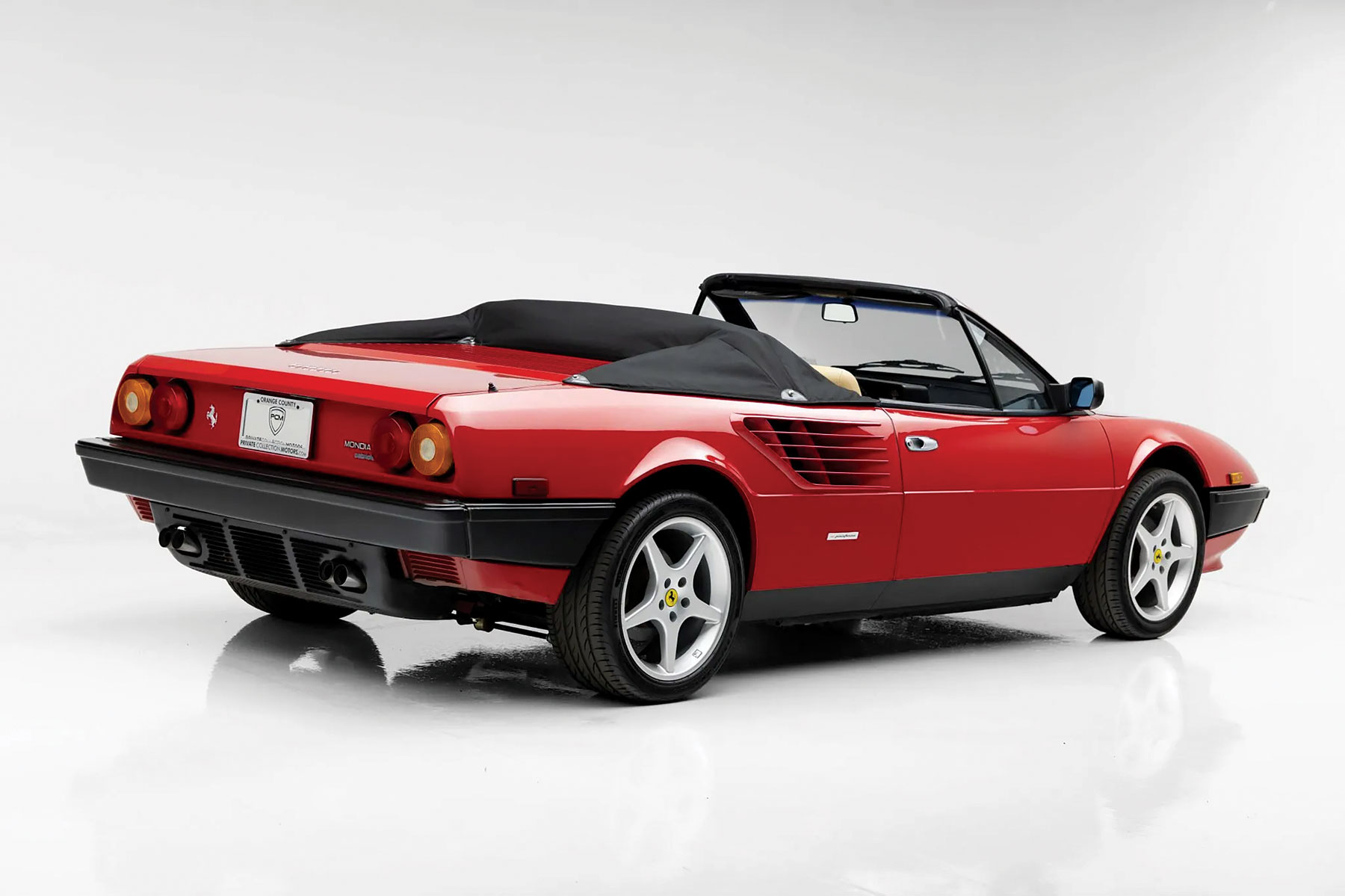

Photo courtesy Bring a Trailer The mid-engine Mondial is the last affordable Ferrari Twenty years ago, if you dreamed of owning a Ferrari, there were several relatively affordable ways to tick that item off your bucket list. Dino 308 GT4s were plentiful in the $20k–$30k space, as were 4-seat V12 models like the 365 GT4 2+2. For a little more money, $30k–$50k bought you a good 308 GTB or GTS. But things have changed. As the Ferrari market has evolved, its rising tide has brought even the bargain models to just outside “affordable.” Yet one model remains beached. Ferrari Mondials are […]
Photo courtesy Bring a Trailer
The mid-engine Mondial is the last affordable Ferrari
Twenty years ago, if you dreamed of owning a Ferrari, there were several relatively affordable ways to tick that item off your bucket list. Dino 308 GT4s were plentiful in the $20k–$30k space, as were 4-seat V12 models like the 365 GT4 2+2. For a little more money, $30k–$50k bought you a good 308 GTB or GTS.
But things have changed. As the Ferrari market has evolved, its rising tide has brought even the bargain models to just outside “affordable.” Yet one model remains beached. Ferrari Mondials are no longer credit-card buys, but $30k to $45k is still enough to put a decent early example in your garage.
Two doors, four seats
The 1980 Mondial 8 was introduced to succeed the 308 GT4, which had sold sufficiently well to warrant a replacement. This time, Ferrari chose Pininfarina rather than Bertone to design bodywork around what was essentially the same 2+2 seating layout and mid-mounted 2.9-liter (2,927-cc) V8. The result was less visually striking than Marcello Gandini’s avant-garde wedge, but also less polarizing. Ferrari styling hallmarks were there, such as four circular taillights and an aggressively raked nose, while unique slatted air intakes on the car’s rear fenders would foreshadow Ferrari’s upcoming flat-12-powered Testarossa supercar. (Also, it must be said, the Toyota MR2.)
Designed to be a more usable car than its 2-seater 308 sibling, the Mondial’s interior was spacious and focused on comfort. Rather than a tight, hooded cluster of instruments directly in front of the driver, the Mondial’s horizontal, rectangular instrument pod stretched towards the center of the cabin. Seats were wider and plusher, good for daily driving or longer road trips. Steering was less sensitive than Ferrari’s sportier cars, while the suspension was tuned softer for pockmarked U.S. roads.
Unfortunately, while practicality was up, performance was down. In that era, ever-stricter emissions regulations in the U.S. meant the fuel-injected Mondial 8 could only muster 205 horsepower and 181 lb-ft of torque, down significantly from the quad-carbureted 308 GT4’s 240 hp and 209 lb-ft. Adding insult to injury, the 3,600-pound Mondial weighed 600 pounds more than the GT4 it replaced. Consequently, Car and Driver found the 0–60-mph run took some 9.3 seconds, doing the quarter-mile in 16.9 seconds at 83 mph. Those weren’t atrocious numbers for an entry-level sports car of the day, comparable to a Porsche 924 or Mazda RX-7. But for a Ferrari, they were lacking.
Hot to trot
After less-than-stellar reviews, the 8 was replaced by the Quattrovalvole for 1983. As the name implies, it introduced four-valve cylinder heads, raising output to 235 hp. That was enough to get 0–60-mph times back down into the 7-second range, which was acceptable enough for a grand-touring car. In 1984, Ferrari introduced the Mondial Quattrovalvole Cabriolet, an open-top version sold alongside the coupe.
Positive developments kept coming, in line with the 2-seat V8 models. A new Mondial 3.2 arrived for the 1986 model year, powered by the larger 3.2-liter V8 also found in the 328 GTB/GTS, rated at 260 hp. The exterior of the car was also updated with better-integrated bumpers and subtle interior revisions.
The model soldiered on, with the 1989 Mondial t borrowing the 3.4-liter V8 from the all-new 348. That lower-case “t” stood for “transverse,” referring to the mounting of a new 5-speed manual gearbox (not the engine, as many assume, which was now longitudinal). This final iteration produced 300 hp and introduced power steering for the first time in a production Ferrari. The Mondial was finally discontinued in 1993 after a lengthy 14-year production run.
What goes wrong
In real estate, it’s “location, location, location.” With Ferraris, it’s “records, records, records.” Timing-belt services on these cars are recommended every 30k miles or five years. While doable with the engine in place for pre-t models, you should still expect around an $8k bill, presuming not much else needs a Ferrari whisperer’s attention. Of course, a broken belt means a broken engine and a financial nightmare. Typically, timing belts will be part of a major service that will also include fluids, pullies, tensioner and accessory belt.
Because these cars were reasonably competent daily drivers, many were used that way, especially as they depreciated. Interiors have at least a few cows’ worth of Connolly leather, so don’t think you’ll retrim a rough-looking cabin affordably. While most coupes have sunroofs, they rarely work properly and often leak. This means rare non-sunroof coupes are sometimes worth a premium. Also, second-gear synchros can be sluggish until the gearbox oil is warmed through, which doesn’t necessarily demand a rebuild, just patience in use.
Which one for you?
In keeping with this column’s “affordable” nature, we’re focused on Mondial 8 through 3.2 models. Not only do the final Mondial t models start upwards of $55k for a good example, but the belt service becomes a mandatory engine-out job. That said, if the extra expense isn’t a barrier, this is the most highly developed model of them all.
At the opposite end of the spectrum is the Mondial 8. You’ll find plenty sitting in the mid-$20k area, and these early cars top out just over $30k. The sweet spot is likely found in the 1983–85 Quattrovalvole. With reasonable power and additional refinement, their $30k–$45k price tag is similar to 996-series Porsche 911s. The 1986–88 Mondial 3.2s are a great choice from $40k and up, with the best cars rivaling the bottom end of the Mondial t market.
Publisher Martin owned a green 1984 QV Cabriolet named “Kermit” for 18 months and put 6,000 miles on the car, noting, “it made glorious four-cam Ferrari sounds with the top down.” Would he own one again? “A good one, properly maintained, yes. If you want top-down motoring in a Ferrari with kids or dogs in the back, it is your only choice.”
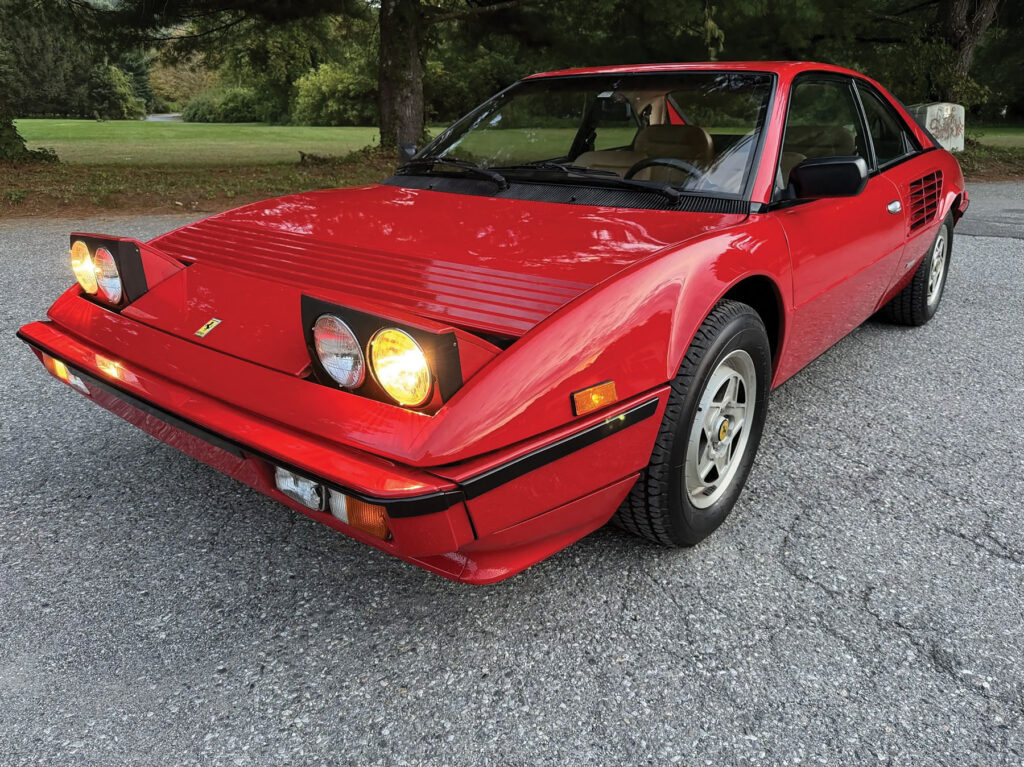
Photo courtesy Bring a Trailer