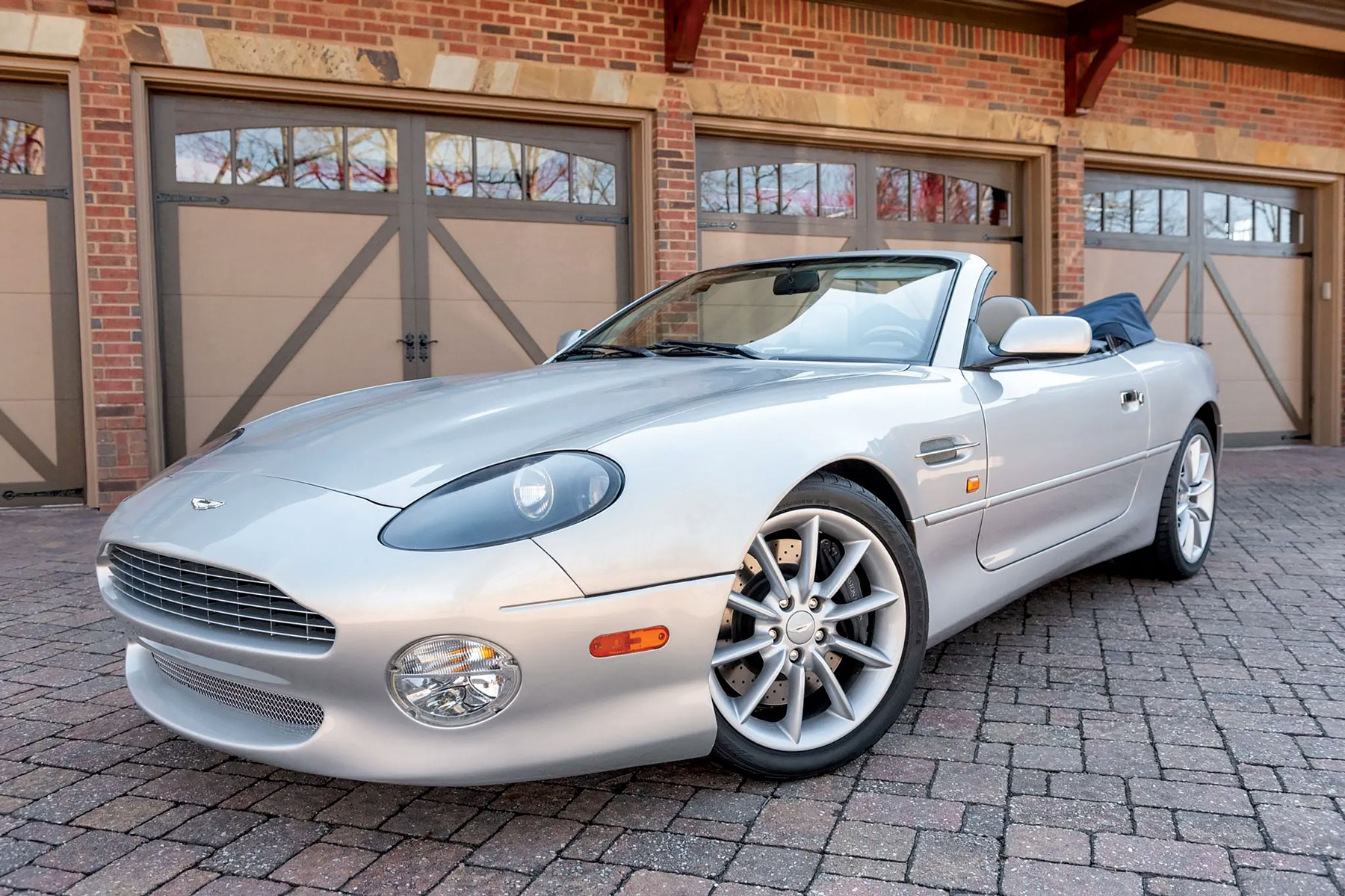
Aston Martin was under Ford Motor Company’s ownership from 1987 to 2007, an era in which even its most ardent fans would have to agree the brand was in the doldrums — or at least a bit lost. Yet Ford’s money in that era certainly saved one of Britain’s legendary marques from the graveyard, and by the end of the Ford regency, Aston was sturdy on its feet and arguably producing some of its best cars ever. In addition, the Ford era gave the world the most affordable Astons on the market. Leading the way is the DB7, produced from 1994 to 2004 in greater numbers than any Aston that preceded it.
The everyman Aston
The situation in the early 1990s was dire. Aston Martin needed a new model, but also needed to leverage sunk costs from the corporate parent to do it. Ford also held a controlling stake in Jaguar at the time, and the aging XJS provided the bones of a platform that would become both the DB7 and the Jaguar XK. Tom Walkinshaw Racing, which had campaigned the XJS successfully in the European Touring Car Championship, did much of the chassis development work. Needing to persuade Ford management, Aston turned to TWR’s Ian Callum to design the exterior of the new car and gave it the most luxurious interior it could manage.
A great deal of credit for the DB7’s success goes to the drivetrain team, who first gifted the car with a supercharged 3.2-liter inline 6-cylinder engine rated at 335 horsepower and 361 lb-ft of torque. Then, in what was already becoming a departure for high-end cars, the DB7 buyer was given a choice of a 5-speed manual gearbox or a 4-speed automatic. With the manual, the DB7 offered a sub-six-second 0–60 mph time and a top speed of 165 mph. The automatic was a bit more sedate, needing about an extra second and losing 5 mph in top speed.
That was enough, as it turned out, because the 1994 DB7 was met with rave reviews at an initial price of £78,500, or $125,600 at the horrendous exchange rates of the mid-’90s. Still, Aston Martin was back in business. Aston followed the successful DB7 coupe with a Volante convertible for 1996, and in 1999 fully realized the promise of the DB7 platform with a 6.0-liter V12 engine and a 6-speed manual gearbox for the DB7 V12 Vantage. That engine produced a heady 420 hp and 400 lb-ft of torque, though it only dropped the 0–60 mph time to 5.0 seconds, or 5.1 with the new 5-speed automatic gearbox. The Volante convertible received the V12 in the same year.
A headache, or a migraine?
Anyone contemplating the purchase of a 20- to 30-year-old British near-exotic ought to first think deeply about maintenance and repair costs. With regard to DB7s, there’s good and bad news. The good is that a lot of parts on the DB7 come from the Ford family of vehicles. For example, the front turn signals are the same as found on a Mazda Miata, and the taillights were borrowed from the Mazda 323.
On the other hand, the DB7 is known for cracking its exhaust manifold, and the suspension requires more attention than usual. If the bushings get old (and you can bet they’re all old by now), you’ll have alignment difficulties. The 4,000-lb curb weight of the car also leads to a regular need to replace the front brakes.
Also, first-year cars were pre-OBD-II, and the engine-management system is renowned for being difficult to sort out. Later models use the OBD-II standard and are much easier to get along with.
Cheap as chips
A full 30 years after its introduction, the DB7 is still the entry-level Aston Martin. You can, if you’re careful, pick up a basic 6-cylinder automatic DB7 coupe with 40,000 miles for around $20k. Among the 6-cylinder models, you’ll find far more convertibles, and those tend to fetch a bit more money, typically in the mid-$20k area.
The V12s are far more numerous, and not appreciably more expensive to purchase — though they will be to service. Earlier this year, a 2002 V12 Vantage Volante automatic with 37k miles sold for $28,350 with fees on Bring a Trailer. Another with 51k miles sold there for $24,675. Models with the 6-speed manual trend a little higher, and those with ultra-low miles can run as high as $80,000.
If you start shopping, you’re sure to notice the existence of the DB AR1 and DB7 Zagato. These are not really part of the standard DB7 line and as such they tend to sell for about $200,000, well outside the definition of “affordable.”
Don’t forget the DB9
The production levels of the DB7 and the availability of the V12 at a reasonable entry price are compelling, but let’s not leave the conversation without mentioning that the later DB9. Its existence is one of the factors that has been keeping DB7 prices at the fully depreciated level. Made from 2004 to 2016, the DB9 is more than twice as numerous (16,500 made) and only costs about $10,000 more to buy today. The DB9 weighs less, owing to extensive use of aluminum, and benefits from 10–20 years of newer technology. Just a thought. ♦
Aston Martin was under Ford Motor Company’s ownership from 1987 to 2007, an era in which even its most ardent fans would have to agree the brand was in the doldrums — or at least a bit lost. Yet Ford’s money in that era certainly saved one of Britain’s legendary marques from the graveyard, and by the end of the Ford regency, Aston was sturdy on its feet and arguably producing some of its best cars ever. In addition, the Ford era gave the world the most affordable Astons on the market. Leading the way is the DB7, produced from 1994 to 2004 in greater numbers than any Aston that preceded it.
The everyman Aston
The situation in the early 1990s was dire. Aston Martin needed a new model, but also needed to leverage sunk costs from the corporate parent to do it. Ford also held a controlling stake in Jaguar at the time, and the aging XJS provided the bones of a platform that would become both the DB7 and the Jaguar XK. Tom Walkinshaw Racing, which had campaigned the XJS successfully in the European Touring Car Championship, did much of the chassis development work. Needing to persuade Ford management, Aston turned to TWR’s Ian Callum to design the exterior of the new car and gave it the most luxurious interior it could manage.
A great deal of credit for the DB7’s success goes to the drivetrain team, who first gifted the car with a supercharged 3.2-liter inline 6-cylinder engine rated at 335 horsepower and 361 lb-ft of torque. Then, in what was already becoming a departure for high-end cars, the DB7 buyer was given a choice of a 5-speed manual gearbox or a 4-speed automatic. With the manual, the DB7 offered a sub-six-second 0–60 mph time and a top speed of 165 mph. The automatic was a bit more sedate, needing about an extra second and losing 5 mph in top speed.
That was enough, as it turned out, because the 1994 DB7 was met with rave reviews at an initial price of £78,500, or $125,600 at the horrendous exchange rates of the mid-’90s. Still, Aston Martin was back in business. Aston followed the successful DB7 coupe with a Volante convertible for 1996, and in 1999 fully realized the promise of the DB7 platform with a 6.0-liter V12 engine and a 6-speed manual gearbox for the DB7 V12 Vantage. That engine produced a heady 420 hp and 400 lb-ft of torque, though it only dropped the 0–60 mph time to 5.0 seconds, or 5.1 with the new 5-speed automatic gearbox. The Volante convertible received the V12 in the same year.
A headache, or a migraine?
Anyone contemplating the purchase of a 20- to 30-year-old British near-exotic ought to first think deeply about maintenance and repair costs. With regard to DB7s, there’s good and bad news. The good is that a lot of parts on the DB7 come from the Ford family of vehicles. For example, the front turn signals are the same as found on a Mazda Miata, and the taillights were borrowed from the Mazda 323.
On the other hand, the DB7 is known for cracking its exhaust manifold, and the suspension requires more attention than usual. If the bushings get old (and you can bet they’re all old by now), you’ll have alignment difficulties. The 4,000-lb curb weight of the car also leads to a regular need to replace the front brakes.
Also, first-year cars were pre-OBD-II, and the engine-management system is renowned for being difficult to sort out. Later models use the OBD-II standard and are much easier to get along with.
Cheap as chips
A full 30 years after its introduction, the DB7 is still the entry-level Aston Martin. You can, if you’re careful, pick up a basic 6-cylinder automatic DB7 coupe with 40,000 miles for around $20k. Among the 6-cylinder models, you’ll find far more convertibles, and those tend to fetch a bit more money, typically in the mid-$20k area.
The V12s are far more numerous, and not appreciably more expensive to purchase — though they will be to service. Earlier this year, a 2002 V12 Vantage Volante automatic with 37k miles sold for $28,350 with fees on Bring a Trailer. Another with 51k miles sold there for $24,675. Models with the 6-speed manual trend a little higher, and those with ultra-low miles can run as high as $80,000.
If you start shopping, you’re sure to notice the existence of the DB AR1 and DB7 Zagato. These are not really part of the standard DB7 line and as such they tend to sell for about $200,000, well outside the definition of “affordable.”
Don’t forget the DB9
The production levels of the DB7 and the availability of the V12 at a reasonable entry price are compelling, but let’s not leave the conversation without mentioning that the later DB9. Its existence is one of the factors that has been keeping DB7 prices at the fully depreciated level. Made from 2004 to 2016, the DB9 is more than twice as numerous (16,500 made) and only costs about $10,000 more to buy today. The DB9 weighs less, owing to extensive use of aluminum, and benefits from 10–20 years of newer technology. Just a thought. ♦