
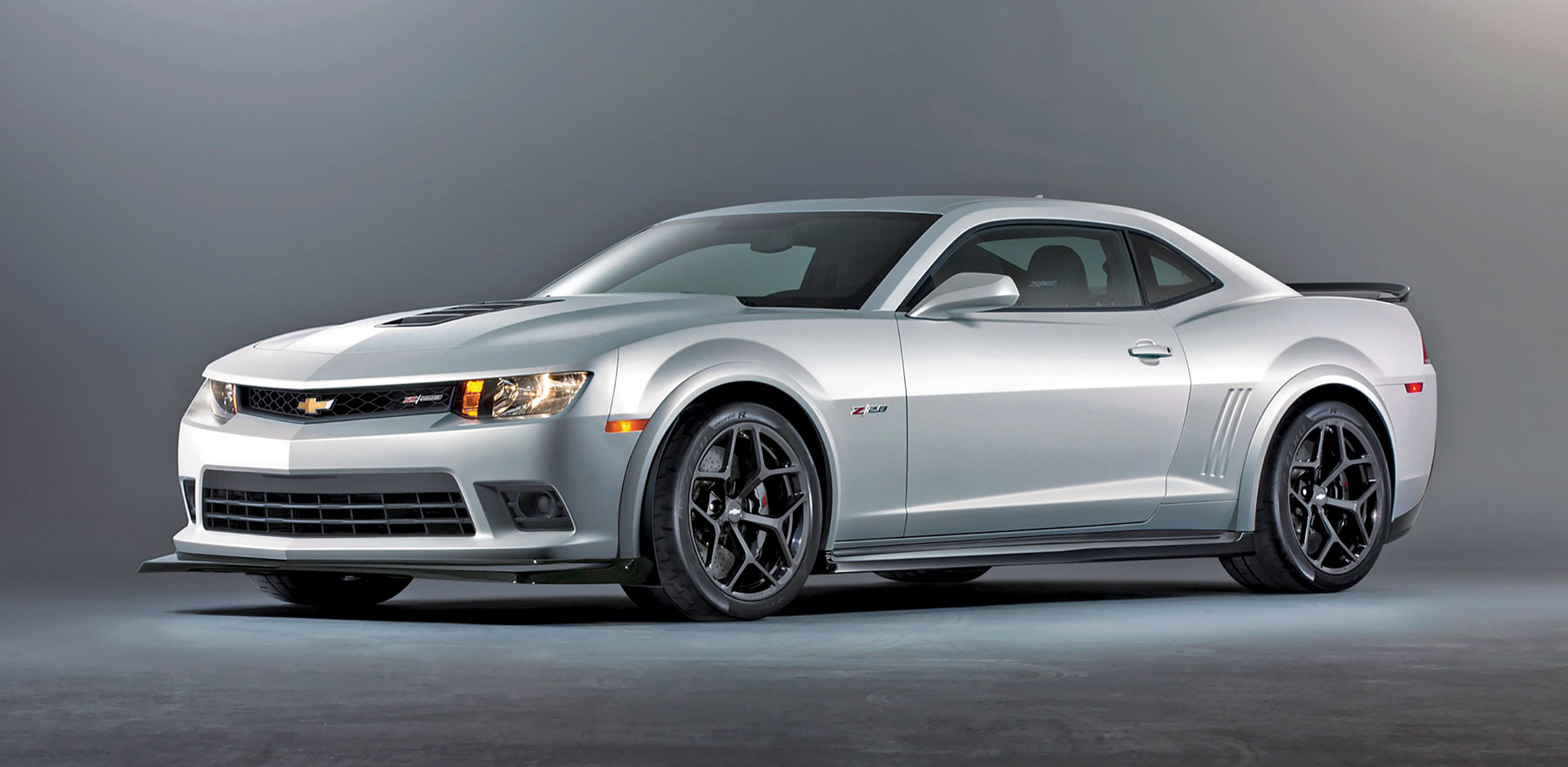

When you’ve owned a significant number of cars, there will be some that stand out in your memory, the special ones that appealed to you in a way that others did not. Like Goldilocks and her choice of porridge, they weren’t too hot or too cold, they were just right. That’s what we call the sweet spot. A sweet-spot car is rarely the most powerful car in the manufacturer’s lineup, but probably not the base trim, and certainly not the luxurious boulevard cruiser loaded with options. A true sweet-spot car does everything well, and it feels balanced. The 2014–15 Camaro Z/28 […]
When you’ve owned a significant number of cars, there will be some that stand out in your memory, the special ones that appealed to you in a way that others did not. Like Goldilocks and her choice of porridge, they weren’t too hot or too cold, they were just right. That’s what we call the sweet spot. A sweet-spot car is rarely the most powerful car in the manufacturer’s lineup, but probably not the base trim, and certainly not the luxurious boulevard cruiser loaded with options. A true sweet-spot car does everything well, and it feels balanced.
The 2014–15 Camaro Z/28 in one of those cars. For the final two years of the fifth-generation Camaro, Chevrolet revived the venerable Z/28 RPO (Regular Production Option, for those who don’t speak fluent GM). First applied to 1967 Camaros, the Z/28 was originally equipped with a high-output 302-ci small-block V8 that had been homologated for the Trans Am racing series. The Z/28 also packed other performance goodies such as front disc brakes, track-ready suspension, close-ratio manual transmission and an optional Positraction limited-slip differential. Later iterations of the Z/28 name were less spectacular but always a cut above the standard run.
A legend, reborn
It took eight years after the fourth-generation Camaro exited for GM to design a new generation with a retro look to approximate the original. Most of the development work was done by GM’s Holden division in Australia, which is always a good sign for muscle cars. The basic fifth-gen Camaro in 2010 came with a capable-but-uninspiring V6, while the SS trim levels were gifted with the 426-horsepower LS3 V8. The fifth-generation Camaro has good bones in the form of fully independent suspension on all four corners, four-wheel disc brakes and a Sport mode for the stability-control system. From 2012, Chevrolet offered the Camaro ZL1 with a supercharged 6.2-liter LSA V8 rated at 580 hp, and magnetic ride suspension.
The 2014 model year brought the Camaro’s mid-cycle facelift, with mostly nominal changes. But the big noise that year was the Z/28. We mean that literally, because this car came equipped with 505 hp and 481 lb-ft courtesy of a naturally aspirated, dry-sump 7.0-liter LS7 V8 derived from the C6 Corvette Z06. The LS7 was mated with a Tremec 6-speed manual gearbox driving a limited-slip differential. In the name of reducing weight, GM stripped much of the sound-deadening material out, made a single-speaker stereo standard (it needed to be there to sound the seatbelt warning chime), and even used thinner rear glass. A Z/28 still tips the scales at over 3,800 pounds. Behind the 19-inch wheels, you got a set of Brembo carbon-ceramic brakes with monobloc calipers front and rear.
But the real secret weapon was the sport-tuned suspension with Multimatic DSSV spool-valve dampers. Multimatics are more adaptable from road to track without having to fuss with them; Aston Martin uses Multimatics in its top-shelf offerings. In addition to all the go-fast pieces, Chevy conveyed that it was serious about the Z/28 by downsizing the battery and removing the air conditioning, though you could add it back as an option. As a result, the Z/28 will hit 60 mph in just under four seconds, will touch 188 mph at the top end, and pulls over 1.0g in the corners.
The whole enchilada
Still, there’s more to a great car than an impressive build sheet. What made this generation of Z/28 special was how all that stuff worked together to create a car that you could reasonably drive and enjoy on the street during the week as well as take to the racetrack on the weekends. At the 2014 media launch event in Las Vegas, we drove the Z/28 around Nevada’s crusty roads and then straight onto a fast autocross without skipping a beat. Realistically, you may want a different set of tires for daily use. The Z/28 came shod with massive 305-width Pirelli P Zero Trofeo R rubber at all four corners, and they are not known for great performance in wet weather.
The Z/28 quickly established itself as a winner on the autocross course and track-day scene, while engendering customer loyalty as an all-around great car that really hit that revered sweet spot. Complaints were few and mostly clustered around GM’s “skip-shift” fuel-economy trick that bypasses second and third gears during low-performance driving, and the fact that Tremec gearboxes tend to be cold-blooded, needing to warm up before being used vigorously. (Aftermarket solutions can address both issues.)
Depreciation deals
Today, the market for this generation of Z/28 reflects its good reputation. Though, strangely, a lot of people bought these cars and didn’t really drive them. Online listings for 2014–15 Z/28 Camaros are chock-full of ultra-low-miles examples. You can take your pick of cars with fewer than 10,000 miles, and about once or twice a year you get a shot at one with three-digit mileage. That said, the vast majority of these cars trade between $50k and $68k, and the ultra-low mileage doesn’t consistently yield top money. Based on the original MSRP of $75,000 from 10 years ago, there’s really no upside to keeping the mileage low.
The bottom line is that the fifth-gen Camaro Z/28 is widely available in as-new condition and costs less today than it did new. You can preserve one in pristine condition, but it’s more fun to use and enjoy. As with other performance cars from this last era of internal combustion, the time when cars like this vanish from the marketplace is soon approaching. Get yours while you still can. ♦