
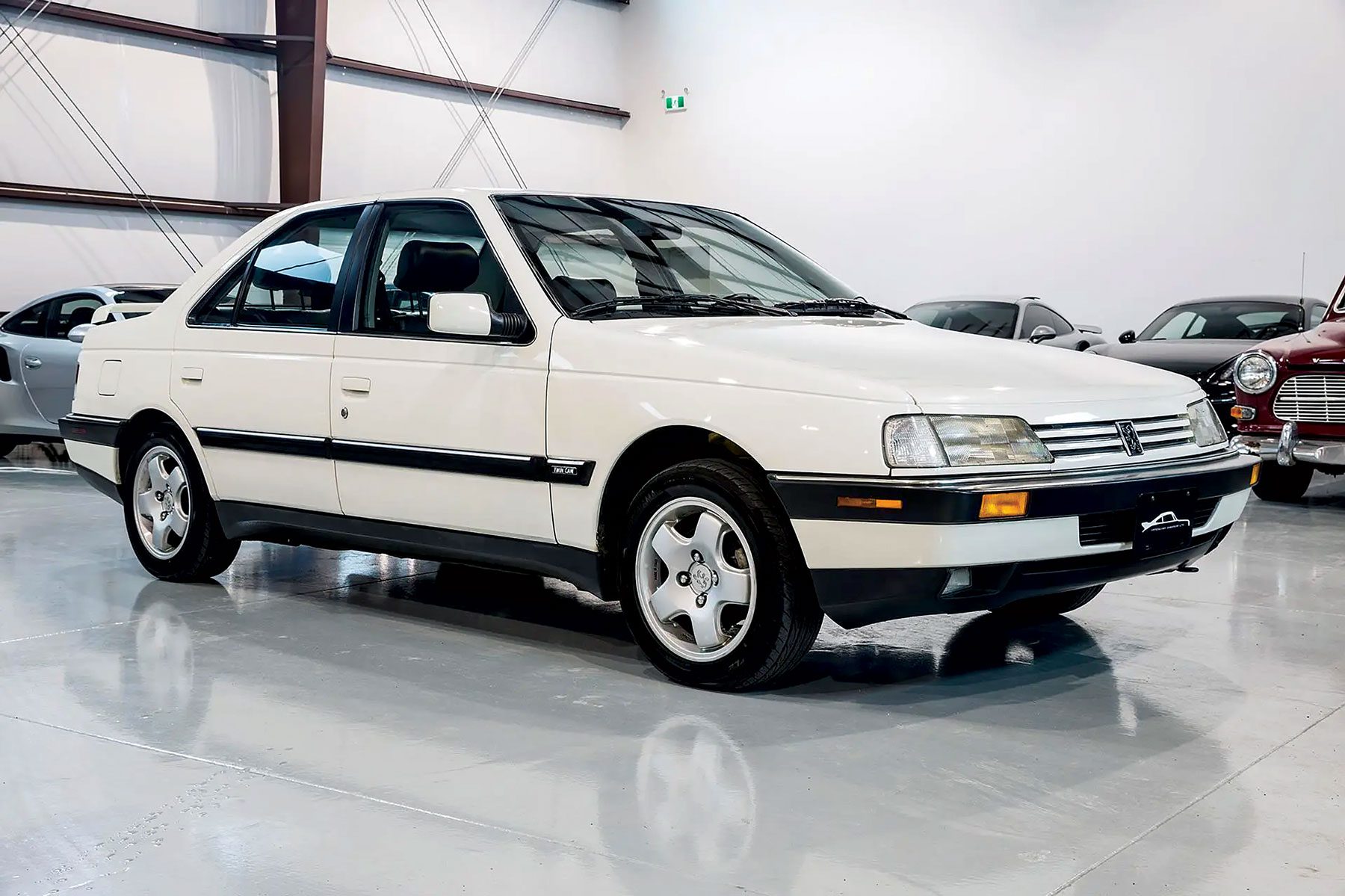

After years of peddling a variety of stodgy semi-luxury sedans on our shores, would a sleek, rev-happy 4-door with impeccable chassis tuning be enough to reverse nearly a decade of slipping sales? Peugeot sure hoped so — which is why it sent its 405 Mi16 to America in late 1988. Modern makeover The 405 was a sensation among European critics and consumers alike upon its debut in 1987. With sharp, aero-honed styling courtesy of Pininfarina, the 405 was a contemporary and significant departure from the 505, Peugeot’s previous (and increasingly dated) mid-range sedan. Riding upon the same front-drive platform as the […]
After years of peddling a variety of stodgy semi-luxury sedans on our shores, would a sleek, rev-happy 4-door with impeccable chassis tuning be enough to reverse nearly a decade of slipping sales? Peugeot sure hoped so — which is why it sent its 405 Mi16 to America in late 1988.
Modern makeover
The 405 was a sensation among European critics and consumers alike upon its debut in 1987. With sharp, aero-honed styling courtesy of Pininfarina, the 405 was a contemporary and significant departure from the 505, Peugeot’s previous (and increasingly dated) mid-range sedan.
Riding upon the same front-drive platform as the Bertone-penned Citroën BX, the 405 ditched Citroën’s quirky hydropneumatics for a more-conventional arrangement with MacPherson struts up front and trailing arms out back, sprung by transverse torsion bars instead of coil springs. That combination quickly earned a reputation for composed ride quality and surprisingly balanced handling. Peugeot managed to sell a half-million examples on its home continent within the first 18 months of production, sweeping the 1987 European Car of the Year awards in the process.
Peugeot had slightly tempered expectations for the 405 in the new world but still hoped it would rejuvenate sales in North America, which had been in freefall since 1984. American-spec models came in three guises, with the base DL and S trim levels using a 110-hp SOHC aluminum 4-cylinder.
The top-tier Mi16, arriving here for 1989, gained a 16-valve DOHC version of the same engine, which produced 150 hp at 6,400 and 128 lb-ft of torque at 5,000 rpm. As those numbers suggest, the engine implored drivers to stay in the upper echelons of the Mi16’s 7,000-rpm rev range, emitting a guttural wail in the process. True to their sport-sedan ethos, Mi16s were offered only with a 5-speed manual transmission, but they were also fully loaded with a sunroof, heated leather seating, Alpine sound system and automatic climate control as standard equipment. All this for a reasonable price tag hovering around $21,000, or just over half the price of a contemporary E34-series BMW 525i sedan.
Strong praise, weak sales
Like their European counterparts, American journalists were fairly smitten with the end result. While the 16-valve’s high-strung nature occasionally ruffled feathers, most reviewers loved its rapturous bark. The 405 Mi16 also won nearly unanimous praise for its chassis tuning, which offered quick turn-in and controllable, predictable lift-off oversteer. “This is one of the most balanced chassis to emerge from Europe since the BMW 3-Series,” crowed MotorWeek — high praise considering the Pug directed power through its front wheels, not the rear.
“If Peugeot has its corporate heart set on building a strong U.S. franchise,” opined one Car and Driver editor, “it couldn’t have picked a finer car with which to start its assault than the Mi16.” Unfortunately, American consumers didn’t bat an eye. Blame any combination of a weakened U.S. currency, an increasingly crowded market segment, laissez-faire marketing efforts or a miniscule dealer network; all these factors played significant roles in conspiring against Peugeot in our market, despite offering just about anything an enthusiast could want in a 4-door.
The 405 ultimately represented roughly 70% of all American Peugeot sales in 1990, but with total volume slipping to 4,300 cars by year end, it wasn’t enough to right a sinking ship. In August 1991, PSA pulled the plug on its stateside operations, leaving bicycles and pepper mills as the only new Peugeots available in America after the fall of that year. Plans for both a Heuliez-bodied coupe and importation of the all-wheel-drive Mi16x4 sedan — to say nothing of the 220-hp turbocharged T16 that was still a few years away — were subsequently stillborn.
By the time the last few 405s rolled off dealer lots in 1992, Peugeot had managed to sell just over 11,000 examples in America. And while Mi16 sales figures were never specifically reported, it’s believed they accounted for well under half of that figure.
An Mi16 for me?
That scarcity means finding a U.S.-spec 405 Mi16 may prove difficult, but it doesn’t equate to an expensive purchase price. While tatty or tired examples may change hands for a couple grand, drivers in good cosmetic and mechanical condition can bring anywhere from $4,000 to $8,000. In recent years, a handful of exemplary examples have even managed to eke closer to the $10k mark.
As is so often the case with cars of this era and nature, patiently waiting to buy the best example you can afford may take considerable time, but may help mitigate subsequent headaches. As these cars inch closer to six-figure odometer readings, they grow fragile and deferred maintenance is almost guaranteed.
An Mi16 with evidence of recent work is a plus, especially when it comes to the timing belt, which needs replacement every 60,000 miles or so to avoid catastrophic contact between pistons and valvetrain. Likewise, be wary of any puffs of blue smoke during a cold start, as it may signal the valve seats aren’t long for this world. Fortunately, all 405s sold stateside utilize a Bosch Motronic fuel-injection system, making diagnosis and repair of the fueling system essentially similar to other better-selling European cars of this era.
Given the 405’s popularity in other markets (some 5 million examples built over 37 years, to date), it may be easier to find certain parts a hop, skip or an ocean away. But given an ever-changing global trade environment, shipping them home may prove more expensive or difficult than ever before, so budget accordingly.
If you’ve determined that bien sur, 405 Mi16 ownership is for you, it’s imperative you network with like-minded enthusiasts on these shores, typically through the Peugeot Owners Group on Facebook or the Can-Am Peugeot Enthusiasts online forum. These groups are not only helpful in finding 405s for sale, but they offer an immense wealth of technical and troubleshooting information. Should push come to shove, they’re also helpful in pointing you to the ever-shrinking handful of specialists on this continent happy to turn wrenches on these fascinating French cars. Bonne chance!