
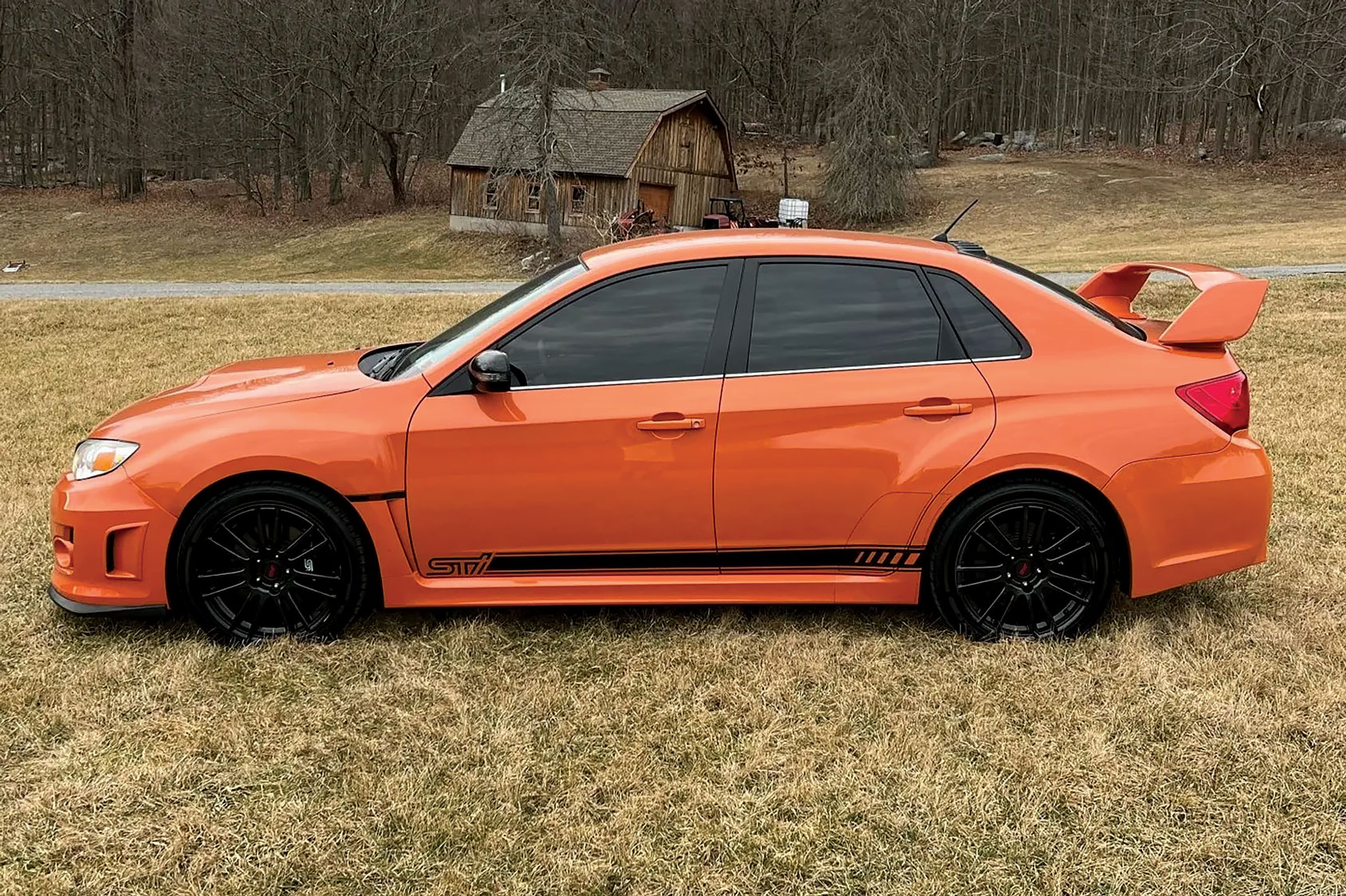

By the time Subaru rolled out the 2008 WRX and WRX STI in the U.S. the car had already enjoyed massive success. Debuting in 2000 as a 2002 model, it was arguably the first modern rally-bred car sold here in significant numbers. Turbocharging and all-wheel drive have a way of making a 3,200-pound car move unlike anything Americans had seen before. The first WRX offered an upright driving position, ample punch and a legacy of otherworldly feats in the World Rally Championship. Plenty of takers fancied themselves the Colin McRae of their extended driveways. Sales soared. When Subaru rolled out the […]
By the time Subaru rolled out the 2008 WRX and WRX STI in the U.S. the car had already enjoyed massive success. Debuting in 2000 as a 2002 model, it was arguably the first modern rally-bred car sold here in significant numbers. Turbocharging and all-wheel drive have a way of making a 3,200-pound car move unlike anything Americans had seen before. The first WRX offered an upright driving position, ample punch and a legacy of otherworldly feats in the World Rally Championship. Plenty of takers fancied themselves the Colin McRae of their extended driveways. Sales soared.
When Subaru rolled out the second-generation U.S.-spec WRX in late 2007, it found that the market had changed. The car arrived with the same 224-horsepower turbocharged 2.5-liter flat-4 as the outgoing version. But 224 horses wasn’t the same news that 227 had been seven years earlier (yes, it lost a few horsepower in the interim). Worse, the engine was packaged in a chassis tuned more for Mr. Bean than Mr. McRae. It was softer and it lost suspension travel due to a switch from struts to double wishbones in the rear. Steering sharpness suffered. So did its rebellious attitude, thanks to ho-hum styling. The WRX had never been a beautiful car, but it also hadn’t been a sterile one. The Subaru cognoscenti responded in anger and Subaru was forced to right the ship with a heavily revised WRX for 2009.
Back to brilliance
The course correction began with a bump to 265 horsepower. It was a meaningful improvement since the new model had gained almost no weight despite a 3.7-inch increase in wheelbase. The suspension was stiffer, too, with spring rates front and rear increased by roughly 40%, while both anti-roll bars swelled by a millimeter. Tires widened from 205 to 225 millimeters, and the steering rack was retuned. It was, essentially, a completely revised WRX — and back to being itself.
The higher-performance STI model wasn’t met with the same rebuke in 2008 as the standard WRX. Its 305 horsepower and 6-speed transmission helped, and it also looked tough. There were nearly two inches of additional bulged-fender track width, plus wider rubber on 18-inch wheels to fill those fenders. The STI was initially sold only as a wagon (a sedan became available in 2011) and it came with serious hardware: inverted front struts, forged lower control arms in the front, three limited-slip differentials, and more-capable brakes from Brembo.
By 2011, Subaru figured out the STI’s recipe for success was a good one, and every WRX was built with a wider body. With the fat fenders and added track width came wider tires (now up to 235 mm), but the WRX remained on 17-inch wheels that grew an inch in width to eight inches.
Driven with impunity, both cars would hit 60 mph in about five seconds. Either was a willing partner on less-than-perfect roads, though neither had particularly communicative steering. But there wasn’t anything as fun and practical for the money.
Prepare for wear
Both the WRX and WRX STI used different versions of the EJ25 engine, which can be a durable powerplant depending on how it’s driven and maintained. Lubrication problems, broken pistons and leaking head gaskets are the usual failures on an abused or neglected EJ25. Steering racks also tend to leak. As always, unmodified cars are your best bet, but still look for evidence of routine maintenance. A compression and leak-down test is worth the money on these cars.
Be especially wary of WRXs making more power than stock. The 5-speed manuals (the only transmission standard WRXs were sold with) are known as “glass transmissions” in the Subaru community, and they tend to fail in catastrophic ways. The STI’s 6 speed — and the rest of its more-robust drivetrain — holds up to bigger power with far reduced failure rates. Everything from the wheel bearings to the differentials are bigger and stronger in the STI.
With age, these cars benefit greatly from chassis upgrades. WRX dampers deteriorate quickly and may be shot by 75,000 miles. Same with engine and transmission mounts, which can be inexpensively replaced with Group N mounts if you’re willing to tolerate additional NVH.
Good, cheap fun
These are not expensive cars today, as mid-mileage, usable WRXs can be had for well under $20k. You will get more value out of an STI, as those are a sub-$25k proposition for a decent example. Despite their faults, these cars offer essentially unmatched bang for the buck. Shop with patience and it’ll be worth it.