
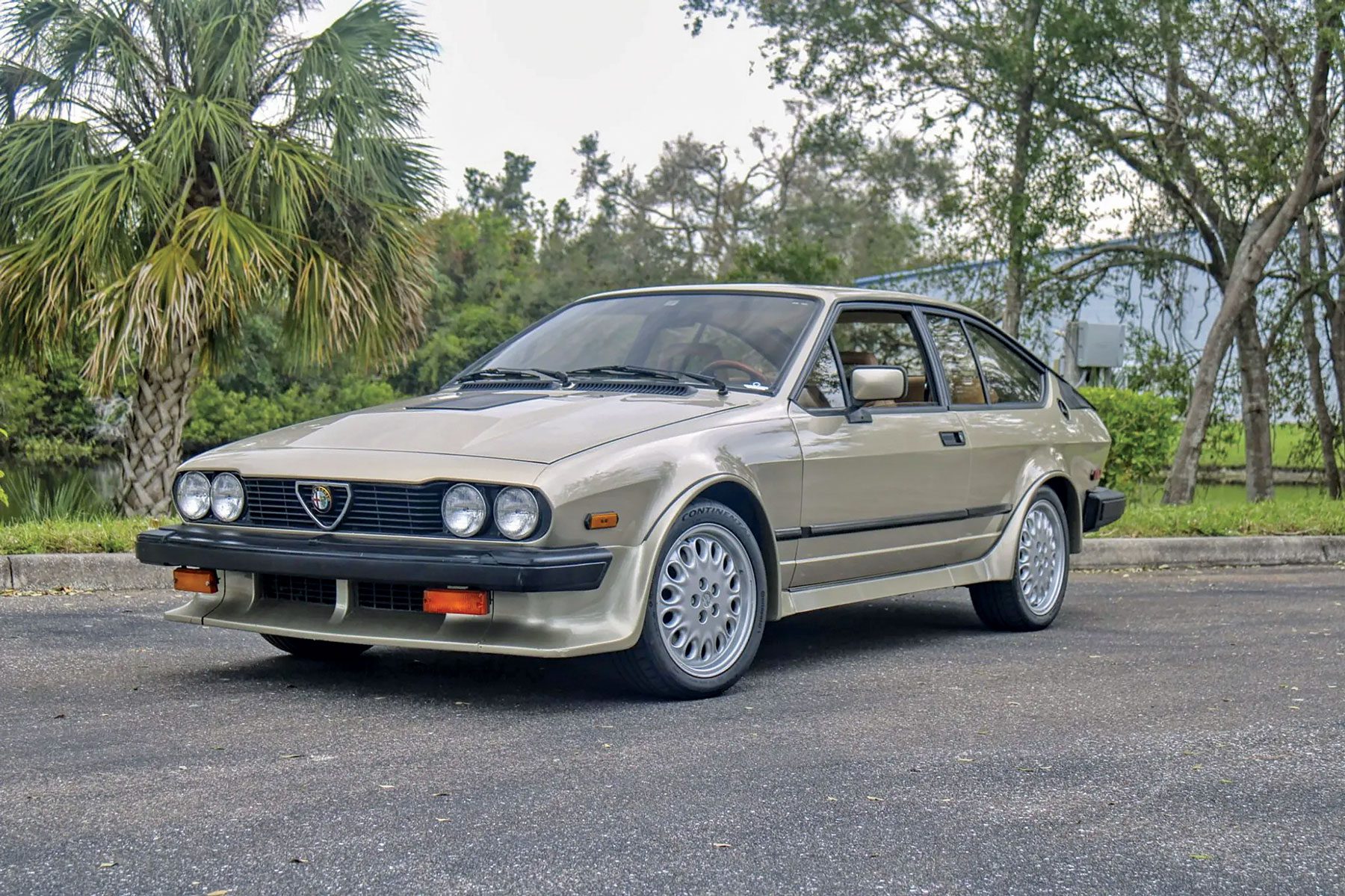

It doesn’t seem like all that long ago when 20 grand was enough to own an honest-to-goodness exotic Italian sports car. Driver-quality Ferrari 308 GT4s, Lamborghini Urracos and Maserati Meraks were all within reach for a middle-class wage earner with some diligent saving and a bit of patience. Today, however, exotics from manufacturers ending in “i” are no longer attainable dream cars. There is still one unconventional option enthusiasts shouldn’t overlook: Alfa Romeo’s GTV6 coupe. In with the new To most Alfisiti, the GTV name signifies the original 115-series car, the Bertone-styled jewel box of a coupe. Part of the U.S.-market […]
It doesn’t seem like all that long ago when 20 grand was enough to own an honest-to-goodness exotic Italian sports car. Driver-quality Ferrari 308 GT4s, Lamborghini Urracos and Maserati Meraks were all within reach for a middle-class wage earner with some diligent saving and a bit of patience. Today, however, exotics from manufacturers ending in “i” are no longer attainable dream cars. There is still one unconventional option enthusiasts shouldn’t overlook: Alfa Romeo’s GTV6 coupe.
In with the new
To most Alfisiti, the GTV name signifies the original 115-series car, the Bertone-styled jewel box of a coupe. Part of the U.S.-market Giulia line from the mid-1960s until 1974, its simple elegance and perfect proportions have caused values to soar. When the new 116-series GTV arrived here for the 1975 model year, it kept the same basic twin-cam 4-cylinder “Nord” engine as its predecessor. But its inextricably 1970s styling was a wedge-shaped Giorgetto Giugiaro design and its chassis was far more sophisticated.
Originally called the Alfetta GT, this new coupe ditched the 115’s solid rear axle in favor of a De Dion-style suspension, a perennial favorite of Ferrari’s racing engineers (think 250 Testa Rossa, among many others). Inboard disc brakes reduced unsprung weight and borrowed from Alfa’s own F1 program, while a rear-mounted 5-speed transaxle nicely balanced the car’s weight. With a hatchback and 2+2 seating, the Alfetta GT was also a practical daily driver. A tachometer housed in its own pod directly in front of the driver, separate from other instrumentation, hinted at the car’s true aspirations.
In 1981, Alfa took the all-aluminum SOHC 2.5-liter V6 from its home-market Alfa 6 executive sedan, swapped the Euro-spec carburetors for emissions-friendly Bosch L-Jetronic fuel injection, and threw the works in a subtly revised car to create the new GTV6. This new “Busso” 6-cylinder (so-called for its creator, engineer Giuseppe Busso), was a revelation, with an exotically mechanical exhaust note not unlike the Dino V6. Power rose from an innocuous 110 horses to a respectable 154 with 155 lb-ft of torque. It made the somewhat ungainly plastic-capped “power bulge” added to the car’s hood — required to clear the fuel-injection plenum — worthy of its nickname.
The GTV6 is quick and entertaining to drive, with no power steering and a lively rear end that will rotate on command. While the gear-lever throw is long and vague, the car otherwise drives and sounds much as you’d expect from a true Italian thoroughbred. Mashing the accelerator creates a symphonious hard-edged wail, with your ears and neck hair tingling to the 6,300-rpm redline. An aftermarket exhaust system further uncorks all that glorious noise. (A YouTube search will make you a believer.)
With an MSRP around $17k, the GTV6 wasn’t cheap. It was $6,000 more expensive than the outgoing Alfetta GT and about $1,000 more than a new Chevy Corvette. The GTV6 was still $4,000 cheaper than Porsche’s new 177-hp 924 Turbo, which the Alfa beat in a 1981 Car and Driver GT-car comparison test. In 1983, Roger Moore drove a gray GTV6 as James Bond in the hit film “Octopussy,” increasing its cachet.
Small changes, special editions
Over the GTV6’s six years of production, plenty of revisions were made to wheels, bumpers, upholstery, instrumentation and more. The front torsion bars were shortened around 1985, while the shift linkage was improved. No automatic transmission was ever available, but a sunroof was optional.
Want a 4-door GTV6 so the family can join in the fun? The Alfa Romeo Milano sedan was sold here from 1986 to ’89 in both 2.5 and 3.0-liter versions. It is nearly identical to the GTV6 mechanically and at least as much fun to drive, while generally being cheaper to buy as well.
Two limited-edition GTV6 models were released for the U.S. market, both cosmetic packages. The Balocco came first in late 1981 and ’82, with special exterior graphics, red seat piping and carpets, and a dash plaque indicating the car’s unique number of 350 produced. The later Maratona was limited to 150 cars with special badging, a clear plastic window on the hood bulge, Speedline alloy wheels, sunroof, rear window louvers, aerodynamic body trim and a wooden steering wheel.
For something truly unique, American tuning company Callaway (of Corvette fame) twin-turbocharged 35 cars in 1985–86 to produce 230 hp and 245 lb-ft. In Road & Track testing, the 0–60-mph sprint dropped from 8.5 seconds stock to 6.2 seconds for these Callaway versions.
When the GTV6 ended production in 1986, little did enthusiasts know it would be the last rear-wheel-drive Alfa coupe until the 8C in 2007.
Attenzione, per favore
Italian-car ownership has its clichés, but the GTV6 is still a serviceable car over 40 years from its introduction. While most mechanical parts for GTV6s are available, some bits, such as Alfa-exclusive Bosch fuel-injection components, are now difficult to find and expensive when you do. Timing belts must be replaced every five years, and breakage can be catastrophic.
Minor engine oil leaks are common, inboard rear brakes can be tricky to service, and driveshafts require occasional replacement of their flexible couplings, called “giubos” (symptoms of wear show up in driveline vibration). Second-gear synchronizers are notoriously weak and will grind in most cars by now, a problem that can be managed with patient upshifts and rev-matched downshifts. It’s not uncommon to find GTV6s with aftermarket cams, exhaust and suspension, or even a transplanted 184-hp 3.0-liter Busso engine from a Milano Verde or later 164 sedan. Generally, these are worthwhile modifications.
Buy the best
Today, you can find GTV6 projects for just a few thousand dollars, but you want the best car you can afford (trust me on this). If you’d like to spend more time driving than wrenching, start searching in the low teens for a #3 condition car. Around $20k will get you a #2- or #3 condition car that will present well for club drives and shows. Upwards of $30k will buy a regional concours-grade example or a driver Callaway. The $40k mark is reserved for pristine 1-condition cars and great Callaways. Maratonas and Balaccos typically aren’t worth much of a premium but can be a bonus to some buyers.
With over 130k GTV6s produced, there are at least a dozen or two on the market at any given time. Be patient, and get any purchase candidate inspected by an Alfa pro. And once you’ve found your GTV6, be sure to join the active and enthusiastic Alfa Romeo Owners Club (www.aroc-usa.org).