
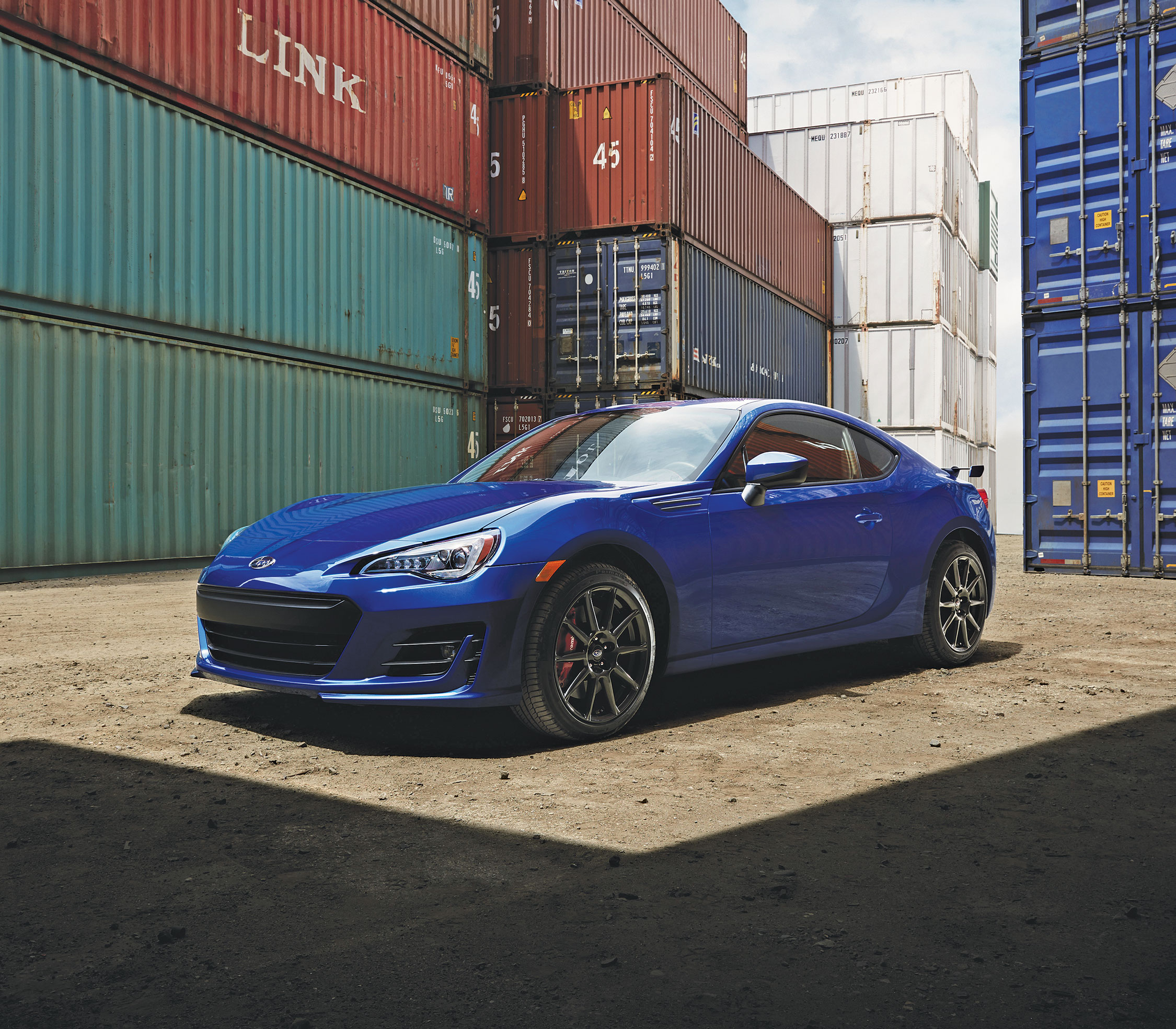

The affordable sports car has always been the foundation of the car-enthusiast hobby, and for decades such cars were plentiful. The Mazda Miata became the king of this segment in the 1990s, evoking everything drivers ever loved about their British and Italian sports cars while providing modern Japanese reliability. That’s the context for the arrival of the twin Subaru BRZ and Scion FR-S models in 2013. Tokyo teamwork The car was fashioned as a fastback coupe, a prime differentiator from Mazda’s ubiquitous sports car. Its design roots lie in the Toyota 2000GT, and the project borrowed Toyota’s historic “86” designation, previously […]
The affordable sports car has always been the foundation of the car-enthusiast hobby, and for decades such cars were plentiful. The Mazda Miata became the king of this segment in the 1990s, evoking everything drivers ever loved about their British and Italian sports cars while providing modern Japanese reliability. That’s the context for the arrival of the twin Subaru BRZ and Scion FR-S models in 2013.
Tokyo teamwork
The car was fashioned as a fastback coupe, a prime differentiator from Mazda’s ubiquitous sports car. Its design roots lie in the Toyota 2000GT, and the project borrowed Toyota’s historic “86” designation, previously found on the 1980s AE86 “Hachi-Roku” rear-drive sports coupes. By the early 2010s, Toyota had lost the sports-car recipe amid an endless parade of Camrys, so it asked bumptious Subaru to collaborate on the project, which was given the “BRZ” moniker. The new sports car was a departure for Subaru as well, the first car designed without the brand’s signature all-wheel drive in well over a decade.
The bulk of the engine work was done at Subaru. The powerplant is a free-revving 2.0-liter horizontally-opposed 4-cylinder “boxer” design. However, Toyota provided a new and efficient direct-fuel-injection system that delivered more performance than Subaru had previously wrung from its naturally aspirated engines.
From the beginning, the engine was paired with a 6-speed manual or 6-speed paddle-shifted automatic gearbox. The manuals claimed 200 horsepower and 151 lb-ft of torque, while the automatics made a bit less. Behind the transmission, the new car was a classic rear-drive sports car with a Torsen limited-slip differential.
The new models came to America for the 2013 model year as part of Toyota’s entry-level Scion brand, with a slightly more upscale twin wearing a Subaru badge. Toyota and Subaru carried the initial design forward for four years, and then gave the car a mid-cycle refresh for 2017, including a 5-hp, 5-lb-ft bump in power. That was also the year that Toyota killed the lackluster Scion nameplate, but the FR-S lived on here as the Toyota 86. The refreshed cars were made through 2020, right up to the launch of the second-generation model early in 2021.
Miata isn’t always the answer
The appeal of the “Toyobaru” is that it’s a lightweight sports car with an all-season roof and 2+2 seating, making it a cozy coupe with better chassis rigidity and more practicality than the Miata. Both Toyota and Subaru versions will crack off mid-6-second 0–60-mph sprints. Typical complaints include excessive road noise and an iffy infotainment system that was a clear afterthought.
The BRZ/86 is known for lively handling and longevity, with the Toyota versions tuned for slightly more tail-out friskiness in the corners. In recent years, the model has found favor with autocrossers and track-day enthusiasts. In fact, SCCA has been developing competition classes specifically for the breed, much as it did with the Miata 20 years ago.
Because of the general affordability of 10-year-old cars that started with a sticker price in the 20s, you can pick up a well-kept early car in the mid-teens now if you don’t mind somewhat higher miles. Around $15,000 seems to be the floor for a quality example. Overall, these cars have held value well, and the facelifted models from 2017 to 2020 are still being sold near to their as-new prices.

Which to buy, what to pay?
Buyers looking for a collectible should strongly prefer a 2017–20 model. Power gains are minimal, but they benefit from consumer-informed development and the inevitable proliferation of special editions. Although Toyota’s version usually outsold Subaru’s, the BRZ is usually more interesting than any of the Toyota models. More of the Subaru cars came with better interiors, including a racy top-stitched leather/Alcantara treatment in the highest Limited trim.
Subaru also brought the special cars. The BRZ Limited with manual transmission could be had with a Performance Package that installed four-pot fixed Brembo calipers and larger rotors on the front and two-piston Brembo calipers in back. These cars also came with Sachs shocks (which are likely ready for replacement by now) and sexy black 17-inch wheels. Toyota offered all this stuff for the 2019 TRD edition, with even bigger brakes, as a track-ready model.

For 2018, Subaru sold a BRZ tS with tuning by STI. Honestly, this was a disappointment because buyers hoped for a fire-breathing turbocharged monster, but got a nicely tuned suspension with some extra chassis bracing. Yet the tS also included the Performance Package brakes as well as a nifty carbon-fiber spoiler, so if you find one, it’s still worth buying. Subaru reprised the tS in 2020 for the end of the first generation, and that’s really the one to get. Asking prices on clean, lower-miles examples run roughly $30,000.
Two last notes if you’re shopping: You generally won’t find them on Bring a Trailer, as just a handful have crossed the block there. First-gen cars are still trading in the general used-car market, which gives you a chance to strike a deal. Also, Subaru and Toyota launched a second generation model for the 2022 model year, with a bigger, more-powerful engine and a host of modern updates. Both brands are selling the new model starting at about $30,000, but be prepared to wait several months for delivery and beware of dealer markups against high demand.