Josh Jacquot is a seasoned automotive journalist with a career spanning more than two decades. His passion for cars has been the driving force behind his career, fueling his love for storytelling and technical work. Josh has held staff positions at Edmunds and Car and Driver, where he performed instrumented testing and wrote everything from technical breakdowns to long-form adventure stories. This hands-on enthusiast’s early fascination with cars evolved into a professional journey that blends his technical knowledge and deep appreciation for engaging driver’s cars. Learn more about Josh here.
Unlike many of its early-2000s counterparts, Ford’s Focus SVT had something truly special going for it. It wasn’t the most powerful car in the sport compact world, and it certainly wasn’t the most aggressive-looking. But it may have had the most passionate development team behind it, ensuring that it filled the driver-centric niche for which it was designed. Ford’s Special Vehicle Engineering team was freed from the restraints, committees and —perhaps most importantly — the Corporate Average Fuel Economy standards to which all other Ford cars were beholden. It existed to create driver’s cars that would help lead the brand image. […]
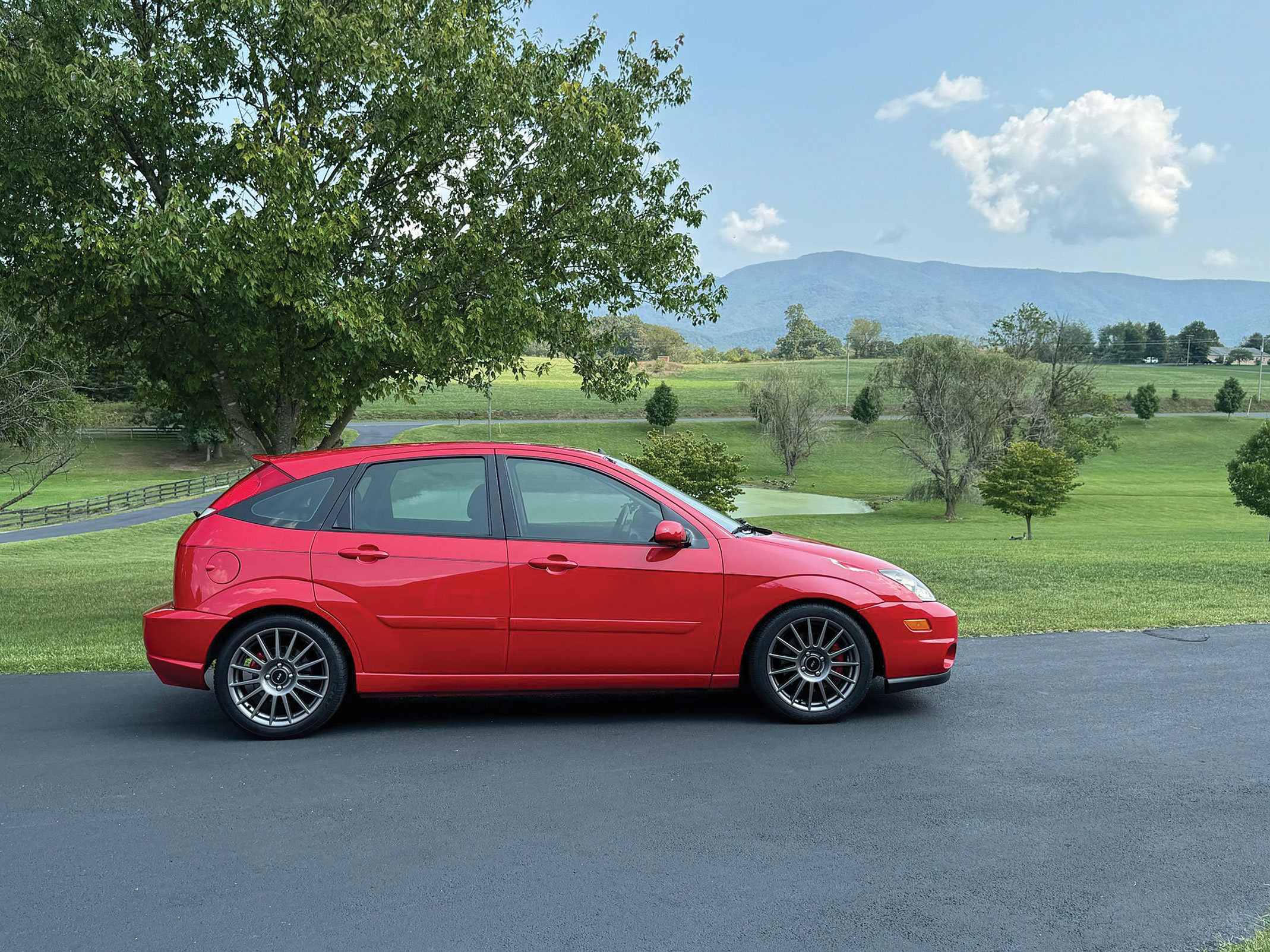
Unlike many of its early-2000s counterparts, Ford’s Focus SVT had something truly special going for it. It wasn’t the most powerful car in the sport compact world, and it certainly wasn’t the most aggressive-looking. But it may have had the most passionate development team behind it, ensuring that it filled the driver-centric niche for which it was designed. Ford’s Special Vehicle Engineering team was freed from the restraints, committees and —perhaps most importantly — the Corporate Average Fuel Economy standards to which all other Ford cars were beholden. It existed to create driver’s cars that would help lead the brand image. And the Focus SVT, in its brief three-year existence, did just that.
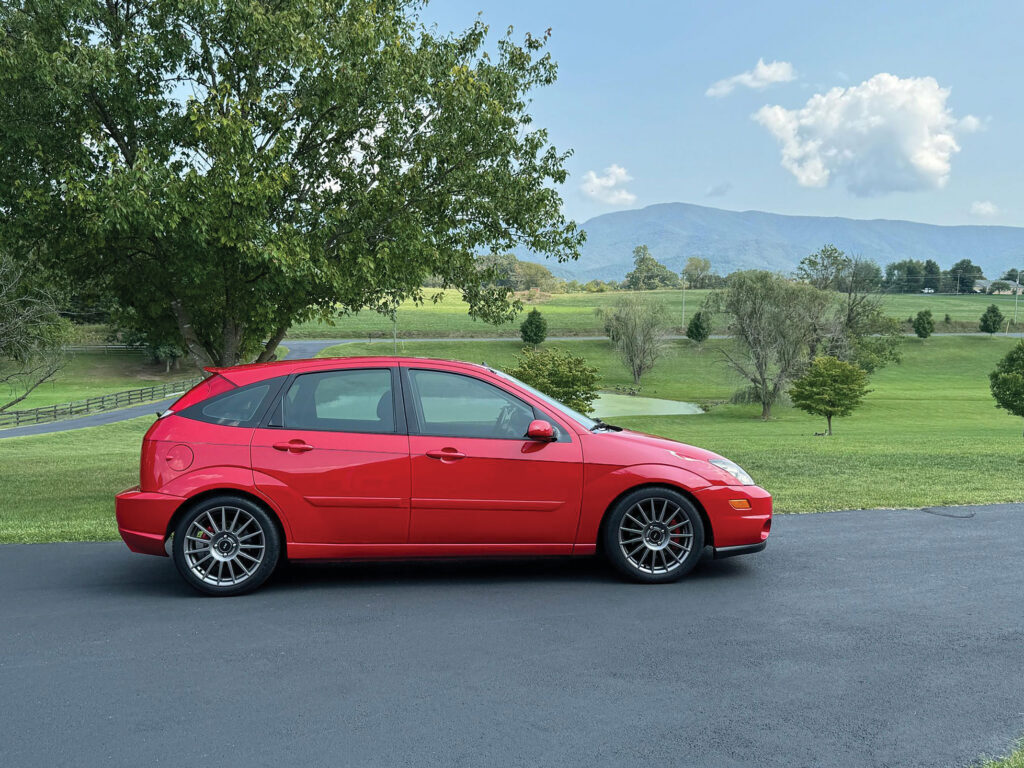
Today, as enthusiasts rediscover the SVT’s unpretentious charm, it remains a special car both for its engaging handling and because it was a truly singular and rare machine. Introduced as a 3-door for 2002, a 5-door variant followed in 2003, and Ford ended the project in 2004.
Delivering the goods
More than 200 unique parts were authorized for the Focus SVT, a huge number for a budget performance model. Many of those found their way under the hood and into Ford’s 2.0-liter DOHC inline-4 engine. It was good for 170 hp, up from 132 in the standard Focus.
Based on the miserly iron-block 2.0-liter Zetec mill, the SVT’s engine got an all-new freer-flowing cylinder head with variable intake-cam timing, bigger intake valves and a two-stage intake manifold. The Zetec’s restrictive stock exhaust manifold was axed in favor of a stainless-steel tri-Y unit. And the engine’s bottom end was beefed up, too, with forged connecting rods and 10.2:1 compression pistons.
A 6-speed close-ratio transmission was sourced from Getrag to replace the more-pedestrian gearbox in the standard Focus. Curiously, there was no limited-slip differential offered, possibly part of a strategy to keep the cost around $18,000. Large 11.8-inch front and 11.0-inch rear discs fill the Focus SVT’s tasteful 17-inch, five-spoke wheels, giving it the thermal capacity to endure real track use — a rarity among sport compacts of the day.
Contemporary tests clocked the 0–60-mph time in the mid-seven-second range, a figure that underscores the hatchback’s relatively light weight. But at around 2,800 pounds, it was actually several hundred pounds porkier than a base Focus, thanks to its go-fast upgrades.
Driving, unfiltered
The Focus SVT’s performance numbers may be modest compared to just about anything sold today, but this wasn’t a car built to overwhelm; it was built to engage. Its compact chassis, responsive steering and purposefully tuned suspension create a driving environment that encourages involvement. Spring rates increased by 10% front and 20% rear, while the rear anti-roll bar grew a single millimeter in diameter. Ride height remained the same as a standard Focus to preserve existing crash-test results, but that didn’t keep the Focus from some fantastic handling tricks.
The SVT’s balanced chassis rotated predictably off throttle. Turn it in, drop the throttle to achieve the desired direction, and reapply the throttle to exit. This move was something none of its contemporaries had mastered, which made it more fun than most of them, even with less power. It convincingly beat VW’s GTI and the Honda Civic Si in a 2002 Car and Driver comparison test, a win no one expected from a Detroit native.
Perhaps the SVT’s biggest drivability flaw was a tendency to hang on to revs between shifts, a product of a heavy dual-mass flywheel and emissions tuning. Fortunately, this was eventually solved by aftermarket suppliers.
A collector’s gem?
The Focus SVT carries hallmarks of an appreciating classic, being somewhat rare and offering a tuning pedigree from a sought-after brand. But it is still a Ford econobox, so prices remain modest. Keep in mind, all is not perfect as these cars age. Oil leaks aren’t uncommon. The same goes for sensor failures and rattles, namely from the exhaust-manifold heat shield.
These cars trade in a somewhat thin market. We found fewer than 20 examples that have sold in online auctions since 2021. Prices range from $5k for higher-mileage (over 100k) examples to $15k to $20k for low-miles (under 40k) 3-doors. A 345-mile car sold for $30k on Bring a Trailer in 2023.
If there’s a lesson, it is this: Focus SVTs are rare enough to be hard to find, which may contribute to appreciation. But even without seeing a positive dollar return, their unpretentious style matched with engaging driving dynamics is a combination increasingly hard to find in today’s electronically mediated machines. Get your analog hot hatch now.