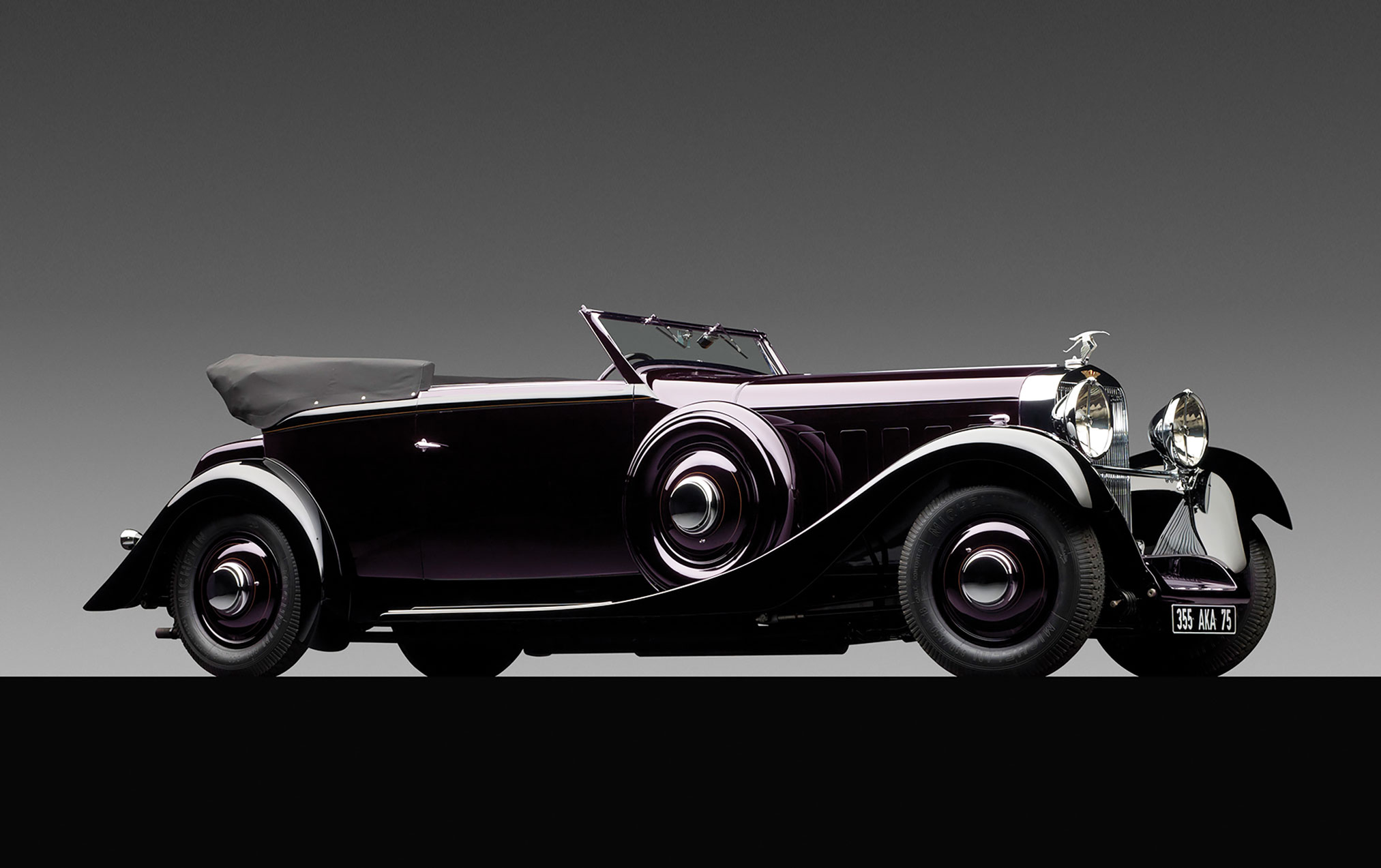
This car, Lot 155, sold for $2,040,000, including buyer’s premium, at Gooding & Company’s Pebble Beach, CA, auction on August 19, 2023.
Hispano-Suiza was founded in 1904 in Spain. The “Suiza” part of the name refers to Marc Birkigt, a brilliant young engineer from Switzerland. Birkigt was responsible for the design of virtually all Hispanos until the demise of the automotive side of the company in 1938. He was also responsible for the design of a radical airplane engine used by Allied forces during World War I.
In 1914, Hispano-Suiza opened a factory near Paris, primarily to produce aircraft engines for the war effort. In 1918, most of the facility was switched to automobile manufacture, although airplane engines remained an important part of the business. The French side of the company quickly became dominant, but some cars were still produced in Spain.
Right from the beginning, Birkigt made some of the best cars in the world. When Parisian production of the H6 began, the car was universally recognized as the greatest luxury vehicle of the time. Unlike its competitors, the H6 was easy to handle, with light steering and proper brakes. You didn’t need a muscular chauffeur to drive you around. The 6-cylinder, 6½-liter engine was smooth and quiet, with plenty of power. In 1924 an 8-liter version was offered for the more-sporting driver; it was capable of a top speed of 110 mph.
Six times two
Birkigt had always dreamed of building a V12-powered car, and in 1931 he did just that. The J12, true to Hispano’s reputation, was a masterpiece and often considered among the greatest touring cars in-period. The 9½-liter engine was capable of powering the two-ton car to 60 mph in under 12 seconds, and could cruise at 100 mph. When the British magazine Autocar tested one, the headline was “A Car Magnificent; Astonishing Acceleration and Ease of Performance.”
A 3-speed gearbox may seem lacking in comparison with modern vehicles, but the big engine had globs of torque and probably could have gotten away with only two speeds. Instead of twin overhead camshafts, a single camshaft was nestled within the V, with pushrod valves. This resulted in smoother and quieter running than the previous 6-cylinder models. The aluminum block ensured a minimum of weight over the front axle, and coupled with servo-assisted brakes, the big car was a delight to drive.
Re-restored, again
Curiously, according to records, our subject car was delivered new to England. The first owner must have known about the reputation of Saoutchik. Author David Scott-Moncrieff may have owned the car next for a brief time, and in 1965 it was purportedly used in a Romanian film. Then taken to Paris with an engine problem, it was purchased by the owner of a French automobile magazine, who already had another J12. But alas, he didn’t have the wherewithal to recommission the car and eventually sold it to French film producer Michel Seydoux, who simply bought a workshop owned by an ex-Hispano mechanic to have it restored.
Seydoux was the first of a number of illustrious collectors who all lavished a great deal of money on the car. Over the past 50 years, nobody has been looking at their checkbook, wondering if they will get their money back. For some reason, each new owner re-restored it. The last restoration reads like a who’s who of the finest American specialists. The amount of money spent must be mind boggling.
Buy why not? The J12 chassis was the finest grand-touring car of the period, and Saoutchik was right at the top of the game. This car is arguably the most elegant 4-seat cabriolet produced on a J12 chassis. Of the 120 chassis produced, this is a rare surviving cabriolet, and apart from a 2-seat version, also by Saoutchik, probably the most handsome survivor.
Given away?
The Hispano-Suiza stork mascot, associated with these cars since 1918, is instantly recognizable. Just as the stork mythically brings babies to caring families, the family that purchased this piece of history will undoubtedly cherish their prize for many years to come. And the previous custodian will undoubtedly regret essentially giving it away.
Gooding & Company sold this car at its annual Pebble Beach Auctions for just $2.04m. The estimate was $2.5m to $3.5m. To nudge the bidders along, the catalog said the car was to be invited to the lawn at the Pebble Beach Concours d’Elegance the day after its sale. Surely a tempting prod? But obviously not enough.
Except for a few highly desirable cars, the pre-war market has been in freefall for the past few years and appears to have bottomed out. Call this one extremely well bought. ♦
(Introductory description courtesy of Gooding & Company.)