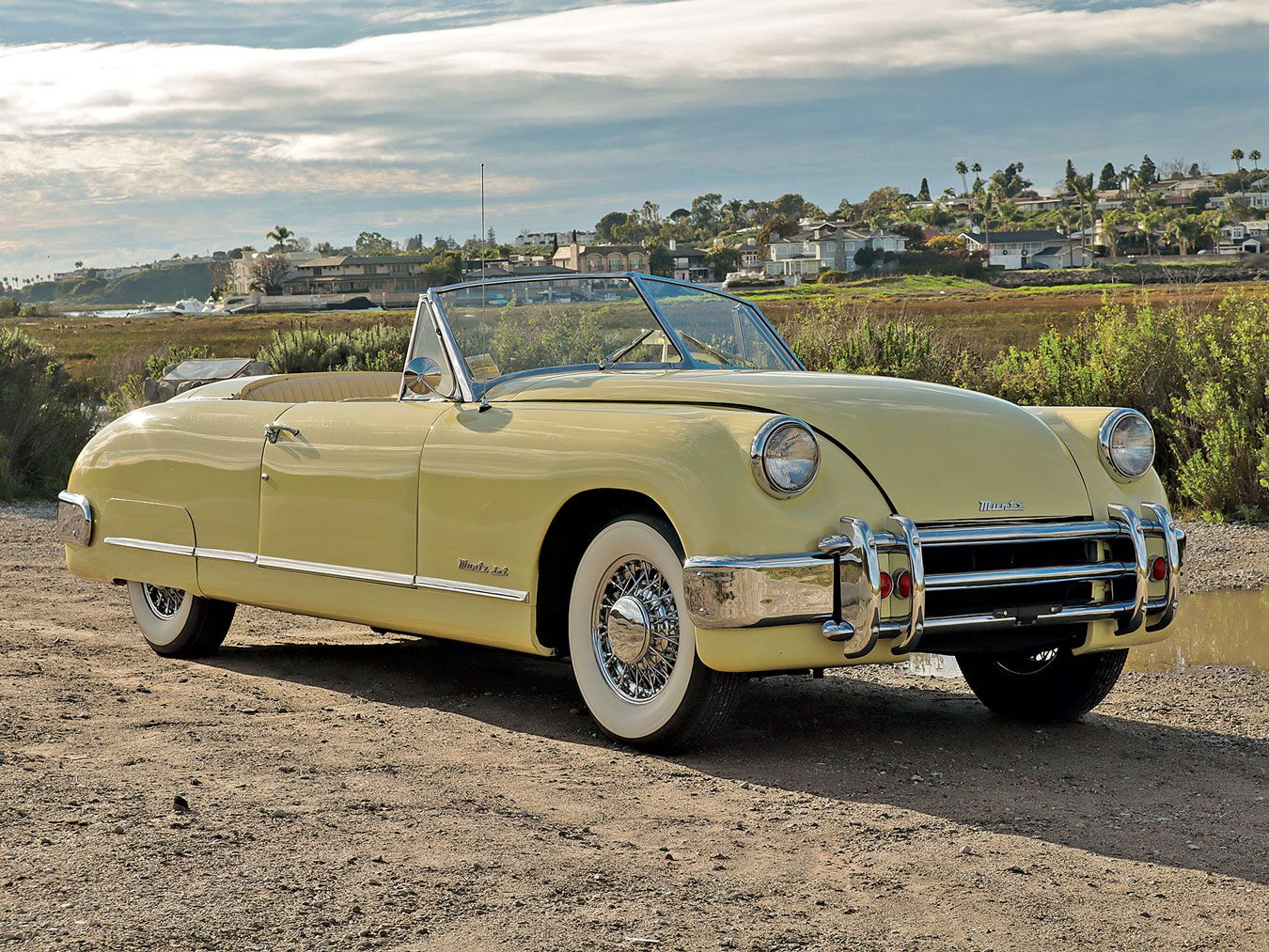
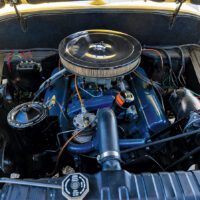
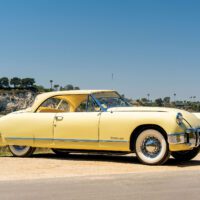
This car, Lot 124, sold for $123,200, including buyer’s premium, at RM Sotheby’s Phoenix, AZ, sale, on January 23, 2026.
Frank Kurtis was American racing royalty. His Kurtis midgets dominated circle tracks across the United States in the 1940s and 1950s and his Indy Roadsters won the Indy 500 five times in the 1950s. In 1949, Kurtis entered the production sports-car market, building a run of what he called the Kurtis Sports Car (KSC). This handsome, low-slung, sporty convertible was built on a sturdy steel platform and was most often powered by a Ford flathead V8 engine. Body construction included fiberglass, aluminum and steel (with more of the latter being substituted for fiberglass in later models). Kurtis built the KSC for the street, but a few were raced, including one by Wally Parks, who reached nearly 143 mph at the Bonneville Salt Flats in August 1949.
Earl “Madman” Muntz grew up in Elgin, IL, and left high school before graduation. In the mid-1930s, he became a successful used-car dealer, moving to California in the process. In television and radio commercials for his business, he promoted his vehicles as a somewhat deranged person — a “Madman” — with wild claims, stunts and other attention-grabbing antics that gained him fame in Southern California pop culture. By the late 1940s, Muntz was also selling stripped-down televisions of his own design at cut-rate prices and later invented a predecessor to the 8-track stereo system, among other enterprises.
A Kurtis fan, Muntz followed Frank’s illustrious racing career as a constructor. Muntz was also an admirer of the KSC and purchased one of the approximately 15 produced, leading to a relationship with Kurtis. This was an unusual pairing, as Muntz was a loud and larger-than-life character, while Kurtis was a humble, soft-spoken man. Whatever the nature of their relationship, one thing led to another, and when Kurtis lost interest in continuing production of the KSC, the Madman was able to purchase the exclusive rights to produce modified versions branded as the Muntz Jet. One of the key elements of the deal involved Muntz maintaining production at Kurtis’ Glendale, CA, Kurtis Kraft facility.
Bigger, heavier, slower
Kurtis had built his creation as a true sports car. It had two seats, a 100-inch wheelbase and weighed just 2,300 pounds. Muntz’s ideas for the car were altogether different. He stretched the Jet’s wheelbase by 13 inches, added rear seats, bodied it entirely in steel, added a removable non-folding hard top and offered it in unusual paint hues, while adding other glitzy and luxurious features.
The net result was that the Muntz Jet was more of a land yacht than a sports car, weighing 1,450 pounds more than Kurtis’ original design. First powered by a 160-hp 331-ci OHV Cadillac V8 paired with a GM Hydramatic transmission, Muntz claimed a 0–60-mph time of around nine seconds and a top speed of 150 mph. When Road & Track got its testing equipment on a Jet in 1951, it recorded a 12.3-second 60-mph sprint, with the quarter-mile run dispatched in 18.8 seconds at 108.1 mph, a speed at which editors said the car “ran out of gear.”
Not only was the Muntz Jet a tepid performer, it was also expensive, costing $5,500 at a time when a new Cadillac convertible sold for around $3,300. Because of this, Jet buyers were typically celebrities or other high-net-worth individuals., including Grace Kelly, Vic Damone and Mickey Rooney. Nevertheless, Muntz reportedly lost around $1,000 on every Jet he sold. After one year of production, and fewer than 30 cars sold, Kurtis asked Muntz to leave the Glendale facility and Muntz relocated the entire operation to Evanston, IL. Generally speaking, the Glendale-built cars were powered by the Cadillac V8 and the Evanston cars got Lincoln V8s — first the 337-ci flathead, then a 317-ci Y-block. Production continued until 1954, when Muntz closed the shop and moved on to his next big thing.
A cult classic
There is an enthusiastic fanbase of individuals who collect Kurtis cars, including the KSC, 500S, 500KK, 500X and 500M. By contrast, today there is not a well-defined group of Muntz devotees. That doesn’t mean there are no buyers for the Jet — it simply means that there is a less-cohesive marketplace.
By best estimates Kurtis built fewer than 20 examples of the KSC, and today nice examples trade in the $200,000–$300,000 range. Muntz built around 10 times as many Jets, resulting in less exclusivity. Not including our subject car, the SCM Platinum Auction Database contains four Muntz Jet sales since 2020, with the average sales price being $84k. Although Muntz buyers generally favor Glendale-built cars with a Cadillac V8 engine, the available data are not robust enough to observe any such trend.
Restored by the highly respected Steve Babinsky, it is not surprising that our subject Muntz was the top-recorded sale in recent years, and only the second Jet in SCM’s database to crest six figures since 2016. Incidentally, 2016 seems to show a peak in the Muntz Jet market, with two cars selling that year for the two highest SCM database values: $165k (SCM# 6806635) and $205k (271281), with subsequent sale prices representing an overall decline in midcentury American classics. Given our subject car’s pedigree, I would say this one was fairly bought and sold at the top of the current market.