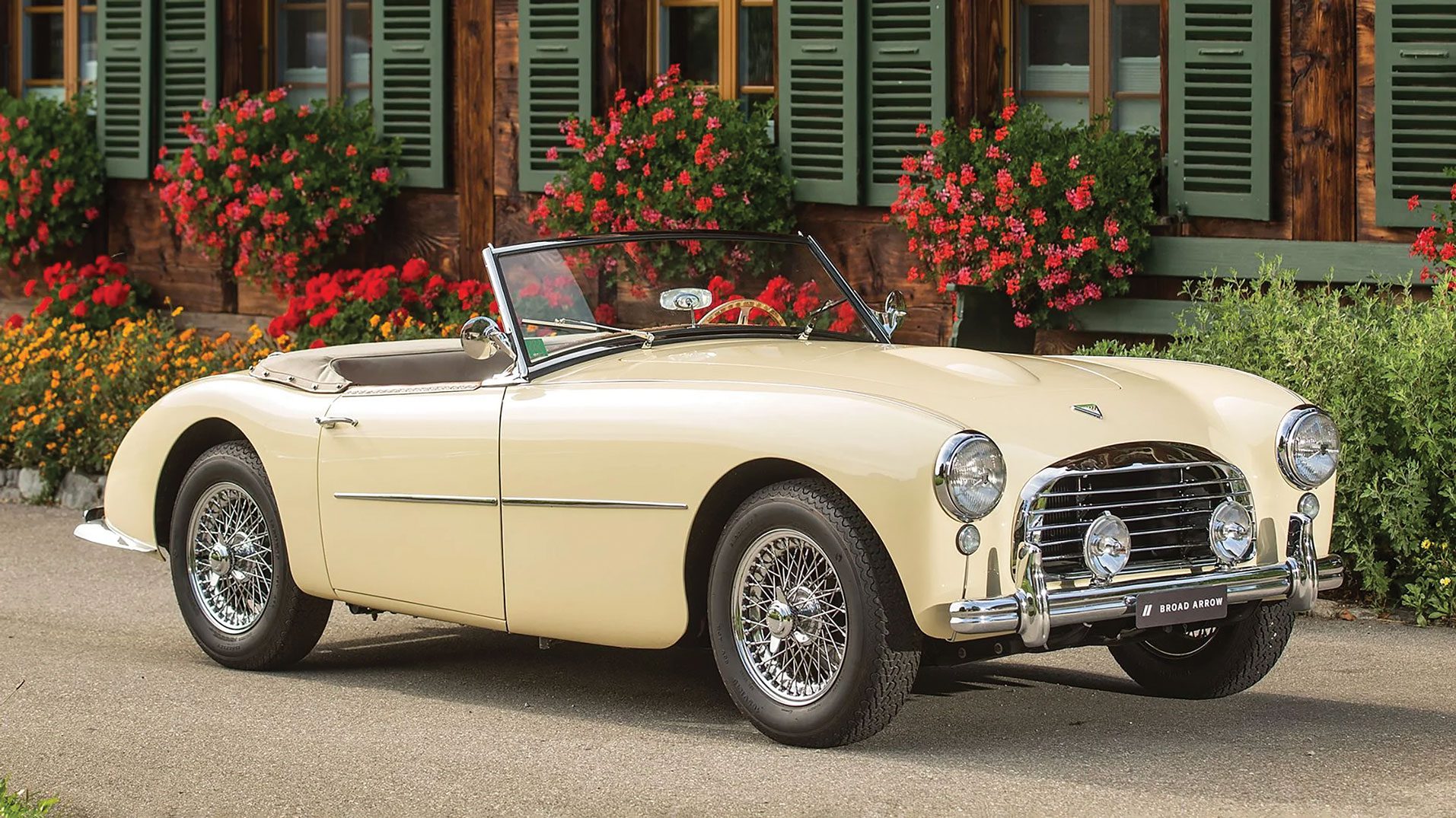
This car, Lot 107, sold for $128,765 (CHF 103,500) at Broad Arrow Auctions’ Zürich, CHE, sale, on November 1, 2025.
The Swallow Doretti made its public debut in 1954, the elegant product of a company that had never before made a car, bearing the unlikely name Tube Investments. To be sure, the British conglomerate was thoroughly familiar with the motoring industry, having supplied numerous automakers with a range of components for decades. But the notion of branding its own vehicle did not arise until Tube’s primary business began to wane in the post-war period.
By then, it owned Swallow Coachbuilding Company, which was dutifully contributing to the bottom line by making scooters and sidecars. Even this division had been stripped of its car-making facilities by previous owner Sir William Lyons, who spun it off of his S.S. Cars Limited — renamed Jaguar following World War II — and then sold it in the mid-1940s. Swallow’s name remained resonant with buyers of a certain age, having been part of Jaguar’s origin in the 1930s.
Management believed that capturing a slice of the flourishing market for sports cars, particularly in America, might provide Tube Investments with a welcome financial boost, while the Swallow name could lend marketing cachet. The fortunate convergence of a California father-daughter team, the head of Standard Triumph and a talented aerospace engineer fed the effort.
Dorothy Deen and her father, Arthur Andersen, had been involved in automotive pursuits for years, operating out of car-crazy Los Angeles. Andersen sold steel tubing, and his daughter organized a line of sports-car accessories — mirrors, valve covers, wind wings and the like. Andersen’s import activities with Tube Investments brought him into the company’s orbit at the moment of the new car’s conception.
Engineer Frank Rainbow, who had arrived at Tube during its acquisition spree, designed a classic roadster, embellished by a sumptuous cabin. The Doretti would be situated on a chrome-moly frame and clothed in aluminum. Such was the rush to bring the car to market that Tube tapped its relationship with Sir John Black at Standard Triumph to supply TR2 gearboxes, axles and engines. These solved major powertrain questions in months rather than years. Together with the TR2, the Doretti would be sold on the West Coast by Dorothy Deen and her father. The car’s name, in fact, was an Italianate contraction of Dorothy’s name: “Dor-etti”.
A short flight
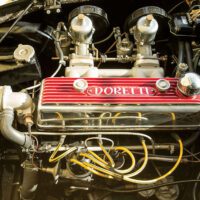
Despite its Triumph mechanicals, the Swallow Doretti was no reskinned TR2. Its wheelbase was 95 inches long to the TR2’s 88 inches, its track was wider and it weighed 56 pounds more for this increase in size. With the same 90-hp, 2-liter inline-4 under the bonnet, road tests measured the Doretti’s top speed at 100 mph, versus the TR2 at over 105 mph. It also cost more than a TR2.
All the same, the Swallow began showing up at California racetracks. Results were underwhelming. However, Max and Ina Balchowsky, of “Old Yeller” fame, proclaimed, “We can swap anything into anything.” The couple acquired six Dorettis, exchanging the British mill for a Buick V8 in four of these, and substantially reworking most of the car’s other components. One, christened the “Buretti,” reportedly achieved a top speed of 147 mph. Meanwhile, Dorothy Deen was a spectacular advocate for the new car. A sparkling blonde, Deen was adept in most aspects of maintenance, racing and promotion.
Nonetheless, Doretti production abruptly ceased in 1955. Why? History proposes two explanations. The first underlines the relationship between Sir William Lyons and Tube Investments, for which Jaguar was an important customer. Lyons apparently notified Tube in 1955 that its status as a supplier-turned-competitor was intolerable. Tube would need to choose one side of the fence — and it did. The second implicates Standard Triumph’s Sir John Black, who was badly hurt riding in a Doretti prototype. His injuries forced his resignation shortly thereafter, effectively ending Swallow’s drivetrain supply. It’s easy to understand a subsequent lack of enthusiasm for continuing the Doretti project. Just 276 cars were ever produced.
On the lawn
We live with the effects of the Swallow Doretti’s modest success today: Chassis 1055 is one of only about 80 surviving examples. This car received a thorough mechanical and cosmetic restoration, culminating in 2008. Its pedigree since then includes exhibition at both American and European events, its last showing being nearly a decade ago. A new opportunity knocks for the buyer, however: The Pebble Beach Concours d’Elegance featured classes will include a tribute to Pebble Beach road racers this year. Our subject Doretti, as a veteran of both the original races and the concours, should easily gain entry, bringing it back to the grass 15 years after its last attendance.
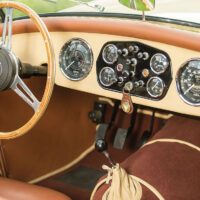
The Doretti’s cosmetics continue to look exemplary. The trademark wide-stitched leather cockpit trim, plush carpets and brightwork appear to be in fine condition. Interestingly, Frank Rainbow clustered the Jaeger gauges in the center of the instrument panel, simplifying the swap from left- to right-hand-drive configuration at the factory. A wood-rimmed three-spoke steering wheel faces the driver; originally, the car would have been fitted with the TR2’s large-diameter banjo-style steering wheel. Occupants enjoy a roomier cabin than supplied by many British cars of the 1950s.
While the Swallow Doretti is a rare bird, sales scattered among the past few years indicate that most examples change hands at around $70,000–$90,000, breaching six figures for the best examples. This Doretti wasn’t competitive at the Pebble Bach Road Race and its concours-level restoration has somewhat aged, so the $129k sale price is certainly strong. But that said, there are likely few cheaper entries to Pebble’s exclusive 18th fairway this August.