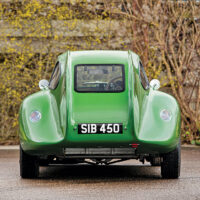
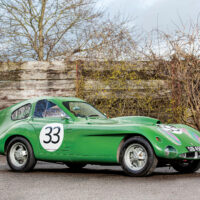
This car, Lot 177, sold for $215,100 (£172,500), including buyer’s premium, at Bonhams Cars’ Chichester, U.K., auction, on April 14, 2024.
“There weren’t any. So, I made one,” is a not-unknown phenomenon in the old-car world. But here the subject matter wins the contest for obscurity. Who knew that Bristol, itself a niche car maker, had developed a streamliner for endurance races in the ’50s? It was based on the Robert Eberan von Eberhorst-designed (and unsuccessful) ERA G-type F2 car of 1952, but with a wind-tunnel-developed body by Bristol whose form defiantly follows its function. The original coupe weighed just 658 kg (1,450 lb) and was smoothed-out further with faired-in headlights for 1954. In 1955 they ran as open cars with one large fin behind the driver, and one of these survives — but none of the 1954 coupes.
Inevitably, of course, somebody wanted one. Creating such a copy is a big risk, with no guarantee that anybody else will share your singular vision when it’s time to sell. A few years ago, a mate of mine built a copy of a lost pre-World War II Hotchkiss streamliner. After enjoying it for a couple of years in VSCC racing, it was time to move it on to fund his next project. He’s still got it, though. It being 22 feet long and pug-ugly doesn’t help.
The Bristol straight-6 family, consisting of 1947–61 401 through 406 models, has always confounded expectations by managing more than seems possible on just 2 liters. This is achieved by dint of lightness and slipperiness, making the most of the limited available horsepower. Bristol was an aero company, after all. But here it’s taken to performance art. These cars swept their class at Le Mans in 1954 and 1955, finishing 7-8-9 overall behind much bigger-engine cars. In October 1953, Bristol had set a series of reliability speed records for the 2-liter class on the banked track at Montlhéry, including 200 miles at an average of 125.87 mph and five hours at a 115.43-mph average. Top speed of the open car on the Mulsanne Straight at Le Mans in 1955 was almost 150 mph — from something like 160 hp.
Labor of love
Enthusiastic French Bristol 404 owner Olivier Boré had always wanted an aerodynamic car and is quoted in a 2022 Classic & Sports Car magazine article thus: “I’ve always been fascinated by this kind of streamliner, like the Bugatti Atlantic. But the cars that appealed to me were either impossible to find or too costly.”
A new build was the way forward, after a long time spent planning. Step forward Andrew Mitchell, who runs the family coachbuilding firm near Stonehenge, responsible for restorations of many Bristols. He was an early adopter of 3D imaging and computer modeling, using these tools to create bucks from which to produce bodies for earlier specials, the technique used to build this car. He and his team had to re-create the body with only old photographs to work from. Using a 406 chassis, he then found a rare “12-pipe” Bristol engine, which fits three twin-choke carburetors instead of the single-choke Solexes of the road cars. “We then knew the height of the carburetor tops, and the wheel size, and scaled up the dimensions from those.”
Some pragmatism had to be deployed, in the name of expediency. The original cars used a transaxle, too large and expensive an undertaking to replicate. A regular 4-speed Bristol gearbox with overdrive was adopted, mounted in the usual place on the back of the engine. The very French-style cast-alloy wheels were copied by specialist Turrino Wheels (“You were never going to do the car without those,” observes Mitchell), and instead of Alfin drums there are disc brakes, like on the 1955 cars.
The body took two years to make, and the curved Plexiglas windows weren’t too difficult compared with the frontal glass. It’s cut down from an MGB windscreen, fitted from the inside; two broke before one was successfully fitted. Unlike the original, the rear window hinges open to allow access to the fuel tank, and a bit of airflow for ventilation. Hand-painted switch labels were copied from old photographs. Invoices for the cost of construction total £273,635 — or about $350k in 2020 money.
Linked with history
While Mitchell was creating the body, Boré was busy unearthing original parts including the steering wheel and chronometric rev counter from the car piloted by the team’s most prominent driver, Jack Fairman. (For the 1955 race, Bristol’s reserve driver was an ambitious Australian newcomer named Brabham).
With that connection, Boré had the car finished with number 33, for Fairman and Tommy Wisdom’s 1954 Works entry. He also added to the dashboard the St. Christopher medal that belonged to racing driver and dealer Tony Crook — the Bristol agent who owned the marque from 1973 until 1997 — and was given upon his death in 2014 to his best friend Peter Mitchell, Andrew’s father. Memorabilia with the lot included the 1954 Le Mans trophy, 1954 Le Mans pewter tankard (Bristol Team), 1954 Le Mans program autographed by race-winning Ferrari Works driver José Froilan Gonzalèz, plus photographs and team autographs.
The car ran at Goodwood, Silverstone and Castle Combe in 2021, then appeared at Paris Rétromobile in 2022, and the Le Mans Classic in July 2023. At Art et élégance à Chantilly, it featured in the Le Mans Legends class and won the Special Jury Endurance Prize.
Delightful and unprofitable
Given that only one of the original 450S cars survives in its final open form, all 450 coupes are going to be new builds even if they incorporate some old parts. Generally, in Europe, toolroom copies of aristocratic racers — Birdcages, Testa Rossas and the like — sell for up to $500k. That would be for a bolt-for-bolt identical copy of the originals, good enough to get a Historic Technical Passport and take part in FIA-sanctioned races.
This car wouldn’t be HTP-eligible, as it differs too much under the skin from the original. And in any case, it wouldn’t be competitive in historic racing, being more suited to long straights than scratchy sprint circuits. Still, it will always be welcome in the invitation class at historic venues such as Le Mans and Montlhéry. Among the bunch of spares included were the unique wheels, tires, roll bars and harness.
I suggest what kept the price down here compared with something like a “new” ’50s sports racer or a 250 SWB made from a GTE is obscurity, lack of usefulness, and — let’s be brutal — ugliness. But what a fascinating exercise, and a delightful curiosity to anyone who encounters it. As Andrew Mitchell says: “It’s just an interesting old mongrel that everyone wants to give a stroke.”
Boré should be commended for having the vision and determination to start and see through this project, with no guarantee that anyone would want to buy it afterwards. Taking a haircut was always going to be in the equation. ♦
(Introductory description courtesy of Bonhams Cars.)