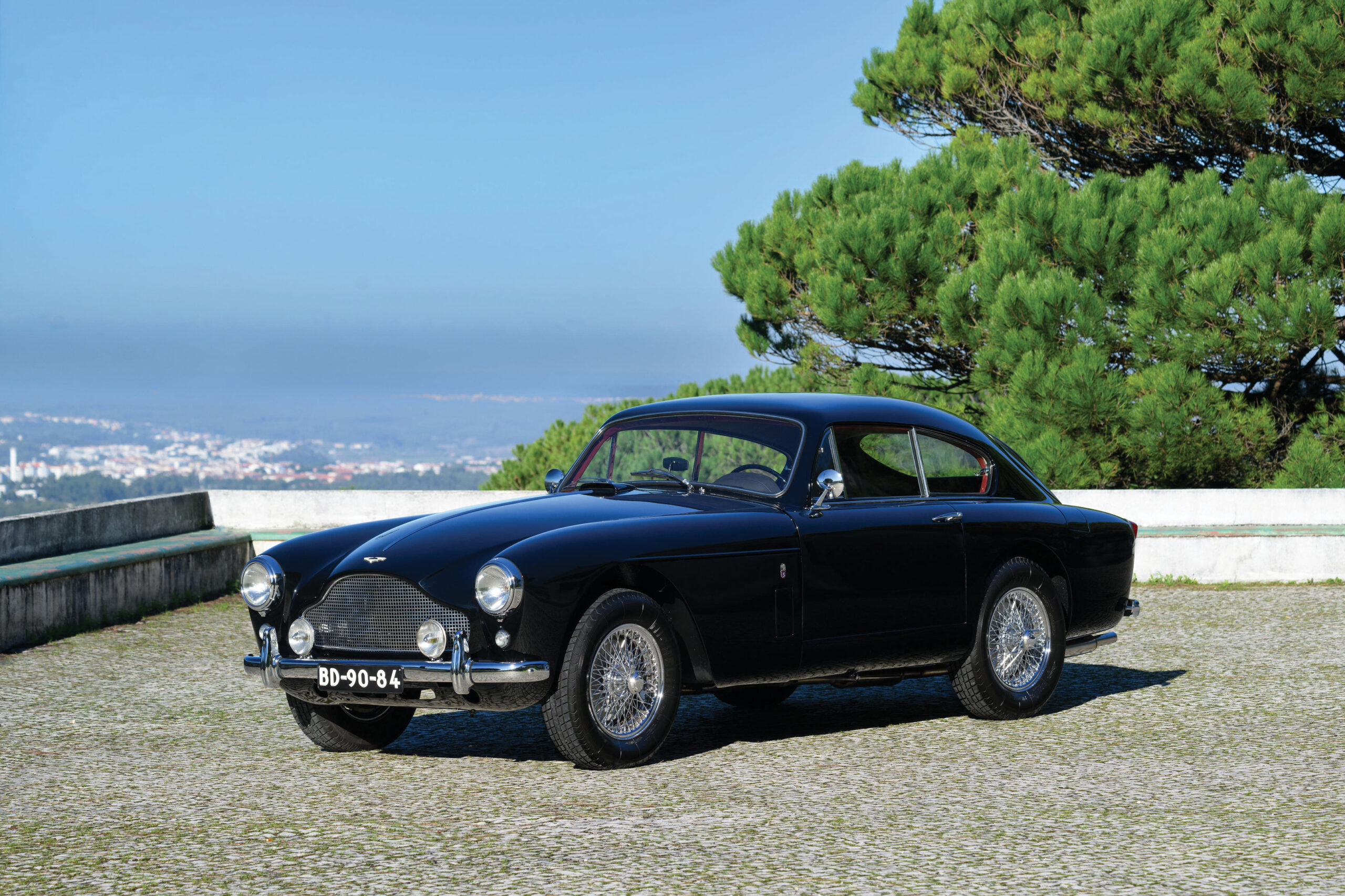
This car, Lot 126, sold for $211,414 (€195,500), including buyer’s premium, at Bonhams Cars’ Paris, FRA, auction on February 11, 2024.
David Brown’s chops as a motorsports enthusiast, engineer and manufacturer were well established by the time he bought Aston Martin and Lagonda in the late 1940s for less than £100,000 (around $400,000 at the time). In the aftermath of World War II, his timing could not have been better.
Contemporary British newsreels exhorted war-weary citizens to forego personal luxuries in favor of exporting goods to secure precious foreign exchange. Car exports surged, and though Aston would not see the same volumes as marques such as MG and Jaguar, the DB2’s class victory at Le Mans in 1950 elevated its standing both at home and abroad. Prior to Brown’s takeover, Aston had never made more than 140 cars in a year, but by 1954 output swelled on the back of the DB2’s successor, the DB2/4, launched the previous year. Aston would produce 565 DB2/4s and a further 199 Mk II models before it gave way to the DB Mark III in 1957.
More power
Critical to Brown’s further expansion in the face of emerging British and European competition was the arrival that year of Polish engineer Tadeusz “Tadek” Marek. His combination of German schooling, practical engineering experience and a keen interest in motorsports — he was nearly killed when his BMW motorcycle crashed in a 1928 race — positioned him to take the motive side of the DB series to the next level. His main task would be the enhancement of the W.O. Bentley-designed straight-6 that had been acquired with Lagonda.
In the DB Mark III the standard engine with twin SU carbs now made 162 hp; this was on par with the 165 of the optional high-compression version offered in later DB2/4s. Power could be enhanced by ordering dual exhausts (178 hp) or a triple-SU setup (180 hp). A high-output version of the engine made 195 hp thanks to three Weber carburetors, different camshafts and a bump in compression, but was ordered on only 10 cars.
Other tangible improvements to the DB Mark III included a Girling front-disc-brake option that became standard after the first 100 cars, a redesigned instrumental panel, overdrive, hydraulic clutch and even an optional automatic transmission. The model was offered in three body styles, the most common being the 2+2 hatchback “saloon,” as well as a drophead (convertible) and the rare and ungainly fixed-head coupe. But the most visible change in the DB Mark III was its seminal grille revision, which still instantly identifies an Aston Martin today.
Fame and fortune
The most significant aspect of the new DB Mark III, however, had nothing to do with Brown or Marek. Indeed, it was author Ian Fleming’s fateful decision (for Aston Martin, at least) to have James Bond pick the DB Mark III over a 3.4-liter Jaguar as his vehicle of choice in the 1959 novel “Goldfinger.”
That move, according to the highly entertaining “The Great James Bond Car Robbery” podcast, came at the request of a fan who felt that an Aston better suited the youthful Bond than the Bentleys he had driven in earlier books. When the film version of “Goldfinger” appeared five years later, Sean Connery as Bond was put behind the wheel of a new DB5, which arguably became the most famous movie car in history and forever connected Aston and 007.
Unsurprisingly, DB Mark III values don’t get much of a literary Bond boost, and the best example in the world today is worth less than a DB5 project car. Prices plateaued in the $300k range in the mid 2010s, reaching $440k for a 1958 DB Mark III sold at RM Monterey in 2013 (SCM# 231214 ). They’ve since declined to the $150k–$200k range, with occasional spikes for cars with particularly good provenance or the rarer higher-output versions.
One reason, suggests Bonhams Cars’ Group Motoring Director Rupert Banner, is that many of these cars have been sparingly used for years, if not decades, and are in need of costly recommissioning or restoration. Our subject car sold at the higher end of recent DB Mark III sales, reflecting the market’s preference for road-ready examples.
While a closer inspection would be desirable to validate its Portuguese restoration (completed at least seven years ago), appearances certainly suggest a vehicle worthy of concours or rally competition, including the Mille Miglia, for which it’s eligible. Assuming everything checks out, the new owner paid a fair enough price. He might now try to fill in some of the history between its delivery as a new car and showing up in France five decades later. ♦
(Introductory description courtesy of Bonhams Cars.)