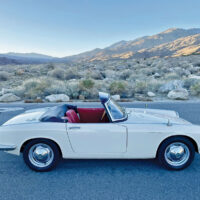
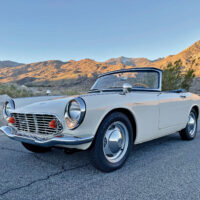
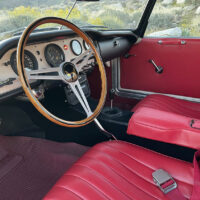
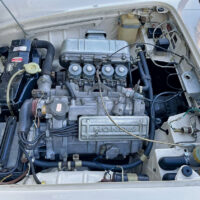
This car, Lot 141159, sold for $109,200, including buyer’s premium, on Bring a Trailer’s online auction, on March 27, 2024.
Honda debuted the prototype for its first-ever sports car at the 1962 Tokyo Motor Show. The design came from the brilliant mind of Soichiro Honda, who founded his eponymous company in the late 1940s. The prototype was known as the Sports 500 (the stillborn Sports 360 was also shown) and this car launched a trilogy of early S-series sports cars that set Honda on a new and exciting course.
Whereas the prototype and preproduction units were called Sports 500, the production examples were sold as model S500 (chassis designation AS280). This car was developed from a clean sheet of paper, which allowed Honda to truly push the engineering envelope. Produced in 1963–64, the S500 was built on a Honda-designed backbone chassis with independent suspension front and rear. The rear suspension was an engineering marvel that illustrated Soichiro’s dedication to innovative solutions. Calling on his experience with motorcycles, Honda mated the S500’s straight rear axle to independently sprung wheels by sealed roller chains.
The water-cooled aluminum inline 4-cylinder engine was another astonishing bit of Honda magic, displacing 531 cc with dual overhead camshafts, four carburetors and a redline of 9,500 rpm. With 44 horsepower on tap, and weighing a mere 1,598 pounds, the S500 had a real-world top speed of 80 mph. While no authoritative roster exists, it is believed that somewhere between 1,363 and 1,501 S500 examples were built, all convertibles, and most in right-hand-drive configuration.
S-car grows
Honda introduced the S600 convertible (chassis designation AS285) in March 1964. Unlike its immediate predecessor, the S600 was designed for the world market and was engineered for full-scale production of both RHD and LHD examples. While the overall design was largely a carryover from the prior model, there was a significant increase in performance.
The upgraded engine now displaced 606 cc and developed 57 hp, which was enough to propel the S600 to a top speed of 90 mph. The S600 engine retained the same rev-happy DOHC architecture of its forerunner, with a hemispherical head and needle-roller bearings for both connecting rods and crankshaft.
Honda surprised the market in March 1965 with the release of its first closed-top sports car, the S600 coupe (chassis designation AS285C). By the time S600 production ceased in mid-1966, more than 11,000 convertibles and 1,800 coupes had rolled out of the factory.
The final iteration of the early S-series offerings was the S800 produced from 1966 to 1970. These were available as either a convertible (chassis designation AS800) or coupe (chassis designation AS800C) in both left- and right-hand drive. At long last this was Honda’s first 100-mph sports car, thanks to displacement increasing to 791 cc, raising horsepower to 70. The first 985 cars were built with the chain-drive IRS. After that, they were constructed with a traditional driveshaft and solid rear-axle assembly with four-link suspension. Convertible and coupe production totaled 11,488 units.
Hierarchy anarchy
Other than convertibles generally being favored over coupes, there is no true consensus in the hobby regarding the pecking order of the early S-series Hondas. The S500 was the first, the purest, and was built in the smallest numbers. It is the least-inspiring model to drive but the most difficult to acquire. These cars seldom come up for sale and are coveted by collectors seeking the rarest of the rare.
While some enthusiasts find the freely revving engine of the S600 most exhilarating, others prefer the driving qualities of the more-powerful S800. Among those who favor the S800, there is little agreement regarding the relative desirability of the chain-drive IRS versus the later solid rear axle, not to mention that of the somewhat confusing Mk I, Mk II and Mk III variants. They are all eye-pleasing machines with innovative technology that are event eligible (and capable), even for Western drivers over six feet tall.
A trend buster?
Setting aside the S500, prices for quality S600 and S800 convertibles over the past 18 months have been hovering in the $50k–$70k range. The Japanese collector car market remains active and strong, and this world-record price for our very well-turned-out subject car is at least one data point signaling that continued path forward.
This sale, however, also raises an interesting question. For the past year or so, the hobby has been abuzz over the fading interest in sports cars of the 1950s and ’60s. SCM Contributor and Porsche expert Prescott Kelly recently wrote the nearly unthinkable: “…neither [Porsche 356] Speedsters nor four-cam Carreras are holding up well right now” (German Profile, May 2024).
Our subject car was indeed a sports car built in the 1960s and I would expect a similar six-figure result for the next high-quality S600 or S800 convertible publicly offered for sale. Does this mean that certain Japanese models are an exception to the current conventional wisdom? Or that the hobby needs to rethink its current widespread pessimism regarding ’50s and ’60s sports cars? Regardless, this S600 sold for a market-correct price. ♦
(Introductory description courtesy of Bring a Trailer.)