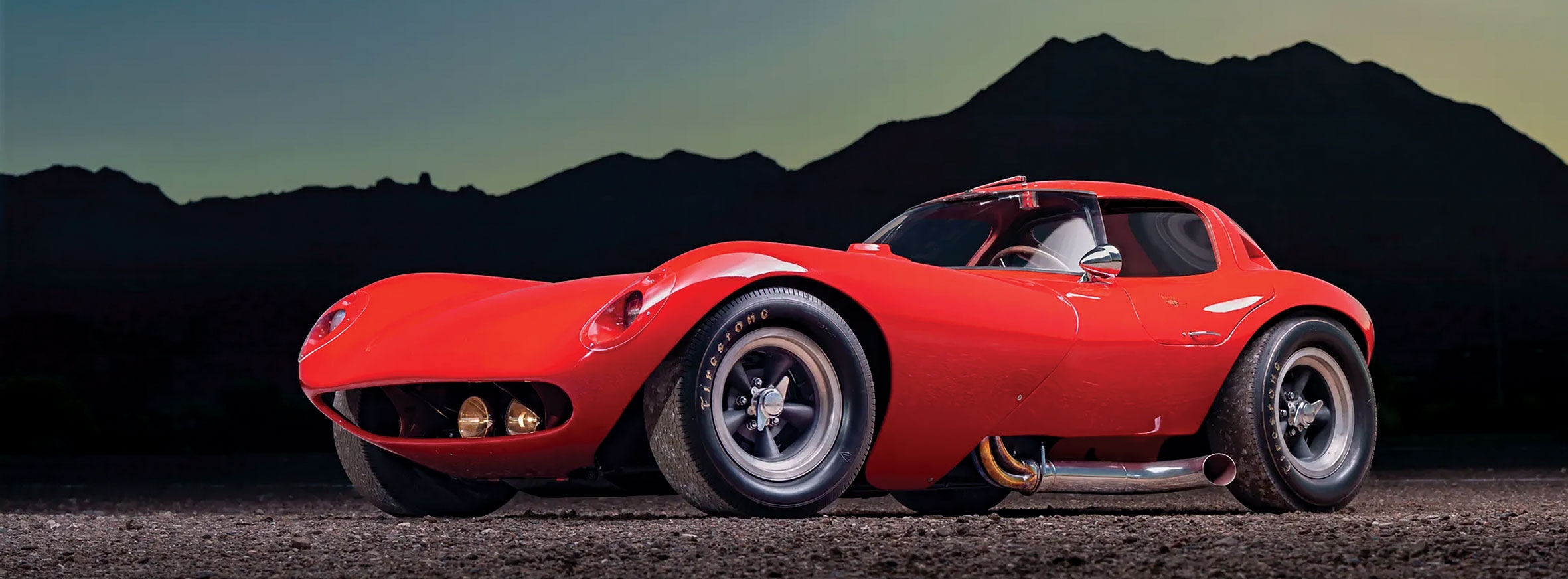
This car, Lot 237331, sold for $527,500, including buyer’s premium, on Bring a Trailer’s online auction on April 14, 2026.
William P. “Bill” Thomas was a self-educated engineer who began working in California’s aircraft-parts manufacturing industry in the early 1950s. Born and raised in Anaheim, Thomas soon became caught up in the racing world and started hopping up Chevrolet Corvettes, first for himself and later for customers. With financial backing from the C S Mead Motors Co., Thomas’ Corvettes quickly became a dominant force.
To kill a Cobra…
By 1960, Bill Thomas Race Cars was a going concern, modifying Corvettes and supporting Southern California’s racing community. But Thomas’ initial enthusiasm for the arrival of the 1963 C2 Corvette Sting Ray was quickly squashed when a certain Texan arrived on the scene with his Cobra sports car.
Understanding that the Corvette was no match for Carroll Shelby’s new Ford-powered roadster, in 1963 Thomas approached Ed Cole, who was top brass at General Motors. Thomas pitched the idea of building a Chevy-powered, Cobra-beating machine, and Cole was receptive. The caveat was that GM could have no public connection to the racing activities, per a recent industrywide initiative in the U.S. The plan called for Thomas to build 100 units to satisfy SCCA homologation requirements for a production-class competitor. Thomas’ new car would be known as the Cheetah, built in both street and racing versions. Chevrolet would provide components, including engines, and would help market and sell Cheetah sports cars built for street use.
As compared to the English underpinnings of the Cobra, the Cheetah was all-American, purpose-built on a weight-sparing chrome-moly tube-frame chassis with independent front and rear suspension and drum brakes. Designed by 1957 Indy 500 Rookie of the Year Don Edmunds, it was an aggressive-looking coupe with a long nose, an extremely short tail and gullwing doors. The Cheetah sported the same 90-inch wheelbase as Shelby’s 289 Cobra but was an incredible 450 pounds lighter. Perhaps the most unique aspect of Edmunds’ design was the position of the engine, which was set way back in the chassis to achieve a 47/53 weight distribution. This eliminated the need for a driveshaft with the output yoke of the BorgWarner T-10 4-speed transmission connecting to the rear differential via a single universal joint. In addition to Edmunds, Don Borth, Warren Williams and Bob Sorrell were also involved in building Cheetahs.
The new car not only benefited from its clean-sheet design, but the available Chevrolet V8 had significantly greater potential than those from Ford. With a whopping 400 to 500 horsepower on tap, acceleration was astonishing, with 0–60 mph times under 4 seconds and a top speed approaching 200 mph.
Reality bites
As the 1964 racing season quickly approached, it became clear that Thomas could not produce 100 Cheetahs. That meant there would be no production-class homologation, and the Cheetahs would have to run against others in the modified class. In 1964, those race cars included the mid-engined Chaparral, King Cobra and Genie, all of which were far more capable in terms of handling, braking and driver comfort.
Thomas could still build killer Chevy engines, and several individuals raced Cheetahs, including Jerry Titus, Jerry Grant, Ralph Salyer, Bud Clusserath, Fred Yeakel and Allen Grant. Although there were some victories along the way, the Cheetah racing program was largely a flop. Developed to beat Shelby’s Cobra, Bill Thomas’ Cheetah never even got to race in the same class.
By the numbers
Precisely how many Cheetahs were originally produced remains a matter that will likely never be resolved. Let’s start with what most enthusiasts can agree on. The first two Cheetahs were constructed with an aluminum body. Following that, a series of eight cars were constructed with fiberglass bodies. The 11th Cheetah was the aluminum-bodied Super Cheetah, which was never completed in-period. Of the first 11 cars, five have a known racing history.
Our subject car was reportedly the 12th Cheetah produced. From the documentation provided, this example appears to have been completed after Bill Thomas closed his business, following a fire. At that time there were several unfinished chassis, and many of these were later completed. Moreover, many years after closing his business, Bill Thomas was back at it, producing additional Cheetahs with a new business partner. It seems that production continued even after Thomas’ death in October 2009. For years, some of Thomas’ heirs have been embroiled in legal proceedings to stop his former partner from using the Bill Thomas Cheetah name, likeness and branding. As a result, the lines between original, continuation and replica Cheetah have forever been blurred and the term “Cheater Cheetahs” has unfortunately made its way into the automotive lexicon.
Here and now
Bill Thomas’ Cheetah is one of the great “what could have been” racing stories of the 1960s. These machines might well have trounced the Cobras had they been homologated to race in the same class. Of course, that never happened. Although our subject car has no racing pedigree, it shares the same raucous performance of the competition cars with sinister looks and sounds, and head-snapping acceleration.
Cheetahs built in Bill Thomas’ workshop in the early 1960s rarely come to market, and today there are many more Cheetah-like cars than were ever produced in-period. The sale of a genuine Cheetah is a rare event, which makes defining the market extremely challenging. Previously, 1964 Cheetah chassis 003 was sold on Bring a Trailer in May 2025 for $422,500. It was said to be the first fiberglass-bodied car built, with about a year of period race history and an open-roof conversion, plus two decades worth of vintage-racing history starting in the 1990s. Chassis 006, also with a fiberglass body and five years of period race history, including winning the 1968 SCCA Southern Pacific region A/SR championship, sold at Barrett-Jackson’s 2017 Scottsdale auction for $935k.
Bring a Trailer’s online auction listing for this well-presented Cheetah had 62,286 views, 3,194 watchers, and garnered a total of 54 bids. The result of $527,500 seems like huge money for a car without competition history and one completed after Bill Thomas closed his shop. However, as is often said in the hobby, try to find another example at a better price. Call this one a fair sale, then.