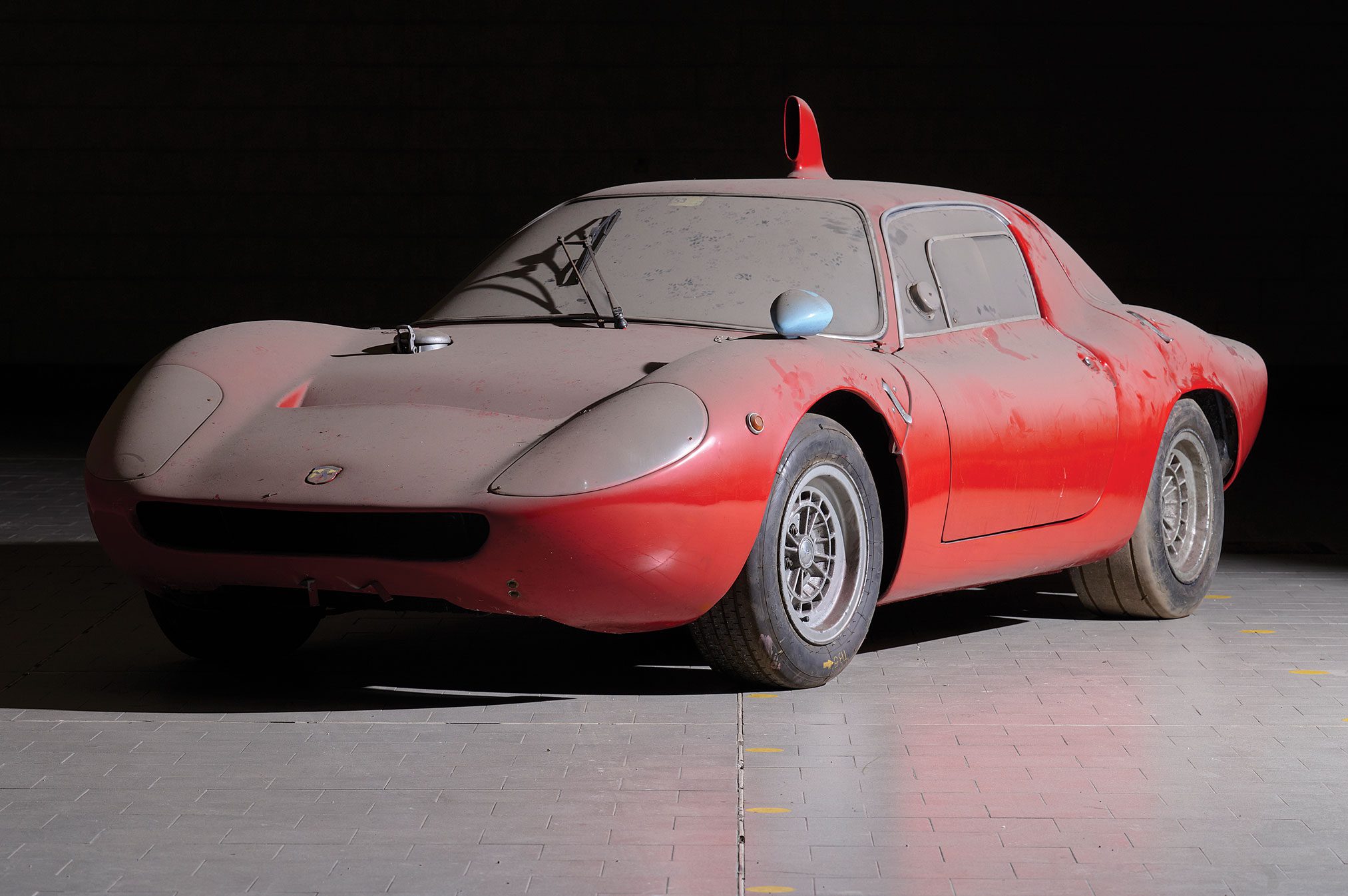
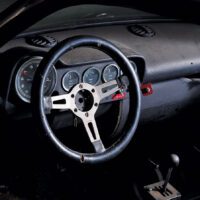
This car, Lot 235, sold for $445,683 (€394,375), including buyer’s premium, at Broad Arrow Auctions’ Cernobbio, ITA, sale on May 24, 2025.
If you didn’t know the background behind it, a 1965 photograph of Carlo Abarth holding a half-eaten apple while casually but confidently leaning on a basket of them wouldn’t be immediately apparent. The story goes that then-57-year-old, six-foot-two Abarth needed to lose a substantial 60 pounds to squeeze into his slender Abarth 1000 Monoposto, with which he hoped to achieve Abarth’s 100th land-speed record. The pre-Ozempic regime proved successful, with Abarth claiming two Class G acceleration records at Monza that year.
That combination of preparation, execution and flair, wrote Don Rosendale in Automobile Quarterly, resulted from a personality combining “Teutonic stubbornness and thoroughness with the frenzied Italian confusion of the Latins around him.” The former came from his upbringing in Habsburgian Vienna, where he was born Karl Abarth six years ahead of the First World War. Interested in all things mechanical, he became an accomplished motorcycle competitor until that career was curtailed by a severe accident just before another war upended Europe.
The Italian job
After several years spent as an engineer in Yugoslavia, Abarth — now Carlo — settled in Torino as a naturalized Italian citizen in 1949. Following a brief stint with star-crossed Cisitalia, he founded his own firm together with former Cisitalia driver Guido Scagliarini. Capitalized by Guido’s father Armando, their core business was mufflers and speed equipment, which, though unglamorous, funded a broad spectrum of automotive adventures, starting with a series of coachbuilt Fiat-powered sports racers in the early 1950s. When the Italian economic miracle encouraged the development of (and demand for) small, affordable vehicles like the Fiat 600, Abarth created the parts that made them faster, eventually putting specific models into production, such as the Fiat Abarth 850 Turismo Competizione, which scored a hat-trick win at the Nürburgring 500 Km in 1961.
Two years later, Abarth secured a lucrative contract from Fiat cousin Simca that supported the development of its own DOHC engine family, achieving an impressive 130 hp in 1.3-liter form when Alfa Romeo’s 1.3 could only manage 100. Placed into Simca’s Fiat 600-based chassis, Simca-Abarths impressively captured nearly 100 racing victories while securing the 1964 Manufacturers’ Division 1 Championship.
Race on Sunday
Simca’s acquisition by Chrysler in 1965 returned Abarth’s focus to Fiat. The learnings from the Simca projects evolved into a series of Omologato Turismo sports racers in a variety of displacements and body styles. Our feature car is one of approximately 50 1.3-liter coupes built for homologation purposes. While early cars, such as our subject, began with Fiat 850 underpinnings, there wasn’t much 850 left after ingegnere Mario Colucci, plucked from Alfa, strengthened the chassis and replaced the 850’s front transverse leaf spring with coil-over springs mounted on A-arms. At the rear, Abarth-designed trailing arms were added. Sinuous coachwork in fiberglass was provided by the small-but-capable local carrozzeria Sibona & Basano.
Impressive results came quickly in the 1966 season with a stunning 1-2-3 class win in April’s Monza 1000 Km and culminating in a Class 1 Championship that year, and in 1967 as well. Along with its light weight, aerodynamic body and revamped chassis, the key to the 1300 OT’s dominance lay with the Abarth Simca-based twin-cam, five-bearing, dry-sump four, producing 147 hp at 8,800 rpm through two twin-choke Weber 45 DCOE carburetors. When the cockpits of early cars were found to be insufferably hot, a “periscopio” roof-mounted air intake improved ventilation and became the 1300 OTs distinguishing appendage.
Sleeping beauty
Our feature car began its racing career at the Targa Florio in 1967 with an auspicious class victory. After nearly 20 years of further competition, it then slumbered for 37 years and was sold in that condition. “Barn finds” like these are fraught with expense, effort and risk. At the top of the punch list, says Abarth expert Antony Berni, will be its bespoke engine: “It’s critical that the block and head are in good shape,” he says. “A spare engine is almost impossible to source.”
Preparing that engine for the sustained operation at its peak output level of nearly 9,000 rpm requires meticulous fettling: “While the original Abarth components are stout, it’s best to consider a new crank, pistons and connecting rods,” adds experienced Italian restorer and vintage racer Santo Spadaro. “The last thing you want is a flawed connecting rod crashing through a priceless original block.”
A down payment
Back in 2016, Gooding & Company sold a 1300 OT at Amelia Island for $506,000 (SCM# 271383) in considerably better condition, though without the Targa Florio provenance. The buyer of this example will no doubt confront many surprises, but a thoroughly documented history of competitive success is a solid starting point.
While recognizing that the considerable initial investment will be followed by a restoration that could itself go well into six figures, this 1300 OT’s illustrious past guarantees an invitation to almost every major historic racing event. And that may well justify the hefty bill for this well-sold example.