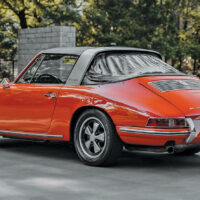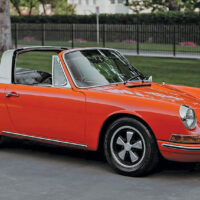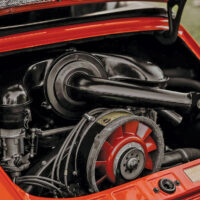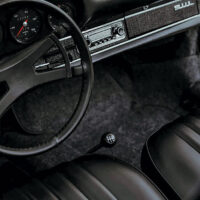
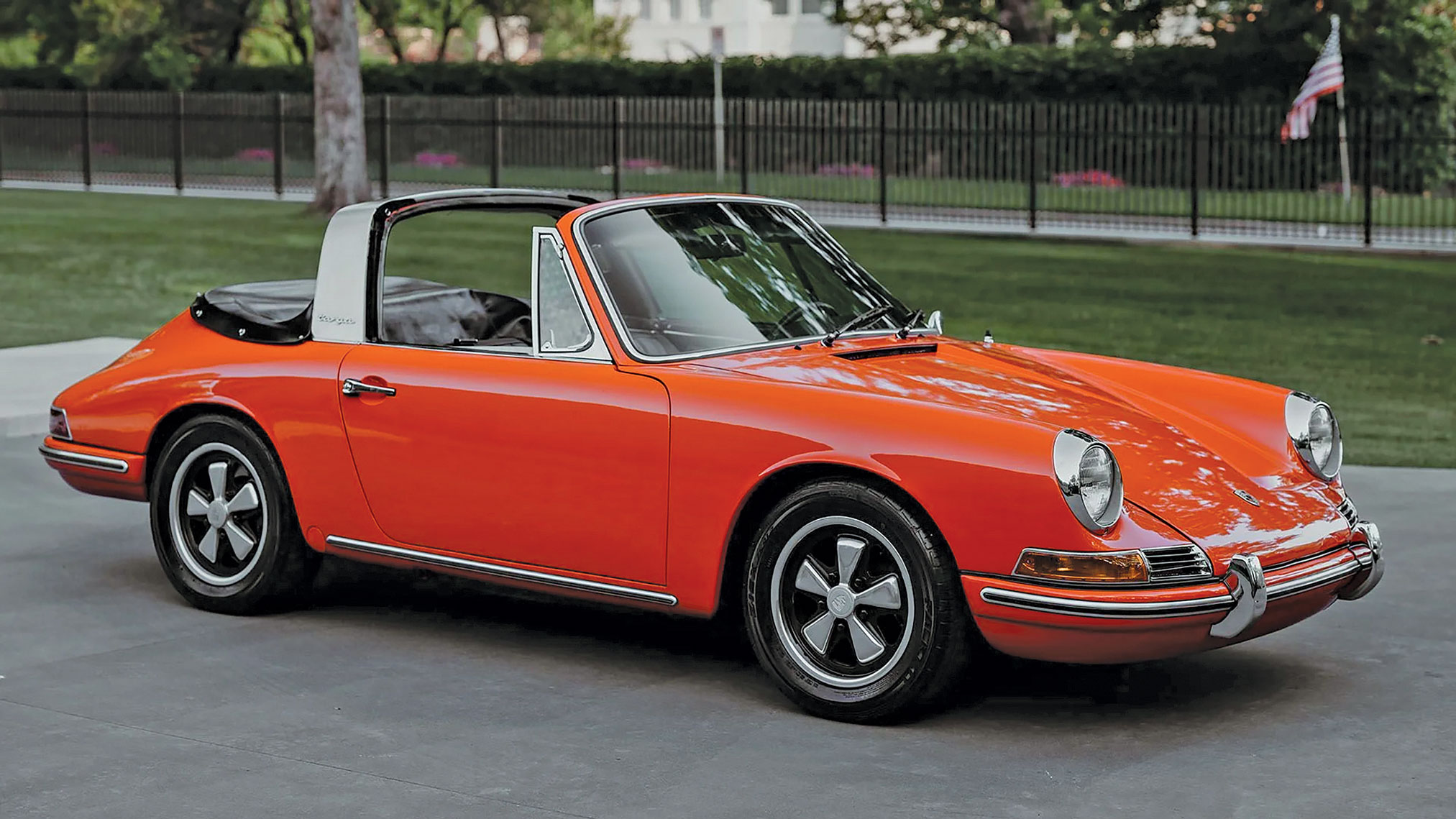
- A matching-numbers example, offered from single-family ownership since 1976
- Presented in the original, as-delivered, striking Tangerine Orange-over-black livery
- Equipped with era-evoking classic Fuchs alloy wheels
- Desirable, limited-production 911L (Lux model) short-wheelbase 911 “Soft Window” Targa
- Offered with a Porsche-issued Certificate of Authenticity and digital copy of its Kardex
- Treated to more than $40,000 in restoration work between 2019 and 2023
Chassis Number: 11860035
| Vehicle: | 1968 Porsche 911L “Soft Window” Targa |
| Years Produced: | 1968 |
| Number Produced: | 441 |
| SCM Valuation: | $100,000–$140,000 |
| Tune Up Cost: | $400 with valve adjustment |
| Chassis Number Location: | Data plate in front trunk near gas tank |
| Engine Number Location: | To right of engine cooling fan, on engine case |
| Club Info: | Early 911S Registry; Porsche Club of America |
| Website: | https://www.early911sregistry.org |
| Alternatives: | 1963–67 Chevrolet Corvette, 1961–75 Jaguar E-type, 1968–71 Mercedes-Benz 280SL |
| Investment Grade: | C |
This car, Lot 101, sold for $81,200, including buyer’s premium, at Broad Arrow Auctions’ Costa Mesa, CA, sale, on April 27, 2024.
Porsche built both coupes and open cars from its inception. Yet from the 1964 through 1966 production years, 911s and 912s were only offered as coupes. Worried about possible restrictions for open cars in the important U.S. market, Porsche searched for a design to protect passengers.
Soft, but safe
Introduced for the 1967 model year, Porsche’s solution was the now-iconic “Targa.” It became quite popular and accounted for about 25% of 1965–73 911 and 912 production. The Targa bar provided structural rollover protection under its brushed-stainless-steel cover. The removable roof folded and fit neatly in the front trunk or the rear seat area. The rear window was clear plastic, as used in most convertibles. To tension and release it, two chrome levers were provided on the interior edge of the Targa bar. The rear window could be easily zipped or unzipped once the levers were eased. When the top is stowed and the rear window folded down, a Targa delivers a wonderful open-air motoring experience with all the sound and fury of a convertible.
In 1968, an optional fixed-glass rear window was introduced and proved popular. It was made standard in 1969 and the soft rear window became an option. There is no doubt the glass rear window is more practical, but the soft rear window is more fun. That fun only lasted for two years, 1967–68, as by 1969 just a handful of “Softies” were built.
The L anomaly
In 1967, the 911S was introduced with 160 horsepower versus 130 for the base-model 911. With the onset of tighter emission controls in 1968, the 911S could not be imported into the U.S. Enter the one-year-only 911L. It is a 911S in all ways except the engine. This included the big S brakes and a host of other S equipment, such as the one-year-only 5.5-inch-by-15-inch forged Fuchs alloys, a 5-speed transmission and special trim items.
All U.S.-bound 1968 Porsches had side-marker lights on the front fenders and rear quarter panels. Porsche redesigned the taillamp and front turn-signal housings in 1969 to eliminate these separate lights.
This 1968 911L codes as a “Rest of World” model, which avoided the clumsy side lights. Many 1968 Porsche owners have removed these, a modification I heartily endorse.
Interior door panels on 1968 models are different from any other year, with a single folding pocket for maps, gloves and sundry small items. All that would change with the first long-wheelbase cars in 1969.
Rare fruit
This short-wheelbase Tangerine Orange 1968 911L Targa is indeed a rare item, but it takes more than rarity to bestow a high value. This car presents well, with good panel gaps and its correct original engine. The color is considered unusual, and most people find the red/orange shade appealing. The biggest selling point remains the soft rear window.
For years, soft-window Targas were rarely seen on the road, at shows or at swapmeets. But for those intrigued by “something completely different,” the soft Targa is now a fairly regular guest of honor. This special club isn’t for everyone, as many still like the lines of the coupe better. But with the top off and the rear window down, you have the closest thing to an open Porsche prior to the 1983 911SC cabriolet.
The price paid is on the money for a condition-2 SWB 911L soft-window Targa. It’s neither a “survivor” nor a concours-winning paragon of perfection. If it runs as well as it looks, along with the fact it has been in one-family ownership for the past 48 years, this could be an ideal way to have an unusual car that you can actually drive.
If you feel the 130-hp 911L (the same engine in base models of all SWB 911s from 1965 to ’67) can’t possibly be fun to drive, that’s only because you haven’t driven a good one. These early short-wheelbase 911s are notoriously hard to get right. Yet when everything is working as intended, you’ll discover exceptional response at all legal speeds. If you regularly drive above 85 mph, later 911 models are better for that. But for driving on regular roads at reasonable speeds, well-sorted SWB 911 cars are a joy.
If it doesn’t impress on your first drive, worry not. Find an experienced mechanic and start the search for that magic blend of lightness and mid-range punch that makes an early 911 such a delight. Yes, it could take some time to uncover, but the outcome will be well worth the effort. ♦
(Introductory description courtesy of Broad Arrow Auctions.)