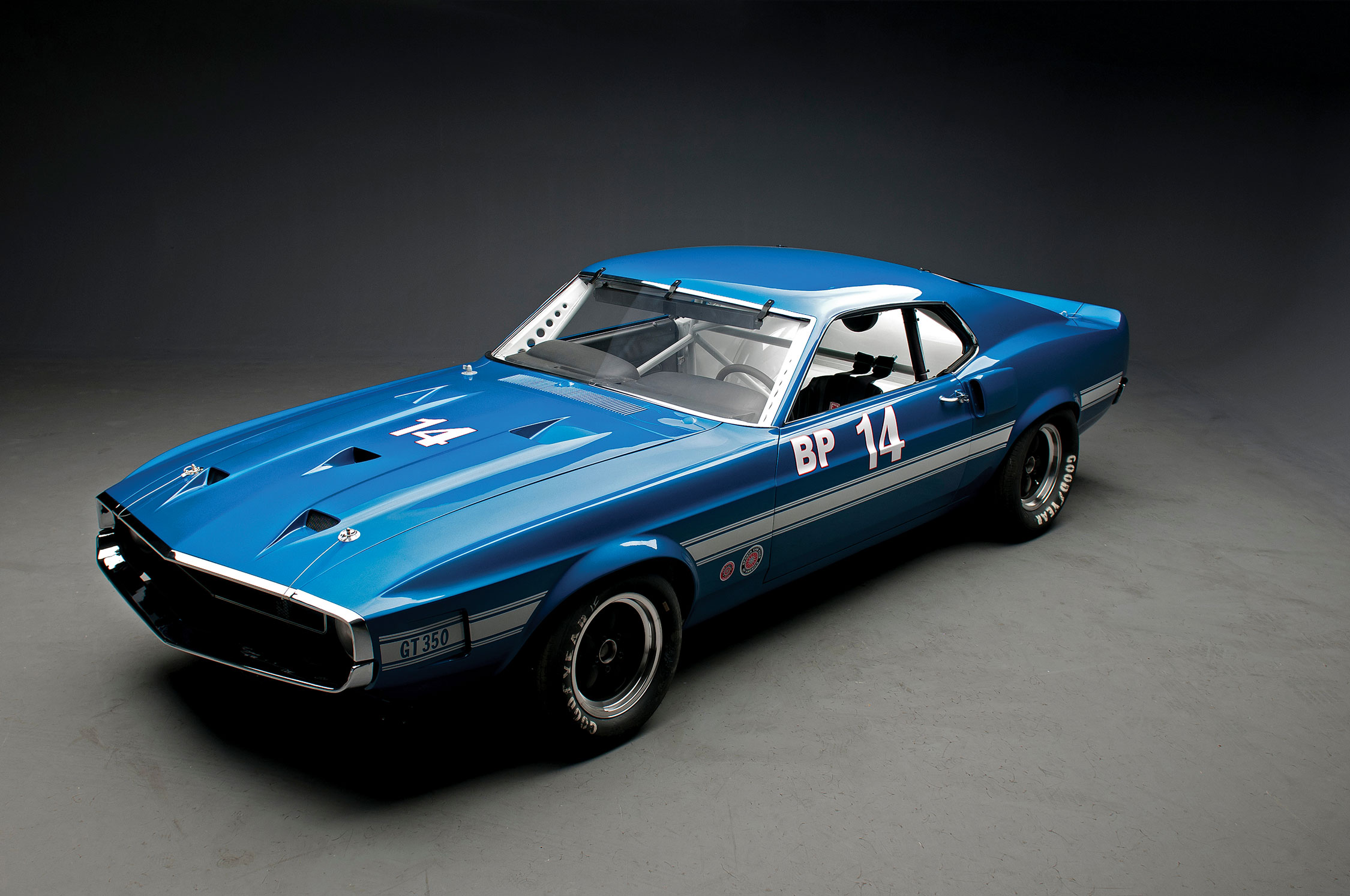
This car, Lot 171, sold for $168,000, including buyer’s premium, at RM Sotheby’s Phoenix, AZ, sale, on January 25, 2024.
Regular readers of my profiles know that I frequently dwell on “collector” versus “weapons” values in any old racing car. Some level of each exists in any example, and understanding how they interact is useful to establishing how the market responds to a car.
The range is illustrated on one end by a Ferrari 250 GTO, which is 99% collector value. On the other end, for example, a race-prepared MGB’s only real value is how much fun you can have racing it. Competition and collectible Mustangs are a more complex topic than you might think, so we will need to spend some time in the weeds figuring out which is what before trying to make sense out of today’s topic.
Mr. Shelby’s Mustangs
Ford’s original concept for the Mustang was anything but a performance or racing car. It was supposed to be a small, inexpensive and economical youth-market car when it was introduced in late 1964. It was an immediate success. When a fastback model was introduced in 1965, Carroll Shelby quickly realized that it could be the basis for a serious sports and racing car.
Shelby had established himself with the Cobra and set up a production facility in Southern California. Ford was game to join him in his quest. For the 1965 and 1966 Shelby GT350 Mustangs, Ford shipped bare K-code fastbacks to Shelby, who completed them, with no rear seats. All first-generation GT350s are very collectible, the pinnacle being the GT350 R team racing cars.
For the 1967 model year, Ford enlarged the Mustang, making it longer, wider, heavier and more luxurious inside. This was not consistent with Shelby’s vision, and though the GT350 model survived, it had little to do with Shelby, becoming more of a performance-image 4-seater Mustang than a fire-breathing racer. This continued through 1968.
For 1969, the Mustang was again made bigger, and Shelby himself was out of the picture. Ford sold the GT350 with a 351 “Windsor” V8 and the GT500 with a 428 “Cobra Jet” engine. The GT500 was good at the dragstrip, but the GT350 had long abandoned road racing to be more of a sporting cruiser.
Horses for courses
Next, we need to talk about American road-racing groups and classes. SCCA production-car racing in those days was for sports cars, defined as having two seats. The 1965–66 Shelby GT350 was thus a sports car and raced against Corvettes and the like. There was a parallel but separate class for sedans, which took off as the professional Trans-Am series beginning in 1966, using a 5-liter-displacement limit.
Ford committed to Trans-Am, but with the 4-seat notchback Mustangs, not GT350s. In 1969, Ford introduced the “Boss 302” specifically for Trans-Am competition. It was the first fastback Mustang in the series. The “golden era” of Trans-Am lasted through 1972, and race cars from that era are very collectible. After 1966, SCCA production-car racing was strictly amateur, and such cars are now just old racers.
So, the serious (and collectible) Ford racers were the 1965–66 Shelby GT350s as B-Production sports cars, with the Trans-Am 1966–68 notchback Mustangs and the 1969–72 fastback Boss 302s also very desirable. You may note that the 1969 GT350 isn’t on this list.
Buy it to drive
Our subject car was originally a 1969 GT500 (with a 428-cubic-inch engine) that was stolen and wrecked, then showed up as a GT350 B-Production SCCA racer in 1973. Weird though it seems, the rules for B Production required the ’69 GT350, which came with a 351-ci engine, to race using a 302. It was, however, allowed to be 1,000 pounds lighter than the production car.
Though this car became a racer immediately post-junkyard, and thus spent most of its life on race tracks, it was never more than a mid-level California club racer. Nobody famous ever drove it, and it has no glorious victories to claim. On top of that, it has a donor chassis, more engine swaps than anyone can count, and few, if any, of its original parts. It’s just an old racer, all weapons value with effectively zero collector appeal.
That said, it appears to be an absolutely gorgeous and beautifully maintained race car. It has been a West Coast vintage racer for years and is familiar to its competitors. It is a known quantity; probably not the fastest car in the fleet, but in this sort of vintage racing, finishing position has more to do with the driver than the car. There is no doubt that the previous owner has spent stupid quantities of money keeping it in the best possible condition.
There is a truism that “the cheapest thing you will ever do in vintage racing is buy the car,” and it is useful to keep in mind when considering this sale. Assuming the purchase is rational, and you don’t destroy the car in the process of racing it, these cars maintain a certain core value when it comes time to sell. You can typically get most of your capital back; it is the cost of racing and maintaining the car that will eat you up.
My conversations with others in the business suggest that this car sold for maybe $25k–$35k more than you would expect for a pure weapons-grade ’69 Mustang racer, but the apparent impeccable quality of this car may well justify the top-dollar result. There is a “pay me now or pay me later” component in this hobby, and if the new owner can have a full season of racing without major issues, any pain from the winning bid will be happily forgotten. Though expensive, this car was rationally bought. ♦
(Introductory description courtesy of RM Sotheby’s.)