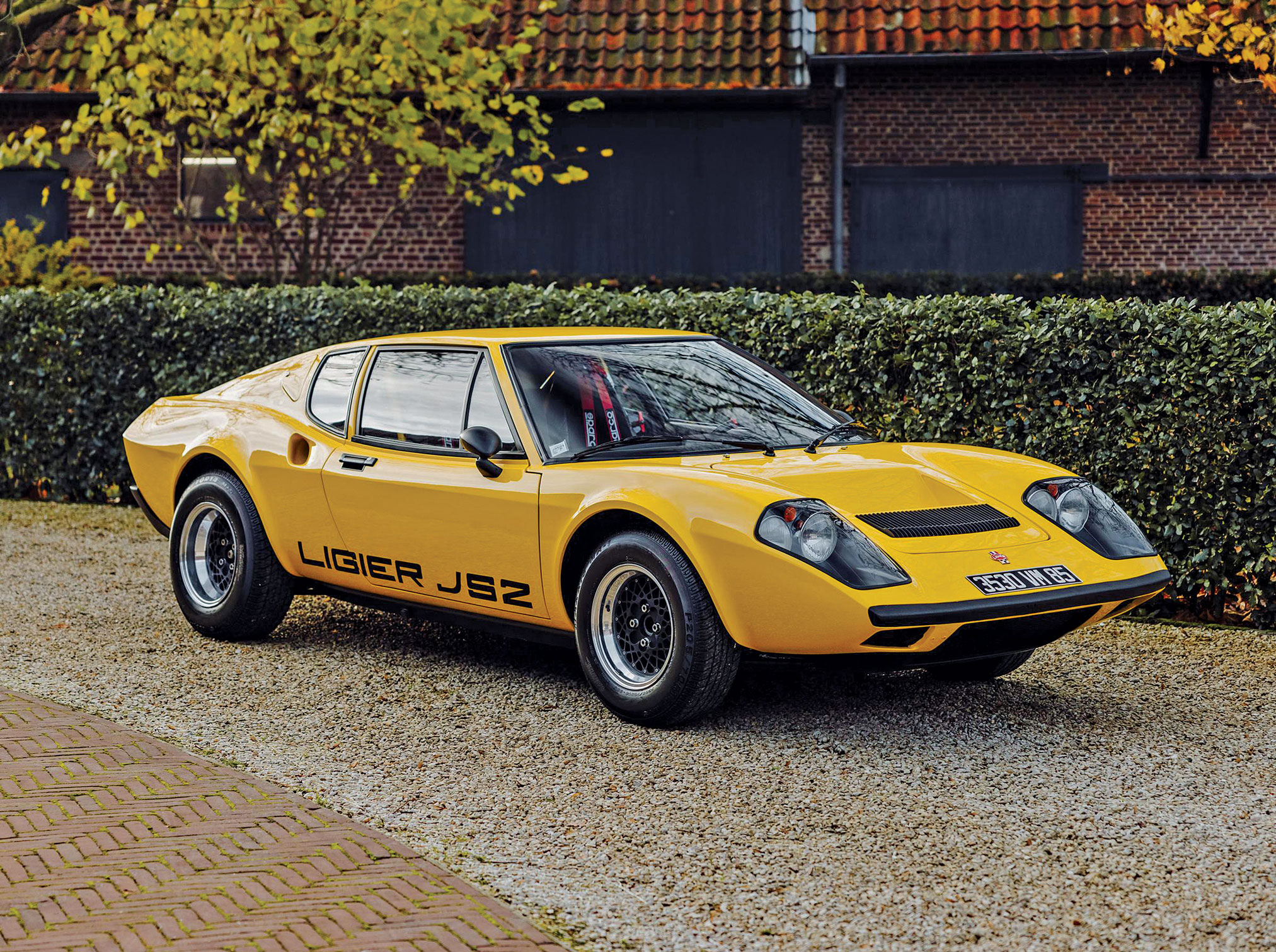
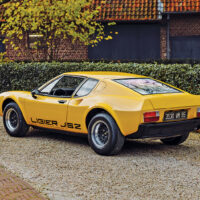
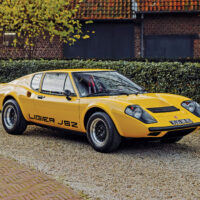
This car, Lot 154, sold for $92,929 (€89,700), including buyer’s premium, at Bonhams Cars’ Paris, FRA, auction, on February 6, 2025.
Guy Ligier, a French orphan and self-made man, was initially a butcher’s apprentice, then a high-level rugby player, a competent racer and a road-construction magnate in his native country. Ligier decided to create a sports car using the initials of his late race-driver friend and former teammate, Jo Schlesser. A factory was set up in Abrest, and Ligier gave engineer Michel Têtu a precise brief: great handling and light weight in an efficient mid-engine package. Italian coachbuilder Frua was hired to design the body.
One man’s dream
Têtu used a backbone-style chassis, similar to Lotus cars of the period. To avoid the cost of honeycomb panels, the chassis was assembled in a sandwich method of steel and polyurethane foam clad with sheets of aluminum alloy. The overlaying body panels were formed in fiberglass.
The suspension was Têtu’s masterpiece, comprised of double wishbones all around, with extensive movement. Damping was fastidiously adjusted and mated to purposefully soft anti-roll bars to allow each wheel to work without interference from the others. This was key to the JS2’s brilliant handling on Europe’s twisty and bumpy back roads, those that unsettle so many supercars with their low-profile tires and track-oriented suspension. Twin fuel tanks were located in a central location between engine and cockpit.
Power was to be supplied by the 2.6-liter V6 from the Ford GT70. Initial tests used this engine until Ford canceled the GT70 program and with it, Ligier’s supply deal. This was, in fact, a blessing, as the Ford V6 had a rather high center of gravity. The 5-speed gearbox came from the Citroën SM, being the only one that would fit.
Meanwhile, Ligier’s road-construction company went bankrupt, but he still built a one-off JS3 prototype racer for the 1971 24 Hours of Le Mans. Despite severe technical issues during the race, the car’s performance and popularity impressed Citroën. It was persuaded to provide the 2,670-cc Maserati V6, also used in the SM, with a reversed final drive. At under 2,400 pounds, the JS2 was a far lighter car than others that used this same powertrain. From 1973 onwards, new JS2s were upgraded to the 3.0-liter version of the V6, as fitted in the Maserati Merak SS.
Short-lived victory
The production Ligier JS2 made its debut at the 1971 Paris Motor Show. Press reviews were good and sales were decent, but the spartan nature of the car and fiberglass body did not appeal to everyone. On the road, the JS2 is a purist, bare-bones driver’s tool. Think of it as more of a rally car. Handling is its forte, as opposed to power, and it is a real delight to drive, truly made for the traffic-free curves of the hilly roads that are so abundant in Europe. The suspension with its ample and precisely controlled movement lends it incredible poise and confidence.
As proof of the JS2’s excellent handling, it won the Tour de France in 1974 with Gérard Larrousse. Another came 2nd at Le Mans in 1975, albeit with a Cosworth V8 (Maserati had been temporarily shuttered following the energy crisis).
But Guy Ligier acted in business like he did in rugby — abruptly. In 1975, when sports-car sales were weak in Europe, he obtained financing to start his Formula 1 team. The road-car operation was shut down overnight, leaving hapless JS2 clients to fend for themselves.
Rare everywhere
The catalog reference to a 250-car production run is erroneous — just 82 were built. Of these, only about half survive today, as many fell into the wrong hands, being trashed and crashed through the 1980s. Half again are non-driving projects, so that gives you a pool of roughly 20 runners, plus some restorations in slow progress. Therefore, when one comes up for sale, it is an event.
Your author was fortunate to drive two JS2s — and sell three. Mine were an early car with covered headlights, the first of the seven Series 2 models with retractable headlight covers, and a hillclimb racer, heavily modified in-period. As rare as these cars are in Europe, they are even rarer in the U.S. One is confirmed, a second-series car which I sold to a friend in Silicon Valley in 2021. According to the late Citroën SM expert Jerry Hathaway, a second JS2 has been rumoured to have been tucked away in Texas for decades.
A declining market
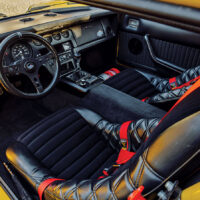
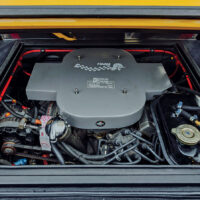
Our subject car was well known in western France, owned by a notorious and thrifty tinkerer. It had a rear-end fire at some point, though the extent of the damage is not known. Upon examining it in the Grand Palais during Bonhams Cars’ preview, it was clear that the car had been extensively restored by one of its two last owners. It is the best, most attractive JS2 I have seen, cosmetically. It has a full roll cage, race harnesses and a homemade plexiglass partition between the cockpit and engine bay. This modification allows removal of the engine cover on summer days, which helps cool the engine bay and avoid vapor lock, a known issue. The car was displayed with the engine cover on, though catalog photos show a non-original airbox.
The three JS2s I sold previously were around the $130k mark, a price level accepted by those in the know. The lower price for our subject car is just a reflection of the current market. In fact, I have had a JS2 for sale for a year now, whereas the three previous examples sold quickly.
Note that Bonhams offered the car at no reserve. That’s a fairly new concept to European sellers who are reluctant to accept both it and the reality of the current market. In the end, the seller — who was divesting himself of a vast collection at this auction — was pragmatic. His focus on the total result rather than individual values allowed the buyer to get a lot of car for his money here.