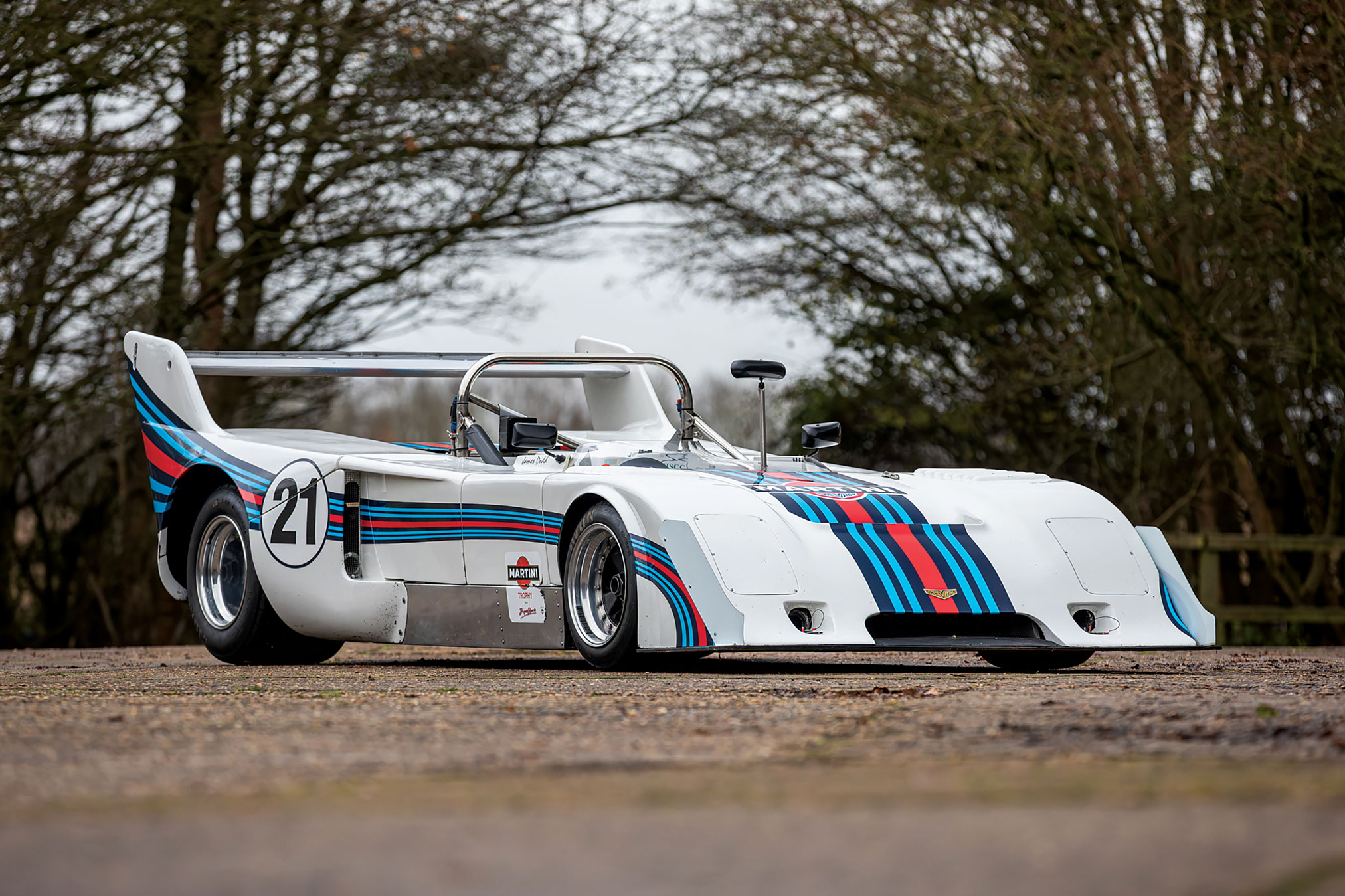
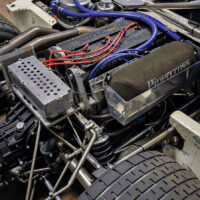
This car, Lot 720, sold for $121,397 (£95,625), including buyer’s premium, at Iconic Auctioneers’ Northamptonshire, U.K., sale, on February 23, 2024.
In the evolution of racing cars during the 20th century, arguably the greatest technological leaps occurred during the 1960s. Beginning the decade with almost exclusively front-engine, rear-drive racers with tubular frames and tall, skinny tires, by the end we had monocoque mid-engine construction, wide, low and sticky tires, aerodynamic sophistication and modern four-valve racing engines. We marvel at how this revolution took Ferrari 250 TRs and gave us 5-liter Porsche 917s and 8-liter McLaren Can-Am racers, but it is easy to overlook that the same dramatic changes happened in small-bore racers.
The Maserati Birdcage was state-of-the-art in 1961, with a 200-hp twin-cam 2-liter engine driving 4.5-inch-wide wheels in a 1,300-pound tubular-framed racer. In 1969, Chevron introduced the B16 with a 265-hp 1,800-cc Cosworth engine in a monocoque chassis using 8.5-inch-wide front tires and 13-inch-wide rear tires, all with about the same weight. In under 10 years the racing world had changed forever.
Small but mighty
Colin Chapman of Lotus had, in a practical sense, invented the monocoque-chassis racing car with the Lotus 25 (yes, Jaguar did it first with the D-type), but chose not to get involved in small-bore sports racing cars. That was left to Lola and Chevron on the English side, and to Porsche and Osella on the Continent. Our topic today is Chevron, specifically the 1975 evolution of the B16: the B31.
The tube-framed, BMW-powered B8 coupes had carried Chevron successfully through the middle 1960s, but by 1968 technology had changed. Derek Bennett started with a clean sheet of paper and designed the B16 using a combination of monocoque and tubular chassis, the new Cosworth FV racing engine, and wide 13-inch wheels with sticky tires. The purpose was FIA GT racing, so it was designed as a very slippery coupe. It was successful out of the box, with Brian Redman convincingly winning at Nürburgring.
The problem was that with Porsche’s careful reading of the rules and subsequent introduction of the 917, the big-bore show in GT racing left limited interest in the 2-liter class. Happily, this corresponded with the establishment of the Can-Am series in the U.S.; it was primarily geared towards unlimited sports racers, but the support series was for 2-liter cars.
This created a great market for both Chevron and Lola. Bennett proceeded to take the body of his B16 and replace it with an open-cockpit version blatantly copied from Porsche’s 908/3. It was the B19 and was a fabulous thing to race, with a stiff chassis combined with huge stick and a light, nimble feel. I drove one some years back and was stunned by its performance. The B19 evolved into the B21 of 1972 and the B23 in 1973. Together these comprise the second and most successful generation of Chevron sports racers, with 89 cars built.
Beginning in 1973, the Arab oil embargo had a huge impact on motorsport. With gasoline increasingly unavailable, racing was one of the first casualties. Bennett went ahead with a new design anyway, a full monocoque chassis with integrated wings and aero devices, now using the Hart 420 engine (an alloy-block evolution of the Cosworth). It was called the B26, introduced for the 1974 season, and was substantially quicker than the earlier Chevrons. There was little market, though, and only nine were built. This was updated to the B31 for 1975 with six sold, including our subject. The B36 of 1976–78 was another evolution, with 21 built before Chevron closed its shops.
Rare in the U.S.
I should mention here that in its history, Chevron never built a street-legal car. It started with the Clubman and GT cars then moved to mostly formula racers along with two more generations of GT and sports racing cars before Bennett was killed in a paragliding accident and the company folded. As a result, the company is little known except among racers, and with the arguable exception of the B16 (because it is so freakin’ gorgeous), there is no such thing as a collectible Chevron.
That said, all Chevrons, particularly the second- and third-generation sports racers, are fabulous things to drive, being amazingly nimble, fast, stable and forgiving. In the day, even as 2-liter cars, they were regularly mixing it up with Porsche 917s and Can-Am racers. I recall watching a vintage race years ago at Road Atlanta, where Brian Redman in his B19 humiliated a fleet of 8-liter Can-Am racers. These cars can be frighteningly fast. For various reasons, mostly having to do with getting enough to enter and make a good race, the market for these cars is almost strictly in Europe. It is unusual to see more than a few show up at even important U.S. events.
Bargain buy
This brings us to the issue of selling pure race cars at auction. Generally, it doesn’t work. A purchase decision for a car that you are going to race at 150 mph is a fraught situation. These cars are expensive to race and maintain, and a failure at speed can be expensive, painful or both. The decision requires thought, careful consideration and confidence in what you are buying — none of which are available to obtain in the two minutes or so that a car is on the block. The result is that an auction will almost never return what a reputable broker can achieve. Though not great for sellers, it can be an excellent opportunity for a knowledgeable buyer.
The auction catalog did not speak to any period provenance or history for this car, though it assured us that it was in excellent condition. A quick troll through the internet tells me that it was the most heavily used B31, with 59 starts in the era. It raced from 1975 to at least 1984 with Hart 420, Cosworth DFV, and BMW M12 engines in a rainbow of different colors, but never with a famous driver or great result. It then sat for probably 25 years before being revived as a vintage racer (with pretty but incorrect livery) and used a lot until maybe 10 years ago. None of this inspires an aggressive bid.
My sources tell me that these cars used to sell for up to $250,000 but are now selling around $200,000 for the best and $125,000 or so at the bottom. Though heavily used, this appears to be a much better car than the price received would suggest. I would say it was very well bought. ♦
(Introductory description courtesy of Iconic Auctioneers.)