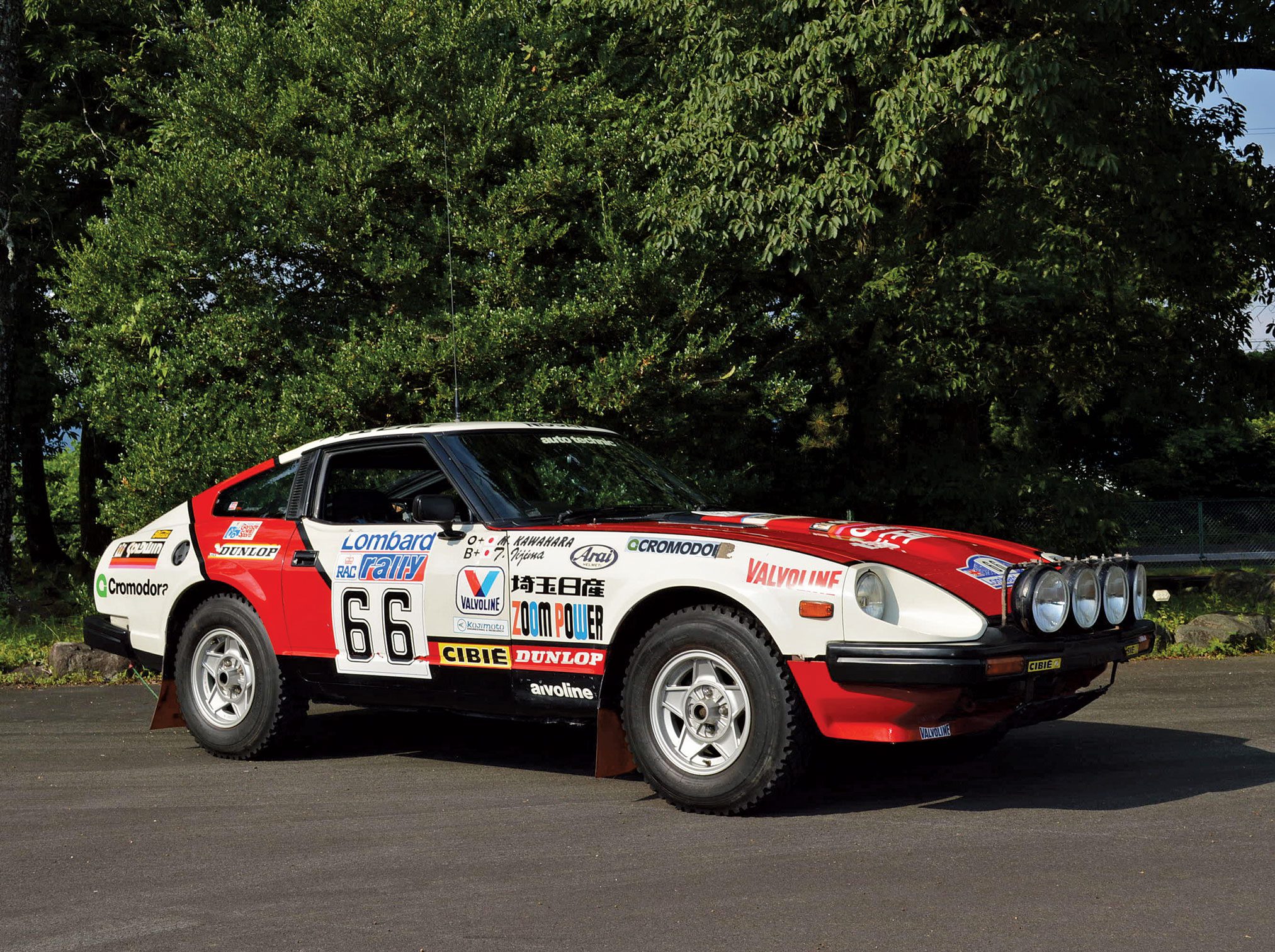
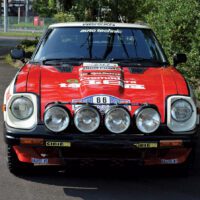
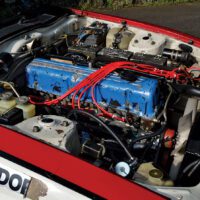
This car, Lot 115, sold for $46,720 (£34,500), including buyer’s premium, at Bonhams Cars’ Chichester, U.K., auction on September 13, 2025.
Not even 50 grand for a historic Nissan Fairlady Z that was built in-period and raced in the World Rally Championship? This was a seemingly disappointing result, but there were many factors that contributed to such an outcome.
Xtra luxurious
The 280ZX (chassis code S130) was released in late 1978 as the second-generation Nissan Z car. Here was a complete redesign of the discontinued 280Z, with a new focus on luxurious appointments over the rawer sporting experience earlier Z cars provided. In the U.S., the cars were branded “Datsun by Nissan” as the sun was setting on the Datsun moniker. In Japan, the cars retained their Nissan Fairlady Z badging.
The 280ZX was a 2-door liftback coupe available with two seats or as a 2+2. Suspension was independent all-around, with MacPherson struts up front and semi-trailing arms at the rear. Stopping power was excellent, with disc brakes at all four corners. Nissan focused on improving aerodynamics and weight distribution while lowering the car’s center of gravity.
Naturally aspirated U.S. cars came with the 2.8-liter inline 6-cylinder L28E engine producing between 135 and 145 hp, while the 280ZX Turbo produced 180 hp. Buyers in Japan had their choice of the L28E or the 2.0-liter inline-6 L20E.
The 280ZX was a lively performer and was named “Import Car of the Year” by Motor Trend in 1979. This was quite an honor, but few could have envisioned this plush new car as a serious racing weapon. Paul Newman understood the car’s potential and won the 1979 C Production SCCA National Championship driving a 280ZX. Others followed in Newman’s tracks, with these cars scoring an incredible six SCCA National Championships in the 1980s. Additionally, Electramotive captured the IMSA GTU Championship in 1979 and 1980 and followed it up with IMSA GTO Championships in 1982 and 1983 in a 280ZX Turbo.
Twisted history
That’s all well and good, but what about rally racing? For more than 50 years, a curious mythology has existed in the car hobby regarding Z cars and rallying. Whereas the folklore proclaims the supremacy of these cars on the rally stage, a careful analysis reveals much of the mystique was created by Nissan’s marketing department.
Here are the facts. In 1971, Edgar Herrmann won the 19th East African Safari Rally racing a Japanese-market Fairlady Z. In 1973, the World Rally Championship (WRC) series was introduced, and Shekhar Mehta drove a left-hand-drive 240Z to an overall victory in that year’s Safari Rally. This historic win represented the first and only time a Z car would win a WRC event.
The 280ZX was not a successful rally car and that includes our subject example, which competed as a privateer entry in some WRC events without getting anywhere near the podium. Whereas the auction catalog characterized its primary driver, Masaaki Kawahara, as a “renowned rally legend,” he is more accurately described as one of many experienced drivers who were not winners in the WRC series.
Limited collector appeal
The most likely factors contributing to what gives the appearance of a disappointing result were an unrealistic estimate, poor overall auction results, our subject car’s presentation and simply that demand for such a car is low.
No-reserve auction lots tend to create excitement in the marketplace, but not when the estimate range is well beyond buyers’ expectations. Such was the case with our subject car, with a pre-auction estimate of $81k–$108k (£60,000–£80,000).
Of the 73 cars that crossed the block here, 46 sold (63%). Of the cars that found a new owner, most sold below the low estimate. This suggests that the estimates here were too high, which likely inspired bidders to sit on their hands. In general, when an auction is not going well, most lots suffer to some extent.
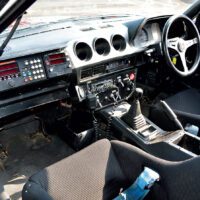
In addition, the catalog description of our subject car failed to discuss its mechanical condition, did not mention if the car was in running order, and the photography available online did not instill much confidence. Finally, the answer to the question, “Who wants to own a 1979 Fairlady Z Rally Car with unimportant history?” has been answered — almost no one.
Today, 280ZXs, as well as Japanese-market S130 Fairlady Zs, are slowly gaining interest. Excellent examples are now fetching $30k to $40k, while Anniversary Editions and Turbos bring even more. Interesting cars of all types with rally history — especially WRC heritage — generally sell for multiples of their street-machine counterparts, but that was not the case with our subject car. Although it did compete in some WRC events, this generation of Nissan Z was never successful, and the principal driver is unfamiliar to most in the hobby. Our subject car did not excite JDM or rally-car collectors and it therefore sold for 280ZX Anniversary Edition dollars.
In 1973, Secretariat won the Kentucky Derby in record time on the way to capturing the Triple Crown. The world has never forgotten him, but does anyone remember the also-rans who finished at the back of the pack? In many ways, our subject car is a forgotten racehorse. It was fairly bought and sold.