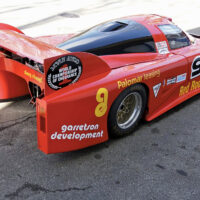
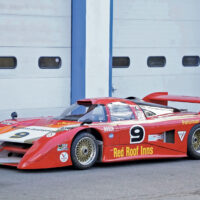
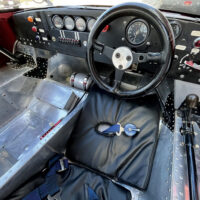
This car, Lot 166067, sold for $304,500, including buyer’s premium, on Bring a Trailer’s online auction on October 12, 2024.
March Engineering was a race-car constructor formed in 1969 by an ambitious group in Bicester, England, that planned to take the motorsports world by storm building off-the-shelf racing cars for purchase. Its first effort, a single March 693 (1969, Formula 3) was short-lived. But in 1970, production and reach expanded dramatically to include chassis for Formula 1, F2, F3, Formula Ford, and Can-Am. Junior formula success, a string of F2 championships and even a few F1 victories followed over the next decade.
By 1982, however, March’s fortunes in European open-wheel racing, its bread-and-butter market, had faded. March turned to other categories, in particular IndyCar, where it did well, building 29 of the 33 starters at the 1984 Indianapolis 500, and winning that race five times on the trot.
Concurrent with this new focus, March had also returned to big-bore sports-car racing in the U.S. In 1981, March designed a prototype for BMW North America, the M1/C, to explore the nascent Group C and IMSA GTP categories. This program failed for lack of an appropriate engine; the initial normally aspirated inline-6 in the car lacked power, the subsequent turbocharged Formula 2-derived 4-cylinder was unreliable, and the F1 engine was still in development. With that, BMW’s GTP program was canceled.
Meanwhile, March had already reconfigured the M1/C’s aluminum honeycomb chassis to accommodate a variety of engines that would appeal to a broad number of potential customers. This is where our subject car’s story begins.
A troubled year
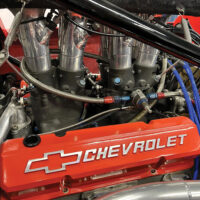
Garretson Enterprises purchased March chassis 82G1 (representing 1982, GTP, chassis number 1) and campaigned it from its base in Mountain View, CA. Benefiting from Chevy V8 powerplants built by longtime Chaparral engine man Franz Weis, the car was fast from the start. In early testing at Laguna Seca, it was more than 3-seconds-per-lap faster than the also-brand-new Chevy-powered Lola T600. Post-test, however, the team found unusually high wear in the gearbox — a portent, as it would turn out.
After starting from the pole at Daytona, the left front suspension upright broke just several hours in. Back in the hunt with seven hours to go, 82G1 retired for good with a broken gearbox. The next race at Sebring was even more fraught. Incredibly, the car finished in 2nd place with only first and third gears working, but still on the lead lap less than a minute behind the winner.
A few DNFs later, the chassis was sent back to March and prepared for Le Mans. In the race, extinguisher residue from a flash fire found its way into the fuel system, clogging the car’s fuel filter and splitting the fuel tank, forcing another retirement. After five DNFs in six races, the car was sold. It raced three more times through 1986 and was then stored for nearly 25 years before being restored.
Buy it to fly it
For additional perspective on this car, I spoke to the man who first raced it, Bobby Rahal. The Indy 500 winner piloted several contemporary GTP cars between his CART commitments, vividly remembered 82G1 as “having the potential to dominate but need[ing] more development and investment.” When asked how the March and other GTP cars compared to the dominant Porsche 962, he said, “The 962 was easy to drive; fast, reliable and, well, it just didn’t do anything that surprised you. No one thing stuck out. It was already developed — a complete car. The others were more developments on-the-go.”
For these and other reasons, not least the Porsche pedigree, most 962s sit in the upper part of the GTP pricing pyramid. At the top would be Al Holbert’s 962-103, a factory-built car with two Daytona 24 victories, three consecutive GTP championships, all-star co-drivers, and still wearing its iconic blue-and-white Löwenbräu livery. It sold in 2012 for $1.9m (SCM# 196897) and would likely be $3m–$4m now if it were for sale.
Next in the hierarchy are the Tom Walkinshaw-built Castrol Jaguars (up to $2m), followed by other factory-built 962s with good histories ($1.3m–$2m). Then privateer-built 962s, the Dan Gurney AAR-built Toyota Eagles, Rick Hendrick’s Corvette-Lolas, and Electromotive Nissan-Lolas ($750k-$1m), with Group 44 Jaguars ($400k–$700k) filling out this middle tier.
At the bottom are cars like March and Spice GTPs, and customer Lolas, which trade for $250k–$300k, plus or minus. They’re interesting enough, but not special. However, they are very capable on track and frighteningly fast. They have a singular purpose to win races; or, as my SCM colleague Thor Thorson says, they are “weapons-grade,” not collector-grade.
Some work required
Our subject car had a short but interesting history, some fleeting success, a world-class driver regularly gracing its cockpit, and a refurbishment by a period March GTP crew chief who knew these cars well. All these factors confer extra value, but this car reportedly has not been on track for at least 12 years. That will require many thousands of dollars of inspection and refreshing — and that’s assuming the engine is sound.
Our subject car has also been across the auction block three times in the past seven years, including a $220k sale at Mecum’s 2020 Kissimmee auction (SCM# 6927588), and savvy buyers notice “frequent flyers,” which sometimes become viewed as commodities. With the pluses offsetting the minuses, this racing weapon looks fairly bought and sold. ♦