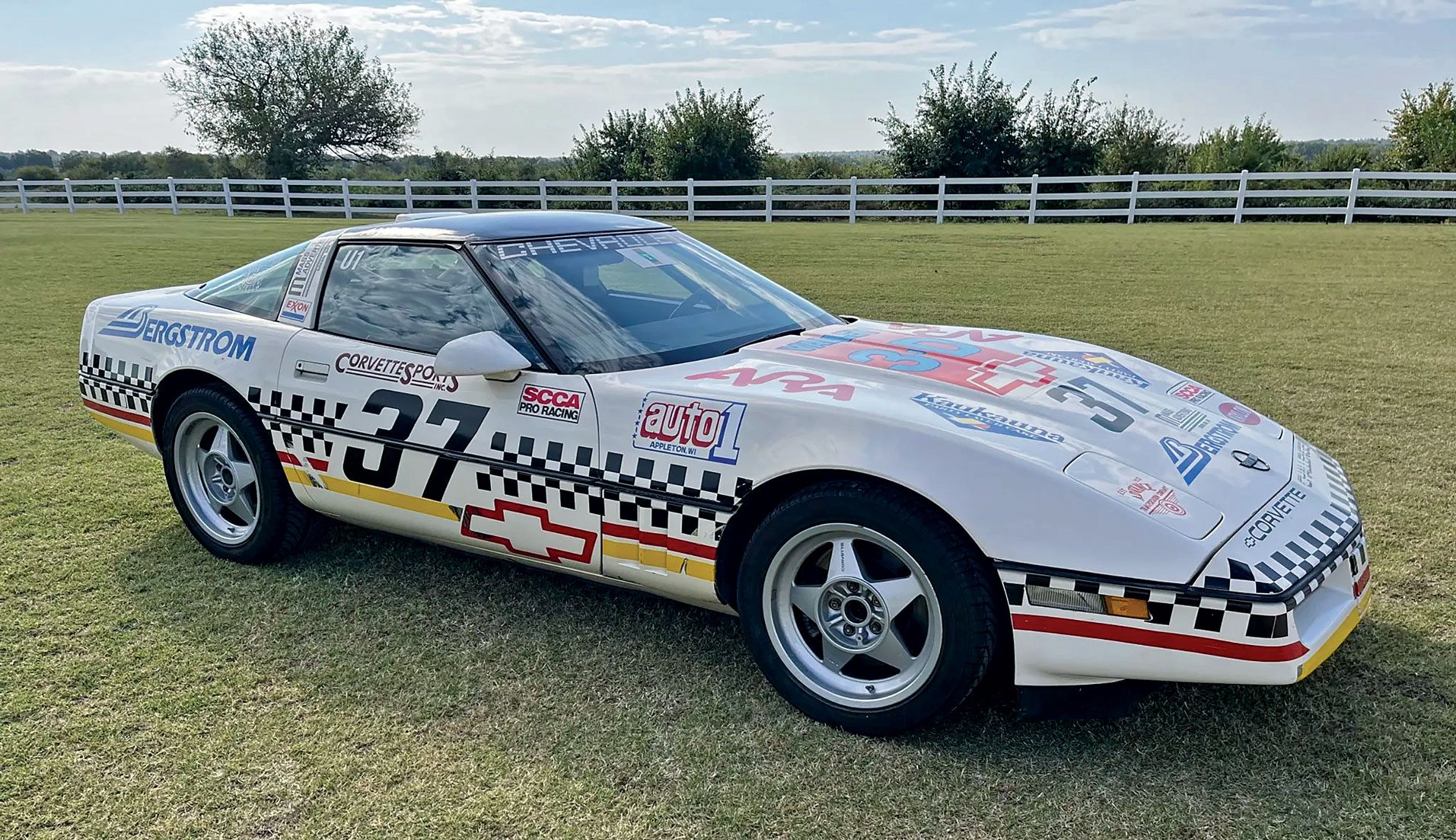
This car, Lot 199493, sold for $31,500, including buyer’s premium, on Bring a Trailer’s online auction on July 7, 2025.
Chevy’s C3 Corvette started out strong in 1968 with curvaceous styling, svelte chrome bumpers and as much as 430 horsepower from 427-ci L88 models. A decade later, the ravages of time and regulation had caught up with it. With just 185 hp from the 1978 Corvette’s neutered L48 350-ci V8, America’s Sports Car had become a boulevard cruiser.
Back in action
That began to change with the introduction of the C4 Corvette in 1984. Designed to revive performance, it delivered on key attributes right out of the gate. Lifting the new clamshell hood revealed a 205-hp, 290-lb-ft L83 V8 with “Cross-Fire” fuel injection. The engine was flanked by aluminum double-wishbone front suspension, 16-inch alloy wheels and meaty 255-width low-profile Goodyear Eagle tires specifically developed for the Corvette. A new Doug Nash 4+3 manual transmission had overdrive functionality on second through fourth gears to meet EPA standards. Styling was a major departure, with straighter body lines and an oh-so-1980s digital instrument cluster.
In Car and Driver’s March 1983 issue, Brock Yates remarked, “It is all that the fevered acolytes so desperately wanted their fiberglass fossil to be — a true-born, world-class sports car loaded with technical sophistication.” Sure, the car was stiffly sprung to a fault — especially those equipped with the optional Z51 sport suspension — but its performance made up for it. The C4 hit 60 mph from a standstill in 6.7 seconds, on par with the day’s Ferrari 308 GTS QV. A top speed of 140 mph and 0.90g of lateral grip on the skidpad were big numbers for the day, while the new Corvette also out-braked its benchmark, the Porsche 928, by several feet.
Goin’ racing
In 1985 performance increased further with new Bosch/Delco Tuned Port Injection that gave the small-block Chevy a new L98 moniker. Output was now 230 hp, with torque raised to 330 lb-ft. The 60-mph sprint dropped to 6 seconds flat, top speed increased to 150 mph, and Chevrolet had the world-beater it needed. A couple of privateers had mixed results with C4s in 1984, but Chevy developed a competition strategy for 1985. Working with privateers, Chevy’s Corvettes were entered in the SCCA’s Showroom Stock category. This class allowed for limited modifications, even requiring street-legal tires.
In the C4’s first race of 1985, a 24-hour event at Riverside Raceway, Corvettes fended off competition from Porsche’s 944 and Nissan’s 300ZX to finish 1-2. Corvettes went on to dominate the rest of the season, winning every race they entered. In 1986, Porsche upped its threat with the new 944 Turbo, but Corvettes continued to win every race that year. When the 1987 season ended with Corvette on top again, the SCCA had had enough. The C4 Corvette was banned from Showroom Stock.
A new sandbox
Canadian ex-racing driver John Powell had run Corvettes in 1987 and pitched the idea of a stand-alone series with identically prepared Corvettes to chief Corvette engineer Dave McLellan. He ran it up the executive flagpole at General Motors and the new Corvette Challenge series was born. Race teams were intrigued by low running costs and a massive $1 million prize package to be doled out over the season. Powell would manage the Corvette Challenge, Chevy would provide cars, the SCCA would officiate and ESPN would televise the races.
Entrants bought a new 1988 Corvette coupe with RPO option code BP9 for $33,000, plus $15k for race prep by Protofab in Michigan. Challenge cars had a sealed but otherwise stock engine (now up to 245 hp), plus the same A/C system, stereo, power windows and more that you’d find on regular street cars. In addition, RPO BP9 Corvettes received the requisite safety equipment, along with the Z51 handling package, race-spec exhaust (some say this raised power to as much as 270 hp), and lightweight Dymag five-spoke magnesium wheels.
For the first year, 56 cars were built (just 46 were actually raced). Then-up-and-coming drivers included Tommy Kendall, Boris Said, Andy Pilgrim, Paul Tracy and Jimmy Vasser, among others. Actor Bobby Carradine and Olympian Bruce Jenner also competed. So did Indy 500 champion Johnny Rutherford. Ten races were planned at tracks all over North America.
The result was spectacular and frenzied racing. Spins and crashes were commonplace, with plenty of scrappy fender-banging passes and off-track excursions. Search for “Corvette Challenge” on YouTube to see some of the action for yourself in all its low-resolution glory. (Speaking of which, Sony was signed as a sponsor; its Handycam camcorders were used to provide in-car footage during broadcast.)
The series continued in 1989 with the C4’s new 6-speed ZF gearbox. Cars built for the ’89 season with a revised RPO code of R7F numbered 60, but just 27 were raced in a reduced field. Unfortunately, when the 12-race season ended, so did the series. Chevrolet was focused on the 1990 launch of its all-conquering ZR-1, and the SCCA allowed the base Corvette into its new multi-marque World Challenge series.
Mid-pack finisher
Our subject car was campaigned by Bergstrom Racing during the ’88 Corvette Challenge season. The Corvette was driven in just five races that season, including a final 23rd-place finish by Jeff Andretti at Road America. The previous four races with drivers Ken Murillo and Mitch Wright resulted in middling finishes at best. Collectively in its five races, Bergstrom Racing was awarded just $2,425 of the season’s million dollars of prize money.
This car remains essentially as-raced, the seller saying it was only subjected to “scuff marks” in battle. Livery appears as it did at its final 1988 race, with Andretti’s name still on the roof. CARFAX indicates this Challenge car was registered for street use in Florida in 1991, showing just under 7,000 miles at the time, with 18,000 miles by 1993. It was relocated to New York, then Oklahoma.
While Corvette Challenge cars are honest-to-goodness factory racers, right down to their unique RPO code, they have been as ignored in the market as their roadgoing C4 siblings. A Corvette Challenge car should make a great track-day car, and some clubs may allow it to race with updated safety equipment and appropriate tires. The relatively lightly modified nature of these cars also means they can be registered for street use in some states. A Challenge car is certainly a worthy piece of history for any serious Corvette collection.
We see Challenge cars at auction every couple years, and our subject’s sale price of $31,500 is in line with others that had little career success. Values have been flat over the past decade. This Corvette Challenge racer was a fair buy; just don’t count on much appreciation, especially in the near term.