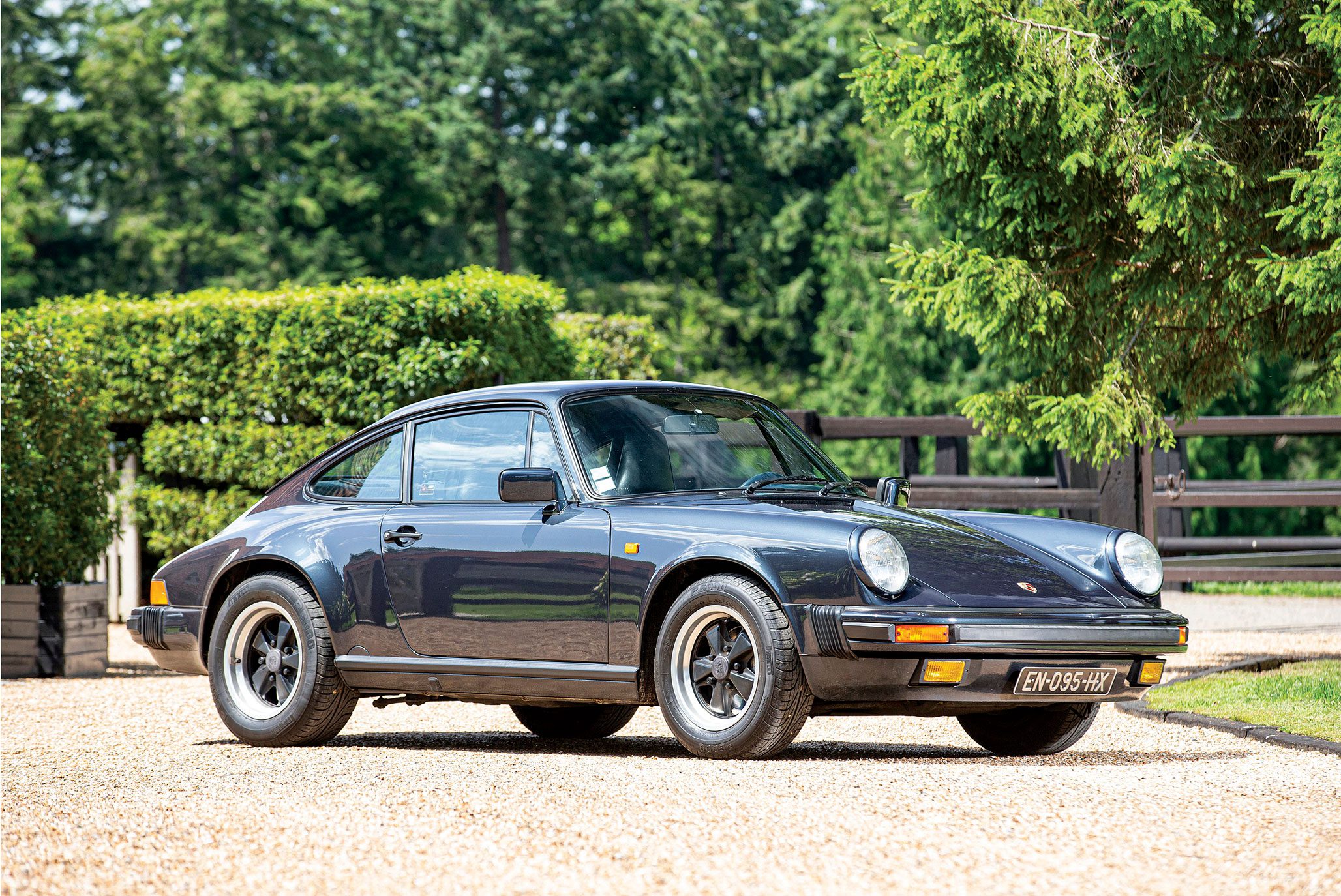
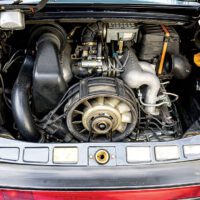
This car, Lot 142, sold for $166,290 (€143,750), including buyer’s premium, at Bonhams Cars’ Knokke-Heist, BEL, sale on October 12, 2025.
In 1974, Porsche changed the 911’s body configuration and engine to match the strictures of U.S. DOT safety and EPA emissions laws. The visible changes were the so-called “high-bumper” and “short-hood” G-body with shock absorbers in the new black-bellowed bumpers. At the rear was a new 2.7-liter engine with CIS induction — a continuous-gas-flow system with electronic metering. It replaced the “dirty” mechanical fuel injection (MFI) used from 1969 through 1973. A lot of additional changes, including high back seats, also came into the equation.
Porsche buyers loved both the older “long-hood” look and the raucous MFI engines. While many aficionados derided the new cars with their CIS engines, public acceptance grew. Five years later, no one cared about the bulbous appearance or the mechanical changes. In fact, performance of the new package was on par with the best of the preceding 2.4-liter MFI cars.
Continual improvements
From 1974 through 1977, changes to the 911 were minor. By the time the 3.0-liter SC model was introduced for 1978, Porsche had started a long series of minor upgrades to the 911. Over time, almost everything unseen was changed. Suspension was uprated, engines were made more efficient and inconsequential power gains were added. Creature comforts also improved, but it was all “small stuff.”
When the 3.2-liter Carrera was introduced for the 1984 model year, acceptance of the G-body was by now widespread. The “new” body style was starting to age after 10 years in the market, though buyers did appreciate the bigger engine with more power and more torque.
A major change came when the 1987 Carreras moved to a stronger gearbox, the G50 (“G” for Getrag, the manufacturer). Its application to the 930 Turbo was delayed until 1989. The 911s and 930s with G50 gearboxes became universally preferred to cars with the previous Type 915 gearbox — although it had been considered a great improvement when brought online in 1972. Other major advances were oil-fed hydraulic chain tensioners that replaced mechanical ramps which occasionally failed spectacularly, and hydraulic clutches that superseded cables, which gave problems as they aged.
Braking parameters were also changed to eliminate the 911’s tendency to slide the front wheels under heavy braking on wet surfaces. In the cabin, both the heating and air-conditioning systems were much improved. Porsche moved to power-operated tops on Cabriolets for the 1986 model year.
From 1984 to ’89, Porsche built 80,383 911 Carreras for the global market. Sales peaked in 1986 at 15,120, then declined through 1989. Coupes made up 45% of production, Targas 24%, Cabriolets 28% and the 1989 Speedster less than 3%. The G50 models accounted for almost half of the production at 39,976 cars built, with coupes accounting for 17,369 of those. Recently, the market has been focused on G50 cars.
Desperate times
During the run of the Carrera 3.2, Porsche AG experienced financial highs and lows. Initially, a weak Deutsch Mark translated foreign earnings into increased profits. Then the pendulum swung back and Porsche’s profitability evaporated. Its management came under fire and the firm’s financial situation led to rumors that either Mercedes-Benz or BMW would have to acquire Porsche.
The firm survived, but with major changes. American Peter Schutz departed as CEO in 1987, although he was correctly credited with saving the 911 from the company’s plan to replace it with the 928. Two new chief executives, Heinz Branitzki and Arno Bohn, followed in quick succession. Things settled down in 1993, when Wendelin Wiedeking took over and instituted modernized ordering and production processes, using consultants with Toyota training. Of course, the hugely successful 993-series 911 introduced in 1994 helped immeasurably.
Enduring appeal
Today, Carrera 3.2s are appreciated as the last of the “old-school” 911s. If you were a teenager with posters on your walls that showed 911s and 930s with captions such as “No Wonder Most Rocket Scientists are German,” you probably developed a love for those models. As such, the Carrera 3.2 is a true collector car — usable and totally analog, with a classic look and driving experience. Some people actually cherished its predictable trailing-throttle oversteer.
While the 1989 Carrera is the market star, 1987–88 models are very salable. In 1986, Porsche enlarged the Carrera’s anti-roll bars from 20 to 22 mm front and from 24 to 25 mm rear. The M491 option package became avalable, offering flared 930 Turbo fenders, suspension, brakes and wheels. In addition to the G50 gearbox, 1987 welcomed larger wheels and tires front and rear, a hydraulic clutch and remapping of the U.S.-spec fuel system, which raised output from 207 to 217 hp, with 195 lb-ft of torque. The next year brought still-larger anti-roll bars. The U.S. compression ratio was a still-healthy 9.5:1, but the RoW 911 was 10.5:1, enabling 231 hp. Some wags knowingly buy RoW Carreras to get the higher-output engines — and then suffer in finding the required higher-octane fuel.
Performance was excellent but not breathtaking, with 0–60 mph times in the 5.5-second range, 0–100 mph in under 14 seconds and top speed of 150 mph. All of the road testers in period were lavish in their praise of the Carrera 3.2’s performance.
A premium price
Our subject 911 Carrera looks to be a very good car. Part of former Cartier CEO Bernard Fornas’ collection, it had a comprehensively documented ownership trail, under 52,000 km (about 32,000 miles), claimed all-original paint and service records from initial purchase through 2015, with only 2,000 km since. It was complete with a full toolkit, owner’s manuals, spare tire, air compressor and jack.
Importantly, it was painted in a reasonably rare color, Porsche-code 347 Dark Blue, with a blue interior. Blue paint is often worth an extra 20%–30% in resale value, along with most greens and some yellows and oranges. This Carrera had all the requirements to be a top sale, and it was. At the U.S. equivalent of $166k, it was far above most estimates, including that of the auction company ($104k–$127k). Given this car’s positive attributes, it was fairly bought and sold.