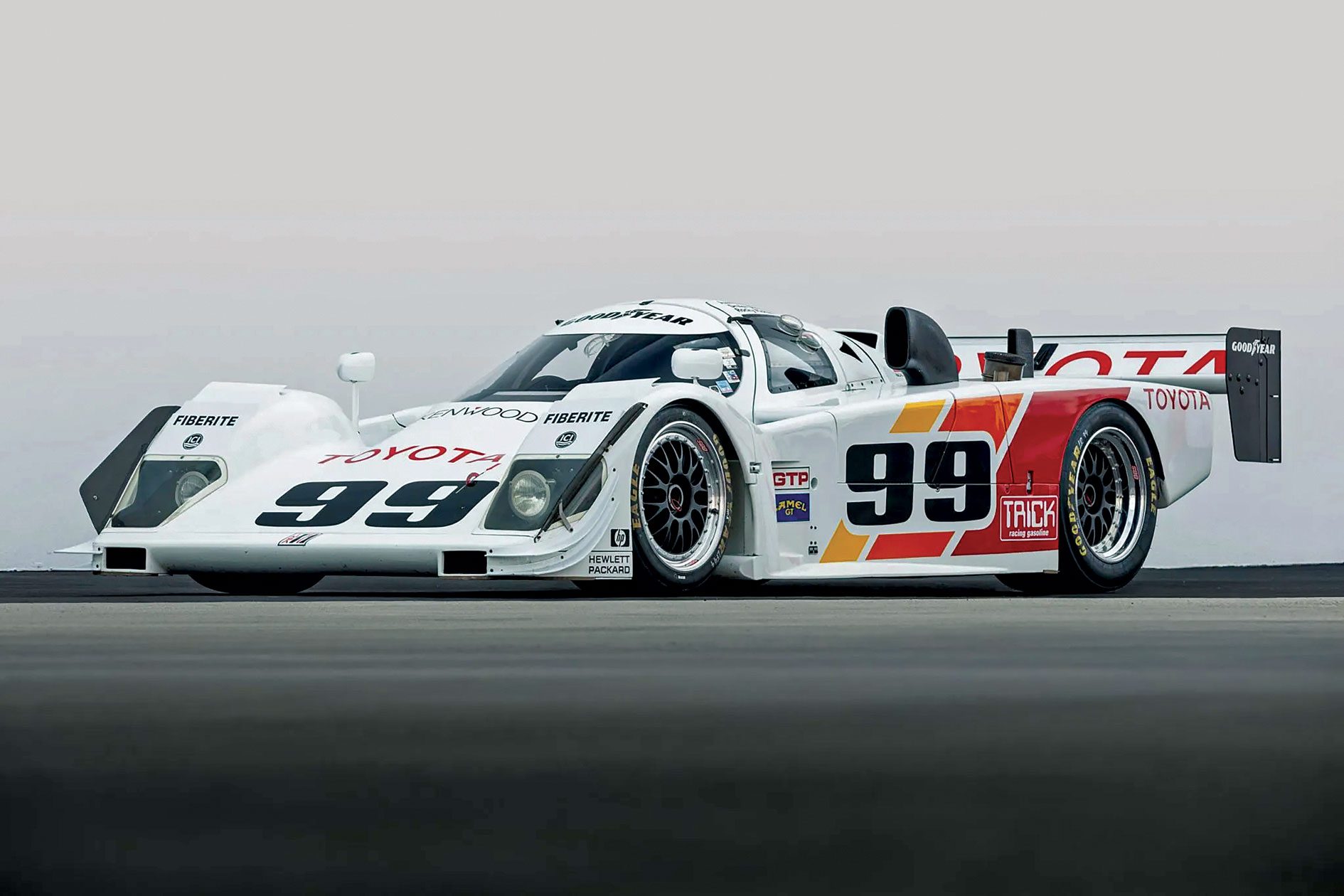
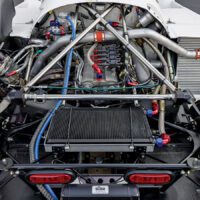
This car, Lot 185263, sold for $1,407,500, including buyer’s premium, on Bring a Trailer’s online auction on March 29, 2025.
All American Racers (AAR) was founded in 1965, when Dan Gurney and Carroll Shelby joined forces with the mission to build, develop and race cars to compete in both USAC Championship Car racing (now IndyCar) and Formula 1. Bankrolling this startup was none other than the Goodyear Tire and Rubber Company of Akron, OH, which was keen to create a platform for beating cross-town rival Firestone on a global stage. Appropriately, AAR’s cars were called Eagles.
The new enterprise set out to build cars for its own racing team and supply them to customers. Roger McCluskey was the first driver to claim victory in an Eagle in 1966. In 1967, Gurney himself won the Belgian Grand Prix in an F1-spec Mk 1 Eagle, while a customer Mk 2 Eagle driven by Bobby Unser won the 1968 Indianapolis 500 and Championship Car title. Gurney bought out Shelby in 1970, and subsequent Eagle Champ Cars also enjoyed success, winning the Indy 500 again in 1973 and 1975.
Teaming up with Toyota
AAR’s relationship with Toyota began in 1983 with race-winning programs based on the Japanese marque’s Celica coupe in IMSA’s GTU and GTO categories, the latter cars taking the 1987 drivers’ and manufacturers’ championship. Moving up to IMSA’s top-tier GTP class for prototype racers in 1989, Gurney’s team designed and built four HF89 Eagles for competition. The chassis name used the initials of its designers, Ron Hopkins and Hiro Fujimori. This model was sometimes also referred to as the “Eagle Mk II,” having been based on an earlier prototype of similar configuration. HF89 drivers included Chris Cord, Rocky Moran, Willy T. Ribbs and Juan Manuel Fangio II, the namesake and nephew of “El Maestro,” five-time F1 World Champion Juan Fangio.
The cars were renamed HF90 the following year, and 1990 began with high hopes after nearly a year of refinement and development. According to its designers, engineers and drivers, the HF89/90 suffered from three fundamental problems that were never totally cured: a very narrow set-up window, inherent understeer, and overheating. These issues were well-enough understood and compensated for by the sixth race of the season at Heartland Park, KS, where our subject car won. In total, the HF90 captured four pole positions, two fastest laps, and three more victories in the latter half of that year. Disappointingly, only a single victory followed in 1991.
Better than bad
Here’s where the discussion gets interesting, despite the plethora of Dan Gurney and Toyota fans who waxed hyperbolic in the BaT comments section. Winning five races over almost three seasons in a ultra-competitive series is nothing to sneeze at, but the HF89/90 was not an especially successful race car statistically.
The HF89/90 was not a bad car — it just wasn’t good enough for most of its lifetime. Other manufacturer-funded, multi-year factory programs that overpromised and underdelivered peppered the original GTP era, so AAR-Toyota was in good company. Other Works cars that only won a handful of races include the Zakspeed-built Ford Probe, also powered by a fragile 2.1-liter turbo-4; the Rick Hendrick-run Chevy Corvette GTP, with its 1,000-hp Ryan Falconer V6 turbo; and the drop-dead-gorgeous, naturally aspirated V12 Jaguar XJRs from Group 44. None of these cars were regulars on the podium, much less the top step. Such was the highly competitive nature of the GTP category at its zenith, when even the backing and engineering resources of a major manufacturer did not ensure success.
Perhaps more telling is comparing the HF89/90’s record with that of its successor, the superlative Eagle Mark III, winner of two consecutive IMSA drivers’ and manufacturers’ championships. The Mk III is the real prize amongst AAR-Toyota prototypes, winning a mind-boggling 21 times in 53 entries (that represents a 40%-win ratio along with multiple 1-2 team finishes). In comparison, the HF89/90 took five checkered flags out of 54 entries (9%-win ratio) albeit against a slightly more competitive field.
Dan’s the man
I previously reported on the sale of Juan Manuel Fangio II’s personal, twice-Sebring-winning Mk III, restored and gifted to the Argentine by AAR. It sold for just over a million dollars in 2014 at Gooding & Company’s Pebble Beach sale, and I thought it a bit of a bargain (SCM# 245050). But I don’t think simple inflation or appreciation is why our HF89 subject car sold higher at $1.4m. The market for these cars in 2014 was far stronger than it is today.
In the February 2025 issue (Race Profile, p. 72), I laid out a matrix of pricing for GTP prototypes where I placed the AAR Eagles in the $700k–$1m price range. Part of that determination involved the 2014 sale above and the two prior instances when our subject car came to auction. Chassis 89T004 was a $660k no-sale in 2015, pre-restoration (SCM# 6785822), and post-restoration it failed to sell at $825k in 2018 (SCM# 6899212). These non-sales don’t define market value, but they can sometimes be a good indicator of what the market believes to be reasonable.
So why did this car sell for so much? We often discuss provenance as a determinant of value. A meticulous restoration, first-class maintenance and preparation, and five period victories don’t raise the bar enough to justify this price. The wild card in this deck is Daniel Sexton Gurney; a legendary driver, innovator and constructor who remains a towering figure in motorsports. Not to mention, a genuine American hero. The man they called “The Big Eagle,” died in January 2018. His legacy most certainly influenced the premium here. The car was well sold, but thoughtfully bought.