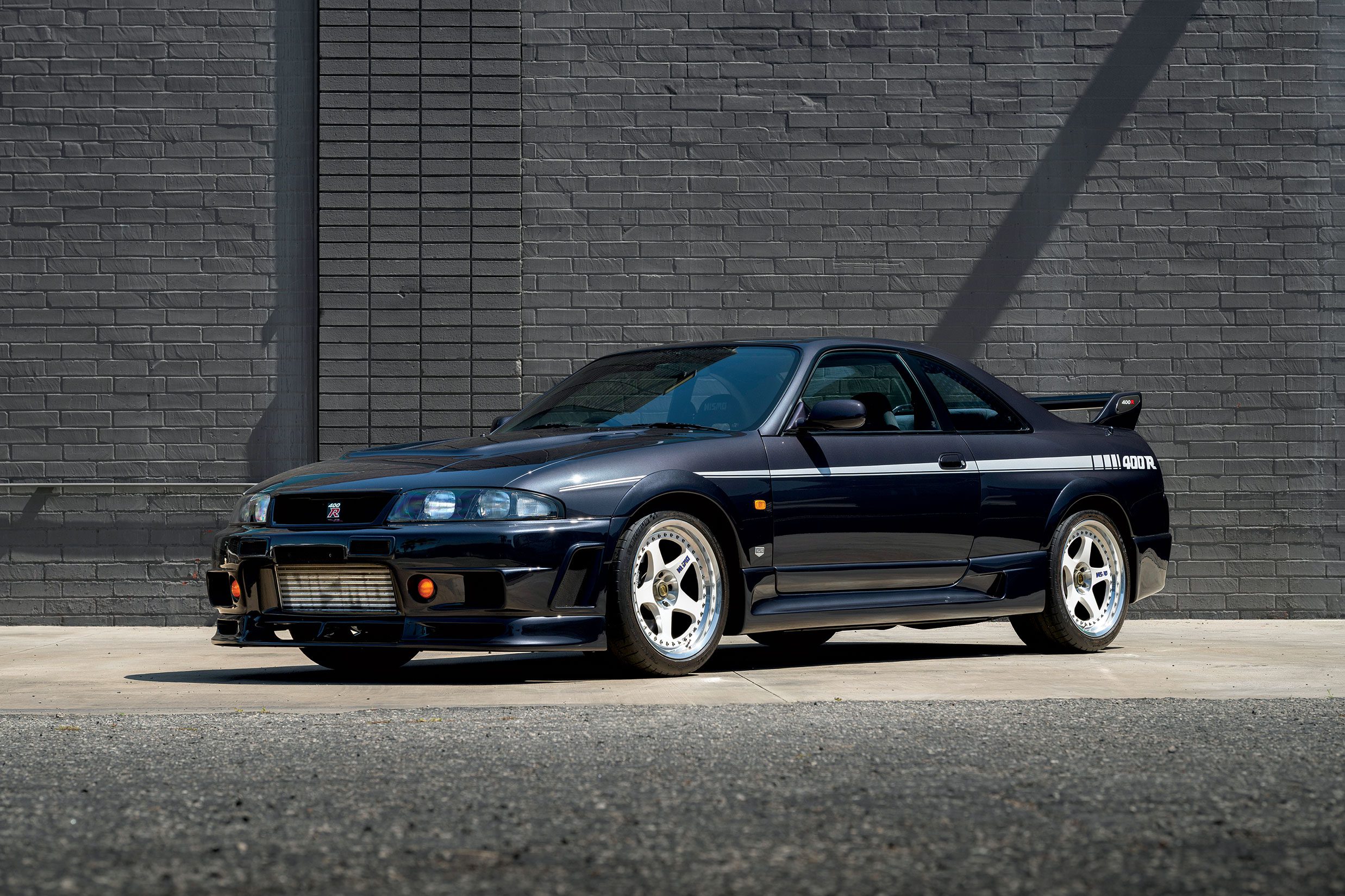
This car, Lot 272, sold for $995,000, including buyer’s premium, at RM Sotheby’s Monterey, CA, auction, on August 16, 2025.
As specified in the auction catalog, this 400R was offered in very fine condition, having been driven fewer than 4,500 miles. This sale provides a useful data point regarding current 400R values, which seem to occupy their own celestial orbit unrelated to all other Skyline GT-Rs.
Back to the start
It was Japan’s Prince Motor Company, not Nissan, that introduced the Skyline name to the automotive world in 1957. Following two generations of Skyline models, with heralded racing success, Prince was acquired by Nissan in 1966. Nissan understood the potential value of what Prince had created and fully embraced the moniker, delivering 11 subsequent generations of Skyline automobiles.
Skylines have always been interesting machines, but they are in no way rare. Over the five-decade production run, several million cars were produced under the Skyline banner. Some of the offerings were sporty coupes, but there were also sedans, station wagons, hatchbacks and even SUVs.
The GT-R (Gran Turismo Racer), however, was a different story, embodying the ultimate performance model of the lineup. Nissan released the first Skyline GT-R in 1969 — the 2000GT-R sedan, with a total production run of 830 units. They followed this up with the 2000GT-R coupe in 1971, with 1,115 examples rolling out of the factory before production ceased in September 1972. Together, these exhilarating DOHC-powered cars, nicknamed “Hakosuka” (boxy skyline), scored 56 consecutive class wins on Japanese racing circuits. As the curtain dropped on the first-generation (C10) Skyline GT-R, Nissan immediately introduced its second-generation (C110) offering, the 2000GT-R “Kenmeri.” Available only in coupe configuration, just 197 cars were produced.
A long drought then ensued, with devotees waiting an unthinkable 16 years for the release of the third-generation Skyline GT-R (R32) in 1989. Nicknamed “Godzilla,” the R32 GT-R captured four consecutive Japanese Touring Car Championships while logging 29 uninterrupted racing victories. Total domination on racetracks coupled with pent-up GT-R demand resulted in sales of 43,937 units. Nissan subsequently released the R33 GT-R in 1995 and the R34 GT-R in 1999, selling 16,712 and 11,577 examples, respectively. The R32, R33 and R34 GT-Rs were each powered by a twin-turbocharged, twin-overhead-cam, 2.6-liter, inline-6 RB26DETT engine coupled to a highly innovative all-wheel-drive system. These cars were engineering marvels and worthy of the worldwide adulation they enjoy.
The NISMO 400R
The Skyline GT-R NISMO 400R was released in 1996, with the “R” denoting that the model was conceived for racing. With no fewer than 14 sub-models of the R33 GT-R available, the 400R was far and away the most special, engineered with many important upgrades.
While the engine began life as a stock RB26DETT unit, the 400R powertrain was bored and stroked by REINIK (Racing & Rally Engineering Division Incorporated Nissan Kohi) to arrive at a displacement approaching 2.8 liters. Nissan’s target of 400 horsepower necessitated the use of a forged crankshaft, uprated forged connecting rods, special high-lift camshafts, polished ports, higher-output N1-spec twin turbochargers with improved intercooling, and upgraded oiling and exhaust systems.
NISMO (Nissan Motorsports International) built the 400R with several distinctive exterior features, including wider fenders to allow for 18-by-10 NISMO wheels and bigger tires, larger air scoops, unique front and rear bumpers and side skirts, and 400R livery. The hood and rear spoiler were uniquely designed and were fabricated from carbon fiber. Inside the cockpit, the 400R boasted special NISMO bucket seats, a titanium shift knob, a leather-wrapped 400R-branded steering wheel and a 400R speedometer. There was 400R badging on the front grille and rear trunk and the sides of the rear wing were also emblazoned with the 400R logo, as was the side bodywork.
At the time the NISMO 400R was released, standard practice among Japanese automobile manufacturers was to adhere to the infamous “gentlemen’s agreement” whereby horsepower output was publicly reported as 276 horsepower or less. With the NISMO 400R, Nissan deviated from this tradition in stunning fashion, proclaiming 400 hp in the model’s name. The company also made no secret of the car’s performance, with the 400R being capable of 0–60-mph runs of 4.0 seconds and a top speed of 186 mph.
Hero-car pricing
With nearly 75,000 Skyline GT-Rs constructed over five generations, the NISMO 400R stands as one of the rarest sub-models, with 44 units produced. The release of the “Gran Turismo” driving simulator video game in Japan in December of 1997 and in North America and Europe in May 1998 closely followed the introduction of the 400R. Based on this timing and the outrageous performance and rarity of the sub-model, the 400R became the hero car for millions of Sony PlayStation gamers.
To date, few NISMO 400Rs have been offered at public auction, and the sale of our subject car, NISMO 400R no. 19, represents the first-ever public sale in the U.S. I am also aware of two 400Rs that sold via public auction in Japan and another in Great Britain. NISMO 400R no. 40 sold at auction in February 2015 for 8.51m yen (about $70,000), and no. 8 sold in November 2022 for 130m yen (about $950,000). NISMO 400R no. 40 sold once again in May 2023 for £701,000 (about $875,000). There are also at least two 400Rs currently being marketed for sale by dealers — one in California for $1.3m and another example in Australia for $2.5m.
Although it may seem pricey for a sub-model of a vehicle built in numbers totaling 16,712, the NISMO 400R represents the ultimate production Japanese performance car for a generation who grew up worshipping it. The sale of our subject car at a tick under $1m appears to be market-correct based on the available data. And for those old-timers shaking their heads in disbelief, the 400R isn’t even the most expensive Skyline GT-R. That distinction goes to the Nissan Skyline R34 GT-R NISMO Z-Tune with a value likely to exceed twice that of the NISMO 400R. Certainly, these aren’t your grandfather’s Nissans.