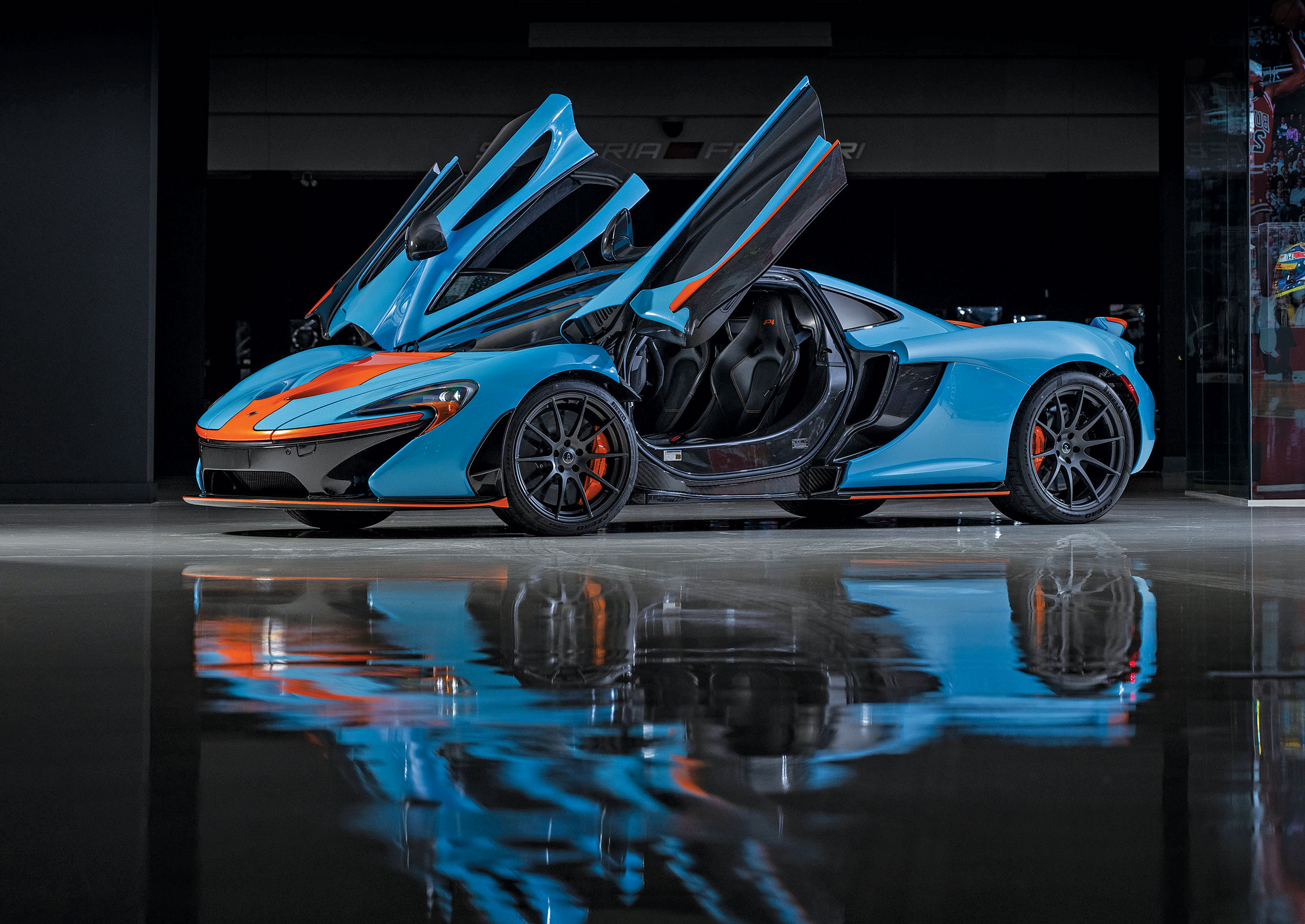
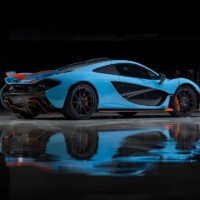
This car, Lot 329, sold for $2,095,000, including buyer’s premium, at RM Sotheby’s Toronto, ON, CAN, auction on May 31, 2024.
If you follow the fortunes of the McLaren P1, you might conclude that the bloom has fallen from the rose in recent years, based on a few sales in the $1.1m range. However, not many examples of this hybrid hypercar cross the block each year at traditional auctions. Bring a Trailer has auctioned just five P1s online since 2022, with only two actually selling. While data points are a little thin, there’s plenty to learn if you dig.
An electrified supercar
The McLaren P1 was eagerly anticipated when it debuted in 2013. McLaren had been teasing its “game-changing high-performance cars” since 2011, with some concept versions displayed in 2012. The 2013–15 McLaren P1 featured a hybrid drivetrain, which was matched by Porsche’s 918 Spyder and Ferrari’s LaFerrari at virtually the same time.
The P1 showed impressive numbers out of the gate, with 727 horsepower from the mid-mounted 3.8-liter twin-turbo V8 engine alone, plus 177 hp added by the electric motor. Combined power output was a dizzying 903 horsepower and 664 lb-ft of torque, with a super-wide 7,000-rpm power band. All that power was directed to the rear wheels through a 7-speed dual-clutch automatic transaxle. That all translates to a 0–62 mph time of 2.8 seconds, on your way to 186 mph in just 16.5 seconds, and an ultimate top speed of 217 mph.
By any estimation, this was a worthy hypercar for the 2010s. Its pricing reflected that, with an MSRP of $1,150,000 in 2013. However, buyers could plus things up to about $1.5m by adding goodies. In all, 375 regular P1 examples completed production by the end of 2015. There were also some special track cars built after regular production ceased; those are more expensive than the standard P1.
A fickle market
As you might expect, the P1 began to hit the auction scene not long after it was released, with some owners looking to flip a rare exotic for a quick profit. If you wanted a P1 in 2015 or 2016, you had to be ready to scratch a check for about $2m, plus or minus. The high-water mark for that era was in March 2017 with a $2.39m sale (SCM# 6827751). Things cooled after that, with sales happening at about $1.75m through 2018 and then down as far as $1.1m at a few sales in 2020.
The market has been somewhat stronger over the past two years, but buyers are also more selective. That’s what’s really interesting about the P1. For example, Broad Arrow Auctions sold a 2015 P1 for $2.4m at Amelia Island in 2023 (SCM# 6960710) just one month after a similar P1 sold at RM Sotheby’s Paris auction for half that price (SCM# 6960584).
RM Sotheby’s sold our subject car, with 1,913 miles showing, for $2,095,000. Then, just a month later, Bonhams Cars sold a similar P1 at its Bonmont sale in Switzerland (with 8,700 miles on the odo) for about $1.1m. (See “Market Report,” p. 112.) What’s the million-dollar difference between these cars?
Pricing P1s
We reached out to Michael Marzano at Chicago-based Mouse Motors. This specialty dealership has plenty of experience with McLarens.
“I think mileage is a big part of that but also, European- and Asian-market cars always seem to do much less,” Marzano says. “The U.S. market is the strongest for these cars, and most ‘worldwide’ cars these days seem to be sold with the intent of bringing them into the U.S.”
Importing a modern foreign-spec car generally involves significant expense in “federalization,” the process of making the car street-legal here in the States. Per the U.S. Department of Transportation, federalization often includes changes to the car’s lights, emissions equipment and safety equipment. (For more on this topic, see “Collecting Thoughts,” p. 38.)
“When you factor in duties, federalization and shipping, you end up pretty close to market value,” Marzano explains. “The other issue that is being factored into some of these, especially overseas, are the service expenses, primarily the upgraded batteries that are now being installed. I see a vehicle that requires federalization, service, etc., as being a $900k–$1m car that will likely need $400k–$600k worth of investment to be completely sorted in the U.S., and a fully sorted car sitting in the U.S. as being in that $1.6m–$2m range, depending on mileage and spec.”
Further, Marzano believes that once a given P1 is brought to America and made street-legal here, the car will have substantial future upside potential, pegging the near-term value range at $2m to $3m.
When new McLaren reported that 34% of P1 production went to North America, or about 128 cars. Europe got about 98 cars, and the rest were sold around the world, largely in the Middle East and Asia. With those facts in mind, the market for the McLaren P1 becomes clearer, and it’s up to the buyer to choose a sorted U.S.-spec car or a less-expensive overseas model as the best value.
It also shows that our subject P1, with its low mileage and in a desirable livery and spec, sold at a fair price. ♦