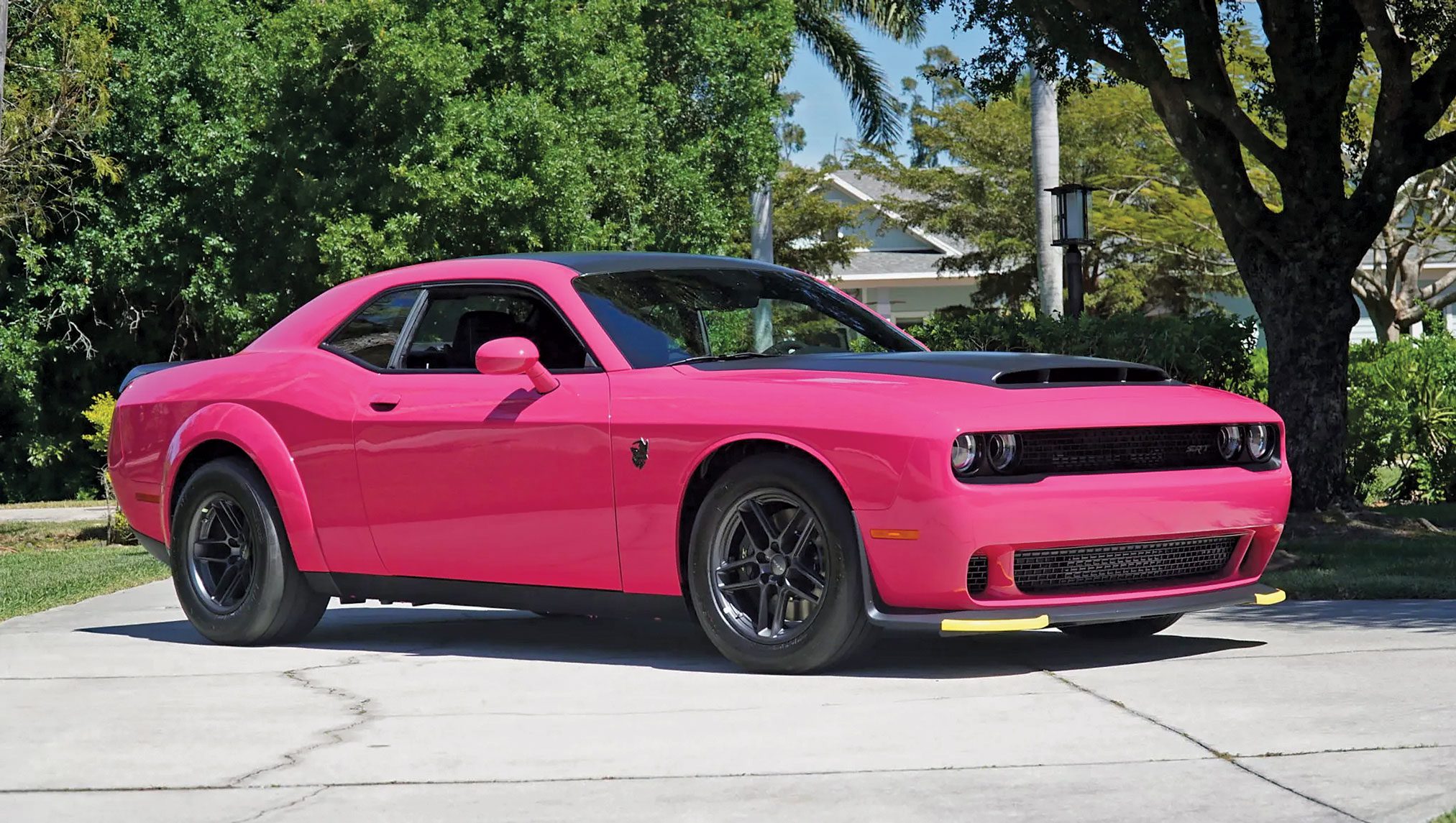
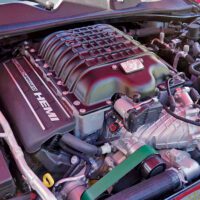
This car, Lot 186012, sold for $457,500, including buyer’s premium, on Bring a Trailer’s online auction on April 2, 2025.
To explain how a two-year-old Dodge managed to sell for nearly half a million bucks, it’s necessary to start at the beginning — with the introduction of the 2008 Challenger. Launched at the peak of the early-2000s retro-design era, this coupe was the most unabashed throwback of the three domestic pony cars released during the decade. Its design brief was simple: Copy the E-body 1970 Challenger. Developed under the DaimlerChrysler regime, the new Challenger was largely based on the W211 Mercedes-Benz E-Class, although its Hemi V8 was a good old-fashioned pushrod beast with an iron block.
The Challenger initially drew criticism when compared to its crosstown rivals from Ford and later Chevy — for its cheapness, its crudeness, and even its failure to be a ’Cuda, that branding choice having been eliminated when DaimlerChrysler discontinued Plymouth in 2001. Challenger sales were mediocre for years — a distant third behind the Mustang and Camaro. With the Germans having dumped Chrysler — which slid into bankruptcy before being passed off to Fiat in 2012 — the Challenger nameplate seemed destined for another ignominious departure.
Italian tune-up
But then the Italians showed up in Auburn Hills to see what they had acquired. A possibly apocryphal story circulated at the time, suggesting that the Fiat executives’ propensity for smoking indoors at the Chrysler headquarters was matched only by their enjoyment of lighting up the tires during demonstration drives around Detroit. With both sides of this cultural exchange likely in flagrant violation of the law, we’ll never know the whole of it. What is indisputable is that rather than killing its slow-selling muscle car, Fiat Chrysler doubled down.
The new company revamped plasticky interiors across the Chrysler lineup, with improvements coming to the Challenger in a 2015 facelift. More important was the introduction that year of the legendary first Hellcat, which boasted a supercharged 6.2-liter Hemi that made 707 horsepower and 650 pound-feet of torque. Those obscene numbers meant that Baby Boomers could finally buy a new muscle car capable of outperforming the ones in their increasingly distant and fantastic memories of adolescence.
And buy they did. Challenger sales boomed, topping 65,000 every year for the remainder of the decade, overtaking the Camaro in 2018 and nipping at Mustang’s hooves. Then in 2021, Dodge’s 13-year-old relic outsold both of them for the first time. When it was announced a year later that the Challenger would go out of production at the end of 2023, the car was still selling better than it had through its first seven years on the market.
This uncommon reversal of fortune was fueled by Dodge’s strategy of regularly upping the ante. This brought us the 2018 Demon, a limited-production widebody Hellcat that used a bigger supercharger to make 808 hp. Then came the 797-hp Hellcat Redeye the following year, essentially a slightly detuned version of the Demon for anyone who wanted one. This was followed by the similar, 807-hp 2020 Super Stock.
Space does not permit getting into the details of each of these models — or the myriad other performance packages that were offered on lesser Challengers over the years, extending the considerable mythology of the Hemi down through the lineup. Suffice it to say that a special synergy between Dodge’s engineering and marketing departments in this era created a veritable cult of Hellcat.
Gimmicks and gewgaws
While over and over Dodge made good on its assurance that the Hellcat would be the most extreme street-and-strip performance machine on the market, the cars also delivered features that made their owners feel special. The most famous might be the red key fob, used to unlock the car’s full performance — the normal black fob limits horsepower to a still-ridiculous 500.
Then there was the Demon Crate, offered to original buyers for $1. Besides some Snap-On tools (including a floor jack and torque wrench), it contained a set of front drag wheels and the crucial high-octane powertrain computer that bumped horsepower to 840. On the surface, this was a clever way for the factory to circumvent regulations and minimize its own liability in selling a car that could be downright dangerous. It also had a carry-on effect of making a fervent fan base feel that amid all the changes sweeping through the auto industry, Dodge was on their side.
Strangely, some owners even started refusing to remove the yellow front splitter guards the factory used to protect cars during shipping. However little sense this made (leaving the covers on allows dirt and road grime to collect underneath and scratch the paint), it speaks to their reverence for everything — anything — Hellcat. Even a throw-away piece of plastic!
“Last Call”
The coup de grace for all of this came with the 1,025-hp Demon 170 for the 2023 model year. This was the final of several “Last Call” special editions, this one limited, as was the original Demon, to 3,300 examples. Mirroring what we saw with the Demon market in 2018, these Demon 170 cars initially traded at many tens of thousands of dollars over MSRP, with as-new examples selling on the secondary market for over $200k. Just as it did with the original Demon, that initially strong demand has started to wane, with recent sales around $150k.
Our subject car, as explained in the auction description, is one of these cars. More to the point, it is also one of very few Jailbreak models with one-of-one paint, in a color that screams Mopar louder than most. Clearly this makes it more desirable than your “garden variety” Demon 170, but for what was paid here, the buyer could have had three of those. At more than $300k over MSRP and a record price for any Hellcat, this car was obviously very well sold. That does not mean that the buyer overpaid; there were three bidders in it up to the end of the auction, and this is what it took to bring the car home.
Will the next one to cross the block sell as well? Probably, provided it’s in a similarly arresting or appealing color. Long-term prospects for appreciation seem less certain. The 40 Demon 170 Jailbreak cars represent just a wafer-thin slice of some 800,000 Challengers sold over its 17-year run. Of course, Dodge is not building them anymore, regardless of the incredible enthusiasm for these cars right up until the end. (Although rumors of Hemi V8 production resuming this year abound, leading to speculation that a new Hellcat based on the current Dodge Charger could be forthcoming.) Regardless, it is rare for an “instant collectible” to maintain enduring interest.