


After languishing for years in California’s high desert, the 1948 Norman Timbs Special — a Motor Trend cover car in October 1949 — was restored to a fare-thee-well and won its class at several major concours. Timbs was an acclaimed race-car engineer who’d designed the Indy 500-winning Blue Crown Specials of 1946, 1947 and 1948. He later worked with Preston Tucker, designed the Howard Keck Fuel Injection Special, the Halibrand Shrike racing chassis, and he had a 17-year career with Ted Halibrand. Timbs conceived of and built this unique rear-engine roadster as his personal sports tourer, a true “one-of-one,” the only […]
After languishing for years in California’s high desert, the 1948 Norman Timbs Special — a Motor Trend cover car in October 1949 — was restored to a fare-thee-well and won its class at several major concours. Timbs was an acclaimed race-car engineer who’d designed the Indy 500-winning Blue Crown Specials of 1946, 1947 and 1948. He later worked with Preston Tucker, designed the Howard Keck Fuel Injection Special, the Halibrand Shrike racing chassis, and he had a 17-year career with Ted Halibrand. Timbs conceived of and built this unique rear-engine roadster as his personal sports tourer, a true “one-of-one,” the only example ever constructed.
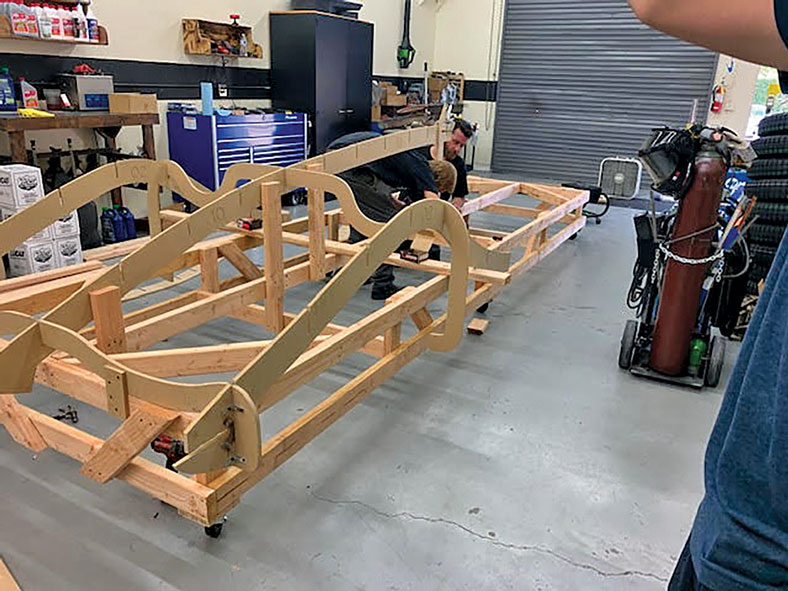
The multi-talented Timbs painstakingly built an elaborate wooden framework, and reportedly, it was famed racing fabricator Emil Diedt who hammered out the curvaceous two-piece aluminum body. Inspired by the pre-war Auto Union racers, the Timbs Special was powered by a rear-mounted 1947 Buick OHV straight-8, fitted with Buick’s “compound carburetion.” Some 200 horsepower was claimed. The car’s custom, chromoly steel tubular chassis was pressurized for stiffness with an on-board air compressor. The frame was suspended over a Ford solid front axle and a De Dion-style independent rear end fashioned from Ford and Packard components. A built-in hydraulic jack lifted the massive rear deck for access to the engine.
A concours winner
Shortly after the futuristic roadster starred on what was just Motor Trend’s second cover, Timbs sold his dream car. He said he was uncomfortable with the constant attention it attracted. The car passed through several hands before it somehow ended up in a field near Antelope Valley, CA, where it sat for years. Gary and Diane Cerveny, undaunted by the challenge, bought its decrepit remains at a Barrett-Jackson Auction at the Petersen Automotive Museum in 2002, and began the restoration. Soon realizing they were in over their heads, the Cervenys transported the car to Dave Crouse’s restoration shop, Custom Auto, in Loveland, CO. An exacting and lengthy restoration, estimated at more than 4,000 hours, ensued.
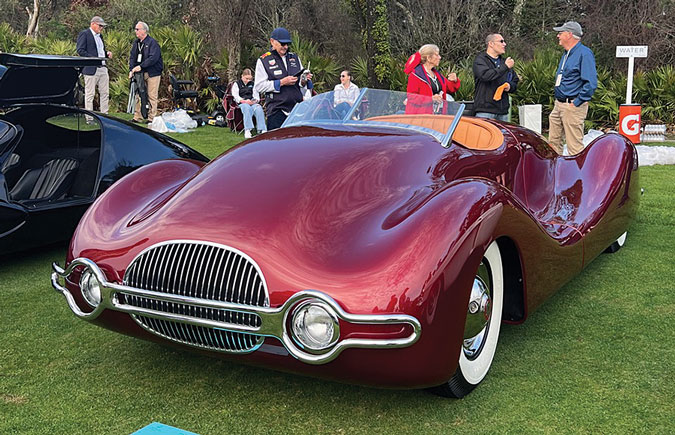
The results were simply stunning. Resplendent in deep maroon, with discreet gold metalflake accents, the Timbs Special debuted at Amelia Island in 2010 and competed successfully on the concours circuit, winning the Sport Custom class at the Pebble Beach Concours d’Elegance in 2012. It was displayed in the “Dream Cars” exhibition at the High Museum of Art in Atlanta in 2014, and again the following year when that exhibition traveled to the Indianapolis Museum of Art.
Tragedy strikes
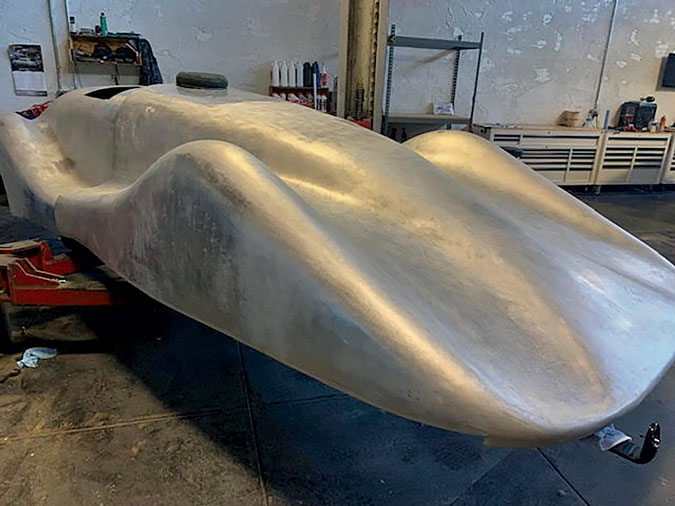
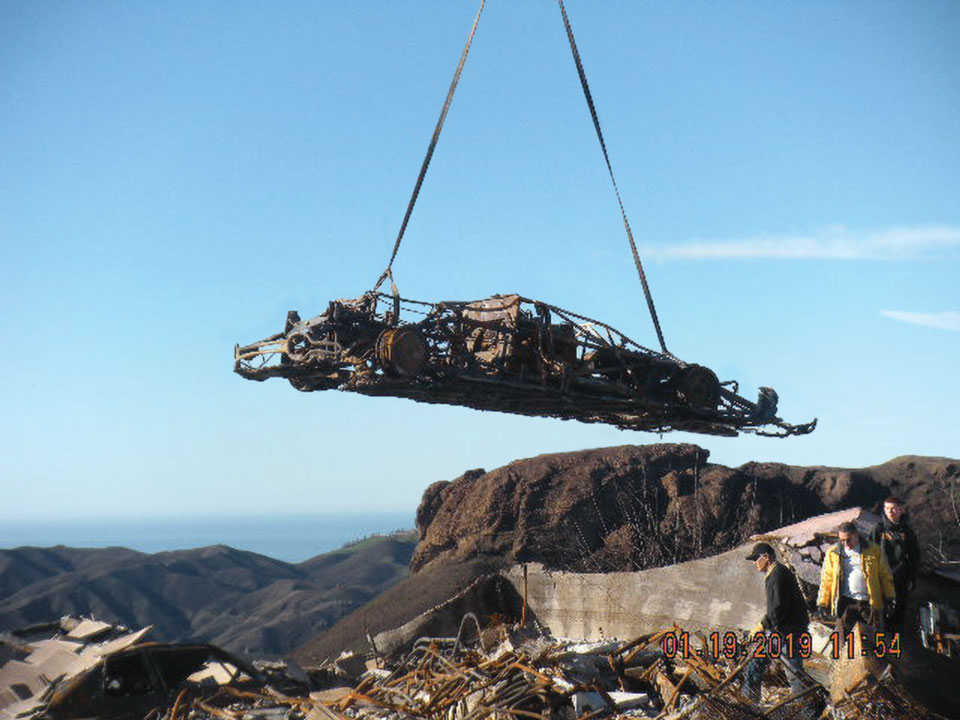
In 2018, the Woolsey fire in Malibu, CA, virtually destroyed the car, along with some 30 other vehicles in the Cervenys’ collection. The couple were out of town at the time, unable to save any of their cars. Luckily, shortly before the fire, Gary had the presence of mind to digitally scan the body of the Timbs Special. Its chassis, although badly burned, survived. Appreciating the significance of the car, the Cervenys settled with their insurer, and work began to bring the car back to life.
John Bothwell spent over 8,000 hours restoring the car at ORC, his Costa Mesa, CA, facility. The unique four-inch-diameter tubular chassis, body cage, engine block, transmission housing, torque tube, differential, both axles, bumpers, windshield uprights and front belly pan were among the key components that could be saved and re-used. The aluminum body was the one significant piece of the car that had to be re-created and replaced.
The Timbs Special was accepted for the 2023 Pebble Beach Concours d’Elegance in the “American Dream Cars of the 1950s” class, but with a caveat. The selection committee examined the photographs that were submitted with the application and concluded that with only one belly pan surviving, the rebuilt car would be considered to have had its body changed. A replacement body necessitates a five-point deduction by International Chief Judges’ Advisory Group (ICJAG) judging standards.
Of course, a five-point penalty is the kiss of death, as entrants for the Pebble Beach Concours come painstakingly prepared. The Cervenys are competitive, and they wanted to win their class again, so they elected not to send the car to Pebble last year. They did take it to Amelia Island this year, where it won its class. The Amelia more resembles classic French judging, where a body replacement doesn’t necessitate a massive deduction.
What to do?
There are two issues here. The first is if it was worth spending the time and money to restore the car. That’s a simple answer: Yes. The Timbs Special is a significant car, one-of-a-kind. The Cervenys had received their insurance settlement and they wanted to restore the car for posterity. The car hobby is certainly better for that decision.
The other question is whether this is a real car or a re-creation. I would posit that this car is absolutely the Timbs Special. There’s a famous British court case about the “Old Number One” Bentley Speed Six. Over years of racing competition, this notable Bentley underwent a chassis change, a body substitution, an engine swap, and countless other components were replaced or modified. But the court found that
“… in essence, even if nothing of a car in its original material form exists, its aura, supported by its continuous documented provenance (in this case an official logbook) was enough to allow its soul to survive.”
With the Timbs Special, we simply have a new body — everything else remains. It’s still the car. Accepting that, perhaps ICJAG should reconsider its body-replacement criteria when it’s done to repair an original car (but never for a re-creation).
Regardless, hopefully, the born-again saga of the Timbs Special will encourage others to restore an important car, even if it’s this far gone. ♥