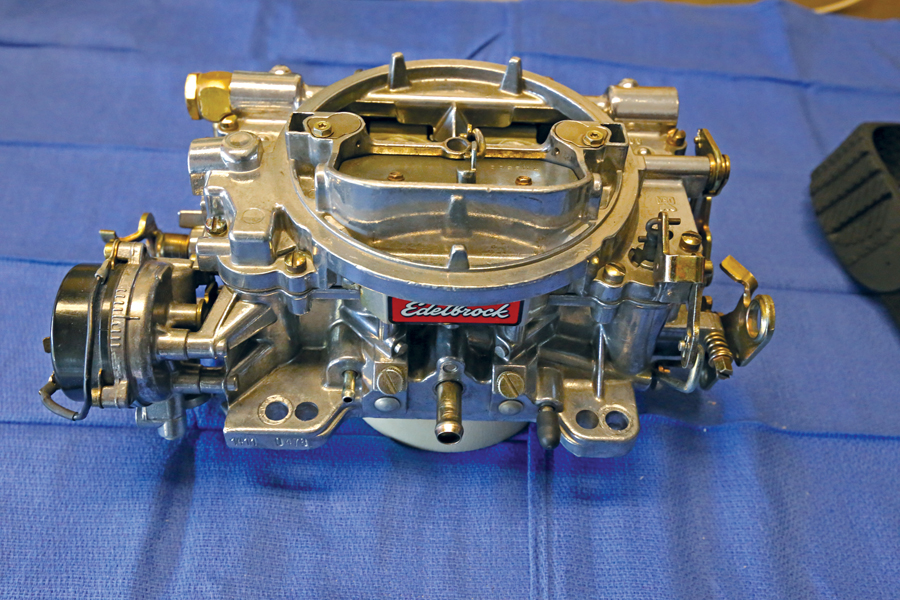
Electronic fuel injection may be the wave of the future, but there’s nothing wrong with a properly tuned carburetor. The key is figuring out how to tune it. Edelbrock carburetors have been a go-to for street-bound muscle cars and classics for several decades. The design itself goes back to the AFB carbs of the 1960s — a tried-and-true setup that offers plenty of adjustability while remaining reliably adjusted once set up. These things are everywhere — if your car isn’t fitted with a Holley or a Rochester, you’re almost certainly running one of these under your hood. But is that carb […]
Electronic fuel injection may be the wave of the future, but there’s nothing wrong with a properly tuned carburetor. The key is figuring out how to tune it.
Edelbrock carburetors have been a go-to for street-bound muscle cars and classics for several decades. The design itself goes back to the AFB carbs of the 1960s — a tried-and-true setup that offers plenty of adjustability while remaining reliably adjusted once set up. These things are everywhere — if your car isn’t fitted with a Holley or a Rochester, you’re almost certainly running one of these under your hood. But is that carb running at its best?
The trick to getting any carburetor set right has always been knowing what to adjust and how to adjust it. A lot of car people tend to get their carb working okay and leave it alone from there, living with any quirks it may have. But a few tools — as well as a modern wideband oxygen sensor — can give you the info you need to make a carb run right.
ACC Contributor Jeff Zurschmeide recently installed a box-stock Edelbrock 600-cfm Performer carburetor on the 383 stroker in his 1969 Chevrolet Corvette. It ran okay out of the box without any adjustment, but we both figured we could make it run even better without much effort. So I grabbed a few tools and ordered up a few parts from Summit Racing to get us on the right track. Here’s how we dialed everything in.
Summit Racing Parts List:
- Edelbrock 1406 carb tuning kit, p/n EDL-1487, $44.27
- Moroso HEI advance curve kit, p/n 72300, $15.48
- AutoMeter Ultra-Lite wideband air/fuel gauge, p/n 4379, $199.95
- AutoMeter gauge panel, p/n 2236, $17.95
- Performance Tool vacuum gauge, p/n W80594, $13.47
- Summit Racing timing light, p/n SUM-G1059, $65.97
- Carburetor base gaskets (useful, but not required), p/n SUM-G1418, $1.97 each
Time spent: Four hours
Difficulty: 2/5
Air-fuel ratio (XX:1)
10–11:1 Very rich
12–13:1 Rich. Best power at full throttle
14–15:1 Ideal. Good for idle and light throttle
16–17:1 Lean. Possible drivability issues
18–19:1 Very lean
-