
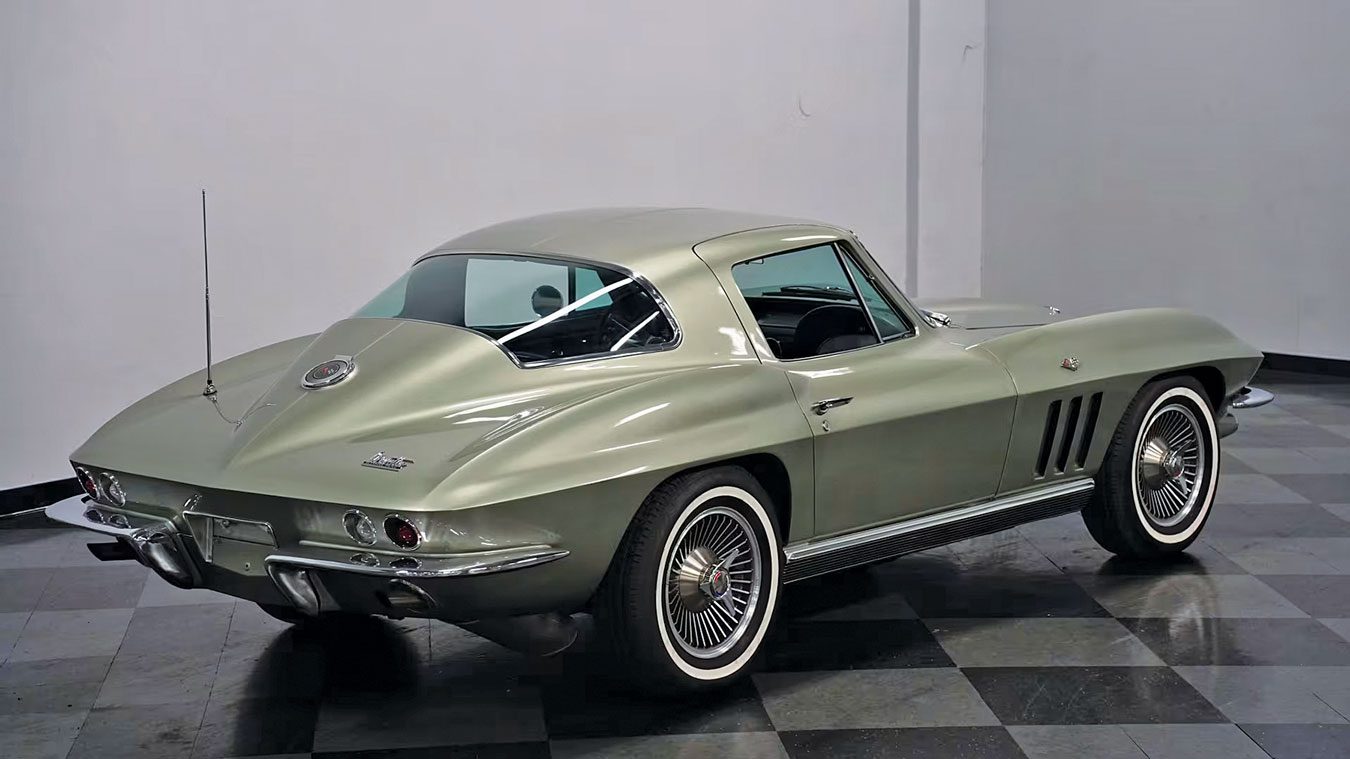

It was an eventful week at Mecum Auctions’ recent four-day Dallas/Fort Worth sale — hundreds of cars sold and only four crashed! The accident happened in the post-sale staging area, where three of the cars were parked. A driver, presumably a Mecum employee, was moving a 1958 Willys resto-mod pickup. The truck sported a 5.7-liter Chrysler Hemi engine. According to witnesses, the Willys “lunged forward without warning,” impaling itself against the right front fender of a 1966 Chevy Corvette. The impact pushed the Corvette sideways into the side of a 1977 Pontiac Trans Am, which was in turn pushed into the […]
It was an eventful week at Mecum Auctions’ recent four-day Dallas/Fort Worth sale — hundreds of cars sold and only four crashed!
The accident happened in the post-sale staging area, where three of the cars were parked. A driver, presumably a Mecum employee, was moving a 1958 Willys resto-mod pickup. The truck sported a 5.7-liter Chrysler Hemi engine. According to witnesses, the Willys “lunged forward without warning,” impaling itself against the right front fender of a 1966 Chevy Corvette. The impact pushed the Corvette sideways into the side of a 1977 Pontiac Trans Am, which was in turn pushed into the 2019 Corvette ZR1 coupe that was parked in the next space.
All three of the parked cars had reportedly been sold — the C2 Corvette at $126,500, the Trans Am at $64,020, and the ZR1 at $232,760.
Photos show that the Willys suffered significant front-end damage. The ’66 Corvette took the brunt of the harm, with both front fenders crumpled. The Trans Am was banged up on both sides and the ZR1 seemed to suffer what appears to be just minor damage to its right side. As would be expected, the force of the impact was dissipated as it traveled through the multi-car crumple zone.
The story spread widely on social media, with reports stating that “the driver’s foot slipped” and that paramedics were called, with three persons taken to the hospital with non-life-threatening injuries.
Quite obviously this was an unfortunate incident. We hope that nobody involved was seriously harmed, and that the cars eventually get repaired. However, as with any crash, there will have to be an accounting of fault to determine who pays for what.
Big damage
The driver must have been a Mecum employee — if the owner or someone else had been allowed to drive the car on the auction site, that would be another type of legal problem. This almost certainly makes the auction company responsible for all of the damage. An employer is fully liable for all acts committed by an employee acting within the scope of their employment.
However, that assumes that the damage was the driver’s fault. Hitting another car is one thing, but hitting it hard enough to push two cars sideways into a third takes some doing and quite a bit of force. Whether the driver’s foot slipped or something else happened with the car, there may be more to the story.
The magnitude of the damage makes one wonder whether there was something wrong with the Willys — say, the throttle linkage or the brakes — that resulted from defects in the resto-mod conversion work. That could create liability on the part of the restoration shop. If the owner of the truck knew about such problems or even other lack of maintenance issues and didn’t bring them up when consigning the car, that could make the owner liable for the damage.
We can expect that Mecum’s insurance carrier is going to conduct a full investigation, looking to see if blame can be assessed against anyone else.
Whose cars got wrecked?
The Trans Am and the two Corvettes had been sold before they were damaged. Did the successful bidders buy damaged cars? Or do they get to cancel their purchases?
We start by looking at the legal essence of an auction sale. While we typically think that the buyer owns the car once the hammer falls, that isn’t really the case. At an auction, each bid is legally viewed as an offer to purchase the car. When the auctioneer, who is acting as the seller’s agent in this regard, drops the hammer, that serves as an acceptance of the high bid and the rejection of all lower offers. As we know from business law classes, an offer plus an acceptance equals a contract.
But the contract made when the hammer falls is considered to be an “executory” contract. The purchase and sale, and all of the relevant terms, have been agreed upon. However, neither party has fully performed their obligations under, or “executed,” the contract. That is, the buyer has not yet paid for the car, and the seller has not transferred ownership and possession of the car to the buyer. In real-estate parlance, the contract has not yet “closed.”
Generally, risk of loss stays with the seller until ownership transfers to the buyer. At that exact instance, the risk of loss transfers to the buyer, which is why the buyer needs to have their insurance ducks in a row before buying at the auction. Fortunately, most auto insurance policies provide immediate coverage once a new car is purchased.
If the car is damaged while the contract is executory, the buyer is free to cancel because the car is no longer in the condition it was in when the hammer drop formed the contract. Of course, the buyer and seller can negotiate an adjustment of some sort to complete the sale, but it takes both of them to agree.
Complex complications
The sellers will obviously make claims for the cost of repair. But that is just the starting point.
From the auction catalog descriptions, these were special cars. The Trans Am and the Corvettes were low-mileage examples, likely in original condition. Once repaired, they won’t be the same. They will always be damaged cars that have been repaired and will both likely suffer from diminished value — they will not be worth as much as they were before they were damaged.
Diminished-value claims are always difficult to pursue, as the insurance companies resist them as much as they can. In fact, many insurance policies actually disclaim coverage for diminished value under their collision coverages.
Fortunately for the owners, it seems likely that Mecum’s insurance policy will be paying the damages under the third-party liability provisions of its policy, where the only limitations or exclusions that might apply are those that are part of the law.
Still, there could be a lot of argument back and forth. An interesting idea might be for the owners to consider running the cars through another Mecum auction after the repairs are complete. If the second auctions bring less money, it would be difficult for Mecum and its insurance carrier to deny that the differences are fully attributable to diminished value.
The Willys presents a slightly different situation. As it was fully restored, it didn’t lose its originality. Having already been restored once, it can be restored again and put back into exactly its pre-damage condition. That may well significantly limit any diminished-value claim.
Of course, that means that the caliber of the repair must match the caliber of the restoration, which is easiest when handled by the same restoration shop. It may be that the front end will need to be disassembled and rebuilt entirely, and that the entire truck will need to be bare-metal repainted. If the original body parts are unable to be repaired, then original items will have to be sourced. And so on. All of that is the sort of thing that most auto insurance companies often try to avoid paying for.
We also have the costs incurred in the failed sale. The owners likely spent a good amount of money preparing their cars for the auction, shipping them to Dallas/Fort Worth, and entering them in the auction. Those costs have now been wasted and may well add to their claims.
Lemons to lemonade
If the damages are significant, Mecum or its insurance carrier might choose to just buy the cars at their hammer price, less seller’s commissions. Had the damage not occurred, that is exactly what the sellers would have ended up with, so how could they complain? The cars could then be repaired later and resold at another auction, hopefully coming out ahead in the equation.
Whether that is a viable option depends in part on whether the law would require the cars to be issued salvage titles, which would significantly depress their subsequent resale values.
John Draneas is an attorney in Oregon and has been SCM’s “Legal Files” columnist since 2003. His recently published book The Best of Legal Files can be purchased on our website. John can be contacted at john@draneaslaw.com. His comments are general in nature and are not intended to substitute for consultation with an attorney.