
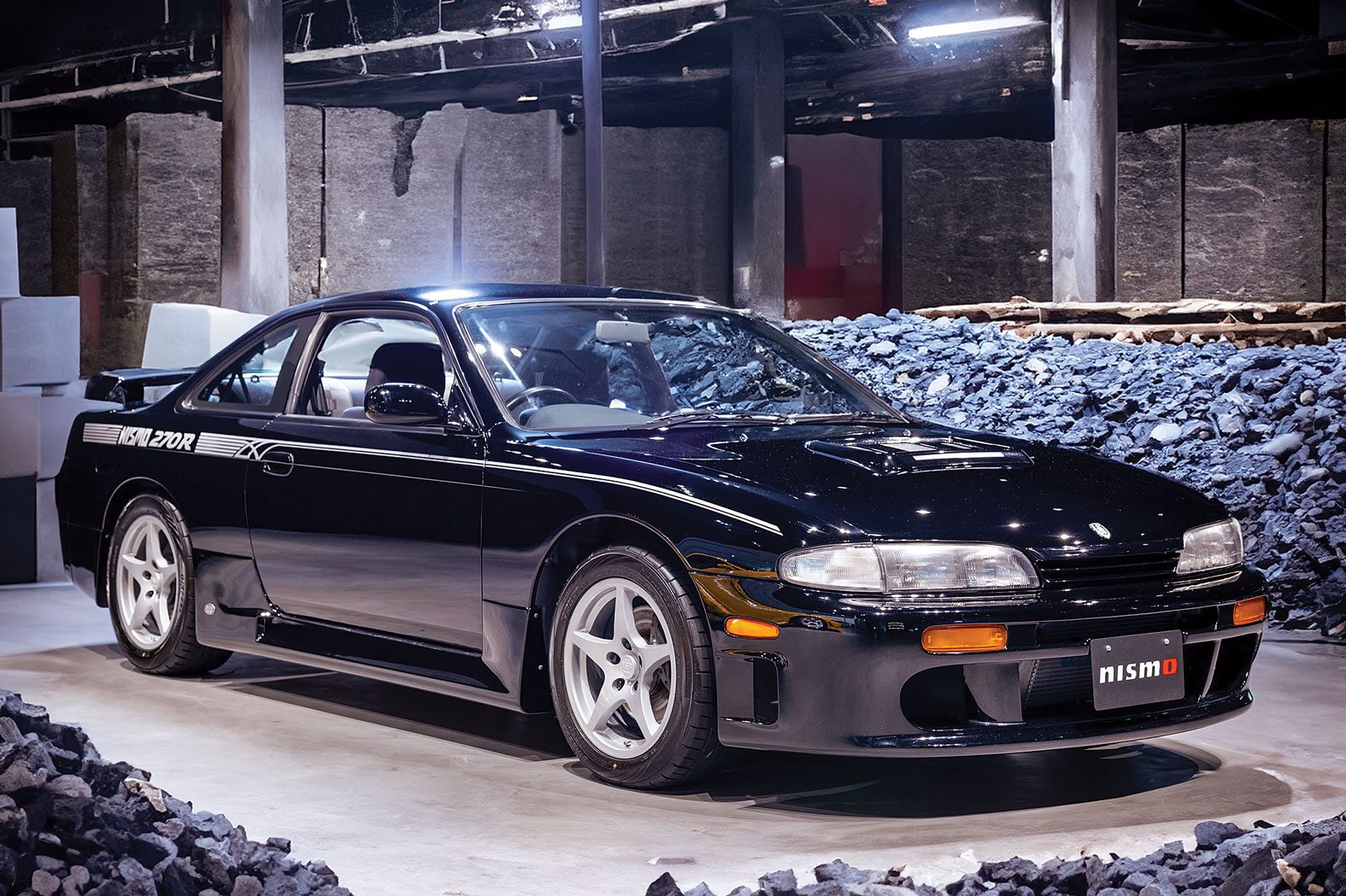

Mark Bahna is a big fan of JDM cars and currently owns a Nissan Skyline R34 GTR Spec II Nür and a Mitsubishi Lancer Evolution IV. But his pride and joy has been his 1994 Nissan Nismo 270R. It is one of only 30 made, numbers matching, and has its original paint and decals. It also carries an impressive provenance, as the car was formerly owned by Keiichi Tsuchiya, Japan’s Le Mans winner, who is known as the “Drift King.” Bahna was stunned one day when he discovered his Nismo 270R covered with rocks, gravel and debris, clearly the result of […]
Mark Bahna is a big fan of JDM cars and currently owns a Nissan Skyline R34 GTR Spec II Nür and a Mitsubishi Lancer Evolution IV. But his pride and joy has been his 1994 Nissan Nismo 270R. It is one of only 30 made, numbers matching, and has its original paint and decals. It also carries an impressive provenance, as the car was formerly owned by Keiichi Tsuchiya, Japan’s Le Mans winner, who is known as the “Drift King.”
Bahna was stunned one day when he discovered his Nismo 270R covered with rocks, gravel and debris, clearly the result of vandalism. The car was parked in the alley alongside a building in Piscataway Township, NJ, that Bahna owns. The alley is mostly on his property and separates the building from the local fire station.
Caught on camera
Fortunately, Bahna had video surveillance cameras installed around his building. When he looked at the tapes, he was shocked to see what had happened. Joshua Scolnick, the volunteer fire chief, had walked up to the car with a five-gallon bucket of rocks, gravel, grass and other debris, and purposefully dumped it on the rear window of the Nismo 270R. Scolnick then left to refill, returning with another bucket load that he proceeded to dump on the car. Then another. And another, before calmly walking away.
Bahna called the police, who arrested Scolnick. He was charged with third-degree criminal mischief. Scolnick worked a plea deal to a lesser charge of disorderly conduct and was ordered to pay Bahna $7,973 in restitution.
But why?
The triggers for these types of conflicts never seem enough to justify the conflict.
Bahna was having difficulty with rainwater flooding the basement of his building, so he installed a sump pump. The water discharged through a pipe that came out the side of his building, and then worked its way next door to the fire station, where it would get the fire station’s flagpole wet. That seemed to make Scolnick’s job more difficult, which angered him.
When he wasn’t able to get Bahna to do anything about it, he appears to have decided to retaliate.
The car suffered a dent in the door, a cracked rear window, chips to the paint and numerous scratches. Although Bahna initially estimated it as a $10,000 repair, he later filed suit against Scolnick and — since he was on duty at the time of the incident — the Township and its Fire District, claiming $500,000 in damages.
Bahna, who is also the manager of Montclair Auto Sales Group, claims that he had a deal to sell the Nismo 270R for $500,000. But when he told the buyer about the damage, the buyer walked away. Bahna claims to have been unable to sell the car after that and that it will have to be completely restored to repair the damage. Since a car is “original only once,” the restored car will suffer from diminished value and be worth less than it was prior to the damage.
Assessing liability
There is no question that Scolnick is liable. He admitted that he intentionally damaged the car, and he doesn’t deserve much sympathy for his despicable conduct. But the question remains: How much?
We don’t know how the criminal court arrived at its $8k restitution figure, but that number won’t be the damage limit. Bahna is not bound by that, and he is free to claim more. In fact, the criminal court’s determination is not even evidence to be considered in a civil suit.
The first thing Bahna is going to have to establish is the pre-loss value of the car, which will largely be based upon its condition. It may have been original and numbers-matching, but it very likely was not a condition-1 show car. After all, Bahna left it parked outdoors.
He will certainly use the $500,000 deal as evidence of the pre-loss value, but there will be many questions asked about that. Was it a firm offer, or was it just a discussion? Had the buyer seen the car, or was the deal subject to inspection and due diligence? Did the buyer have the money? Will the buyer show up in court to testify that he would have bought the car for that amount if the damage had not occurred?
Any less-than-optimal answers to those questions could eliminate the $500,000 offer, and the value will have to be established by other means, probably through appraisal.
Appraisers will always look at recent sales of comparable cars. Recent auction results indicate that Nismo 270R sales were in the $100,000 neighborhood. How then is this car going to be appraised at $500,000?
Scope of repairs
The next issue is going to be what needs to be done to repair the damage. It doesn’t seem that it was all that extensive, and the defendants will argue that localized repairs would be sufficient. But the car has 30-year-old paint, which is going to be tough or impossible to match. If you just spot-paint it, the differences may stand out, which means that a full repaint might be necessary. Once you repaint an old car, you end up with new paint and old trim and wheels. Does everything have to be freshened to make for a consistent look? If you do that, you then have a car that looks new on the outside and old on the inside. Do you have to restore the interior now?
That seems like it’s a bit of a stretch. But if you go there, then what do you do about the undercarriage? Does that have to brought up to snuff as well? And what about the drivetrain and other mechanicals? Where do you stop?
Diminished value
Once you visualize the finished car, you then have to consider the diminished value. No matter how well a car has been repaired, it will always be worth less than it was before the damage.
Look at it this way. Say you want to buy a Ferrari 458 Spider. You find two of them available close to your home that are the same model year, with the same colors, the same options, in the same condition, and have the same mileage. The only difference is that one of them has been damaged and repaired, and the other hasn’t. If they both cost exactly the same amount, which one would you buy?
Obviously, the undamaged one. The repaired car will always sell for less because there is always some risk that the repairs won’t hold up to the test of time, or that they weren’t done properly or completely. You just never know, so why take the risk without getting something — a lower price — in return?
Betterment
If the repairs are modest in scope, you might stop there. But if the car does get fully painted or restored, you also have to take into account that there is a betterment. The fully repaired car, with all-new paint — or a full restoration, as Bahna claims it needs — will be in better condition than it was before the damage. The value of that upgrade will cut into the diminished-value obligation.
There is also the possibility that the car might be totaled; that’s not just something insurance companies make up. If the pre-loss value of the Nismo 270R was, say, $100,000, and the cost of repair plus diminished value is $200,000, then all Bahna is going to recover is $100,000 and Scolnick will end up owning the car.
Lawsuits are intended to make the damaged party whole, not give them a huge windfall.
Other factors
Bahna no doubt has insurance on the car, which should cover some or all of his loss. He must submit the claim, as he can’t give his insurance company a pass and just sue Scolnick. Whatever his insurance company pays will reduce the claim against Scolnick.
However, the insurance policy will likely deny coverage for diminished value, since almost all of them do. That will have to be recovered from Scolnick, who is unlikely to have any of his own insurance coverage for this. It was an intentional act on his part, and I can’t think of any kind of policy that would cover that.
Of course, there are also the attorney fees to consider. Bahna will have to bear the cost of pursuing a lawsuit, and he won’t be able to recover his attorney fees from Scolnick. That will have to factor into his assessment of any settlement that might be offered. Bahna also needs to consider whether Scolnick can even pay a judgment. If he doesn’t have the assets to cover it and files bankruptcy, Bahna could end up being out of luck.
John Draneas is an attorney in Oregon and has been SCM’s “Legal Files” columnist since 2003. His recently published book The Best of Legal Files can be purchased on our website. John can be contacted at john@draneaslaw.com. His comments are general in nature and are not intended to substitute for consultation with an attorney.