
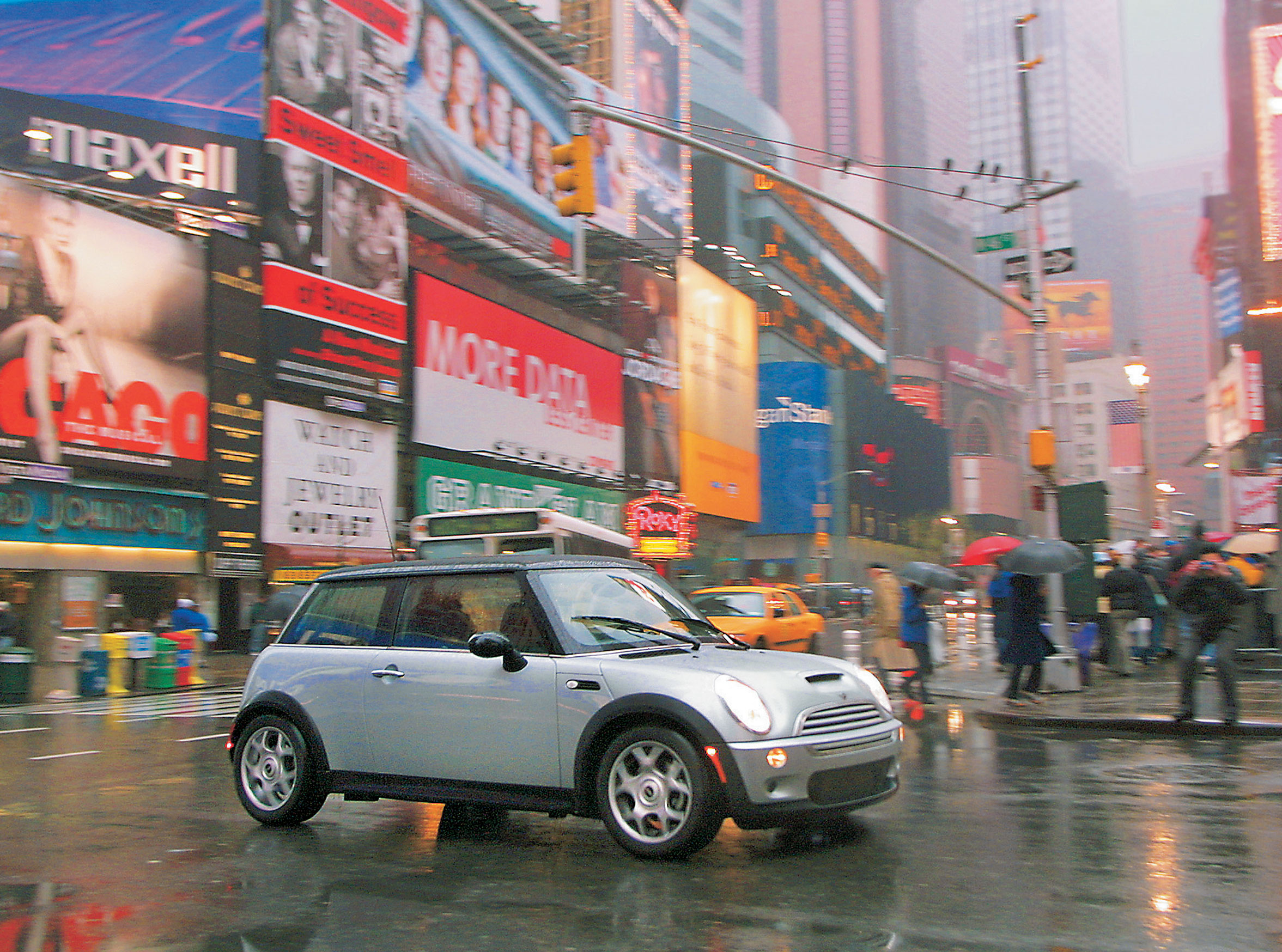

The new Mini entered the market in the 2002, now under BMW ownership, and was immediately successful. This was an era of retro-fabulous versions of European classics. Volkswagen’s New Beetle had turned up a few years prior, and Fiat gave its venerable 500 the same treatment just a few years later. Europeans got a host of options including diesel engines, but in America we got only the top two trims: the gasoline-powered Mini Cooper and the Mini Cooper S. The Cooper was a nice enough car but not a great performer. The Cooper S, chassis code R53, was much more interesting. […]
The new Mini entered the market in the 2002, now under BMW ownership, and was immediately successful. This was an era of retro-fabulous versions of European classics. Volkswagen’s New Beetle had turned up a few years prior, and Fiat gave its venerable 500 the same treatment just a few years later.
Europeans got a host of options including diesel engines, but in America we got only the top two trims: the gasoline-powered Mini Cooper and the Mini Cooper S. The Cooper was a nice enough car but not a great performer. The Cooper S, chassis code R53, was much more interesting. It offered 161 horsepower and 155 lb-ft of torque from a 1.6-liter Eaton-supercharged I4 and used a 6-speed Getrag manual transmission. Output got a boost to 168 hp and 161 lb-ft in 2005 with a new Teflon-coated supercharger. That same year, the manual gearbox was revised with close-ratio gears and an optional limited-slip differential. Mini also added an available paddle-shifted 6-speed automatic transmission. All the Mini offerings in this era were front-wheel-drive. A stock Cooper S offered a 6.9-second 0–60-mph time, though that could be easily and substantially improved in the aftermarket.
The supercharged R53 was built through the 2006 model year, before being replaced by the much-more-sedate turbocharged R56 generation. While the R56 made more power on paper, it lacked the edgy sports-car experience of the R53 Cooper S. Of note is that the Cooper S convertible, launched for the 2005 model year, continued with the R53 driveline and chassis through the 2008 model year.

Special editions
From the beginning, Mini management was cognizant of the brand’s history and made sure to capitalize on it with special editions. The Cooper S was first memorialized with the 2004 40th-anniversary Monte Carlo Rallye edition (known as MC40 by Mini cognoscenti). Mini made 1,000 of these, all for U.S. export, with a purely aesthetic package layered on top of a Sport-package car. These cars were all done up to look like the #37 Paddy Hopkirk rally car from 1964.
If you’re looking for something quicker, check out the 2006 John Cooper Works GP edition, of which 2,000 were made. This factory hot rod made 215 hp and featured a limited-slip differential and various upgrades to the supercharger, intercooler, aero package, suspension and brakes. Note that the factory also cut about 85 pounds of curb weight by deleting the air conditioner and the rear seat.
The GP was a factory version of the John Cooper Works (JCW) kit that dealers had been selling since 2004. The kit (typically installed by the dealer) included a fresh head, Teflon-coated supercharger with an 11% reduction pulley, cat-back exhaust and a reflash of the engine-management software. It produced 197 hp in 2004, and 208 hp in 2005–06, all with a factory warranty. In 2006, you could also get the JCW package from the factory with the limited-slip diff and upgraded brakes as an alternative to the GP.

DIY
The thing most people don’t know about the Cooper S is how easy it is to turn up the wick on this car. Going beyond the JCW supercharger reduction pulley, the aftermarket offered 15%, 17% and 19% versions that got you well past the 215 hp of the JCW GP.
A cold-air intake, cat-back exhaust, uprated suspension and brakes, and a short-shift kit are all easy garage upgrades. The only upgrade not recommended for an amateur is installing an aftermarket LSD. Still, it’s not uncommon to see a lightly modified Cooper S pulling north of 225 hp, with 0–60-mph times in the five-second range and offering exquisite handling.
Parts and labor
To get a sense of what kinds of repairs owners are seeing as these cars hit the 20-year mark, we asked Andy Jennings, owner of Mini Werks in San Carlos, CA. “I really love this model; they are holding up really well,” he says.
Jennings reports that the Eaton M45 blowers last about 150k miles, even with regular service, and that a rebuilt unit costs about $1,000 plus nearly six hours of labor. Together with the water pump, drive belt and other work that goes with the job, owners can expect a $2,500 bill. Alternators have been an issue as well, with replacement costs of $225 plus two hours of labor.
Pricing the market
As a modern mass-market sports car, the R53 Cooper S generally turns up on online auction websites like Bring a Trailer with high frequency. Several Cooper S models tend to change hands online in most months, and many of those are low-miles examples in exceptional condition, including many JCW GP models.
A Cooper S can be had from less than $10k for a nice 2003 example with far fewer than 100k miles up to about $15,000 for a one-owner 2004 example with about 11k miles on the clock. The JCW GP models can sell quite a bit higher, up to around $45k for extremely low-miles examples.
As a rule, look for the 2005–06 cars because of their development advances. You won’t pay any more for those years, but the cars are better. As with most cars of this age, mileage and condition dictate pricing, and the time to buy is now, before the market catches on. ♦
One response to “Don’t Call it “Cute””
Excellent summary of why we love this car!