
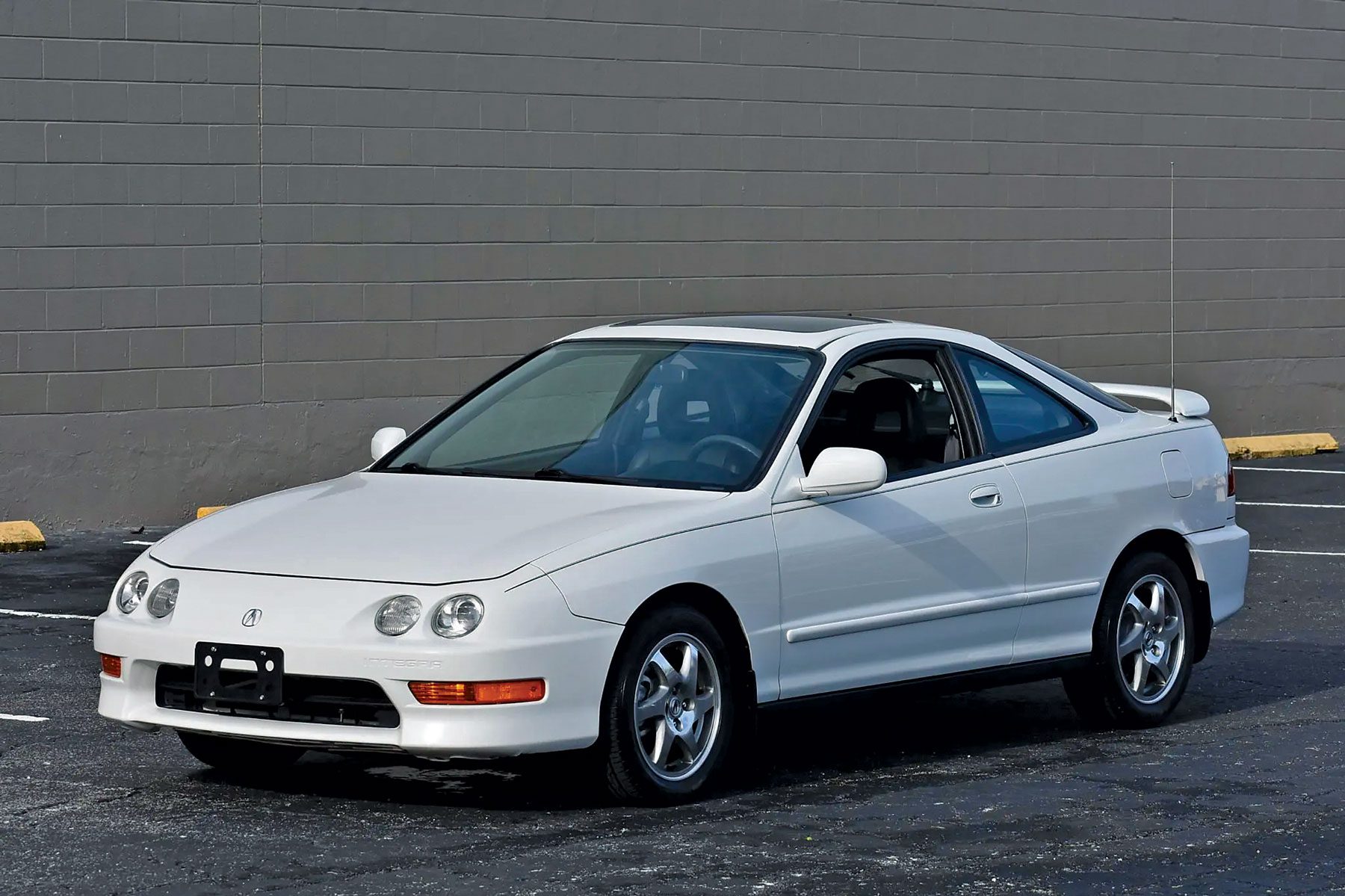

It’s possible that the only thing worth complaining about in Acura’s third-generation Integra is a steering wheel so bloated with a ’90s-era airbag that it dominates an otherwise inoffensive and durable interior. Truly, that’s it. Produced for eight glorious model years, the Integra’s combination of a screaming VTEC powerplant, low cost, capable handling and livability captured enthusiasts’ hearts like few sport compacts of the period. Five trim levels were offered in 2-door-coupe and 4-door-sedan body styles, giving the Integra a wide spectrum of personalities. RS, LS and GS trims came with a 1.8-liter 4-cylinder good for about 140 horsepower. The GS-R […]
It’s possible that the only thing worth complaining about in Acura’s third-generation Integra is a steering wheel so bloated with a ’90s-era airbag that it dominates an otherwise inoffensive and durable interior. Truly, that’s it. Produced for eight glorious model years, the Integra’s combination of a screaming VTEC powerplant, low cost, capable handling and livability captured enthusiasts’ hearts like few sport compacts of the period.
Five trim levels were offered in 2-door-coupe and 4-door-sedan body styles, giving the Integra a wide spectrum of personalities. RS, LS and GS trims came with a 1.8-liter 4-cylinder good for about 140 horsepower. The GS-R came with 170-hp 1.8-liter I4 and the Integra Type R (1997–98, 2000–01) came with a 195-horsepower, 1.8-liter I4. But the low-volume Type R was a different machine entirely, featuring unique unibody stampings to increase stiffness, five-lug (rather than four-lug) hubs, aggressive suspension tuning, tighter gear spacing, and a helical limited-slip differential. Good examples commonly sell for $45,000 or more today — not exactly affordable.
The third-generation Integra that hits the sweet spot is the GS-R. The list of adjectives that make it worth owning is long. Try these: affordable, ubiquitous, powerful, quick, involving, durable and even practical. There’s timeless allure in this balanced sport compact.
Packaging with performance
Thanks in no small part to its B18C1 engine, the GS-R was both a well-rounded daily driver and capable of dominating freeway on-ramps. Though the C1 version of the B18 lacked the higher compression and higher revs of the C5 version found in the Type R, it was praised for both its high-revving power and its fuel economy.
The VTEC switch-over to bigger cam lobes at 4,400 rpm was a difference that mattered back when the 30 horsepower it produced was almost 20% of its engine’s peak output. That peak arrived at 7,600 rpm, but the C1 was happy to keep winding all the way to 8,000. And an appropriately motivated driver could translate that engine speed to a tire chirp on the first-to-second gear shift. A 5-speed manual was the only transmission offered in the GS-R and helped it achieve a 0–60 mph time of about seven seconds.
Part of the magic of the GS-R was that the same clutch that produced rubber on the 1-2 shift was happy to troll around all day in traffic without exhausting or infuriating its driver. That ability to do double duty — to be a performance car one minute and a commuter the next — is what made these cars great.
With its 101.2-inch wheelbase, the Integra was small enough to compete with purer sports cars such as the Miata when it came to mountain roads and autocrosses, but big enough to fit a bike in the back with the rear seatbacks dropped. The chassis was suspended on four-wheel independent suspension, which consisted of double wishbones up front and double wishbones with a trailing link in the back. And it’s this design that allowed over-lowered Integras to remain on the road in the hands of youngsters who lacked judgment to the same extent that they lacked taste.
But perhaps the Integra’s greatest asset was the one it lacked the most relative to its contemporaries — weight. At 2,667 pounds, it was 603 pounds lighter than a Mitsubishi Eclipse GSX. The Eclipse, which bullied the GS-R at the dragstrip, was utterly disconnected when it came to driving hard. Though the GS-R’s steering ratio was a relatively slow 16.1:1, the wheel offered meaningful feedback and directed the Integra’s chassis to dance on command, a test the Eclipse failed.
Durable and affordable
Being Hondas at heart, Integras are relatively durable cars. The engine, especially given its high-strung nature, seems to rack up mileage with few issues. Some owners report problems with VTEC activation, which is often traced back to a faulty VTEC solenoid. The transmission synchros are known to fail, especially if shifts are rushed. And rust can be a problem around the rear wheelwells.
Today, a mid-mileage (40k- to 90k-mile) GS-R in excellent condition can easily summon $20,000 or more at auction, putting original owners in the fantastic position of being able to enjoy one of these cars for more than 20 years, then sell it for a profit. Well-preserved high-mileage examples still sell for more than $10,000. Coupes, with their rear hatch, are by far the most popular body style. Of course, the Integra is perhaps the most aftermarket-molested member of the Honda/Acura family — so be wary of any car that shows signs of modification.
That GS-Rs are desirable and appreciating is without question. But many were made, so it makes sense to be patient and spend your money on a quality example.