
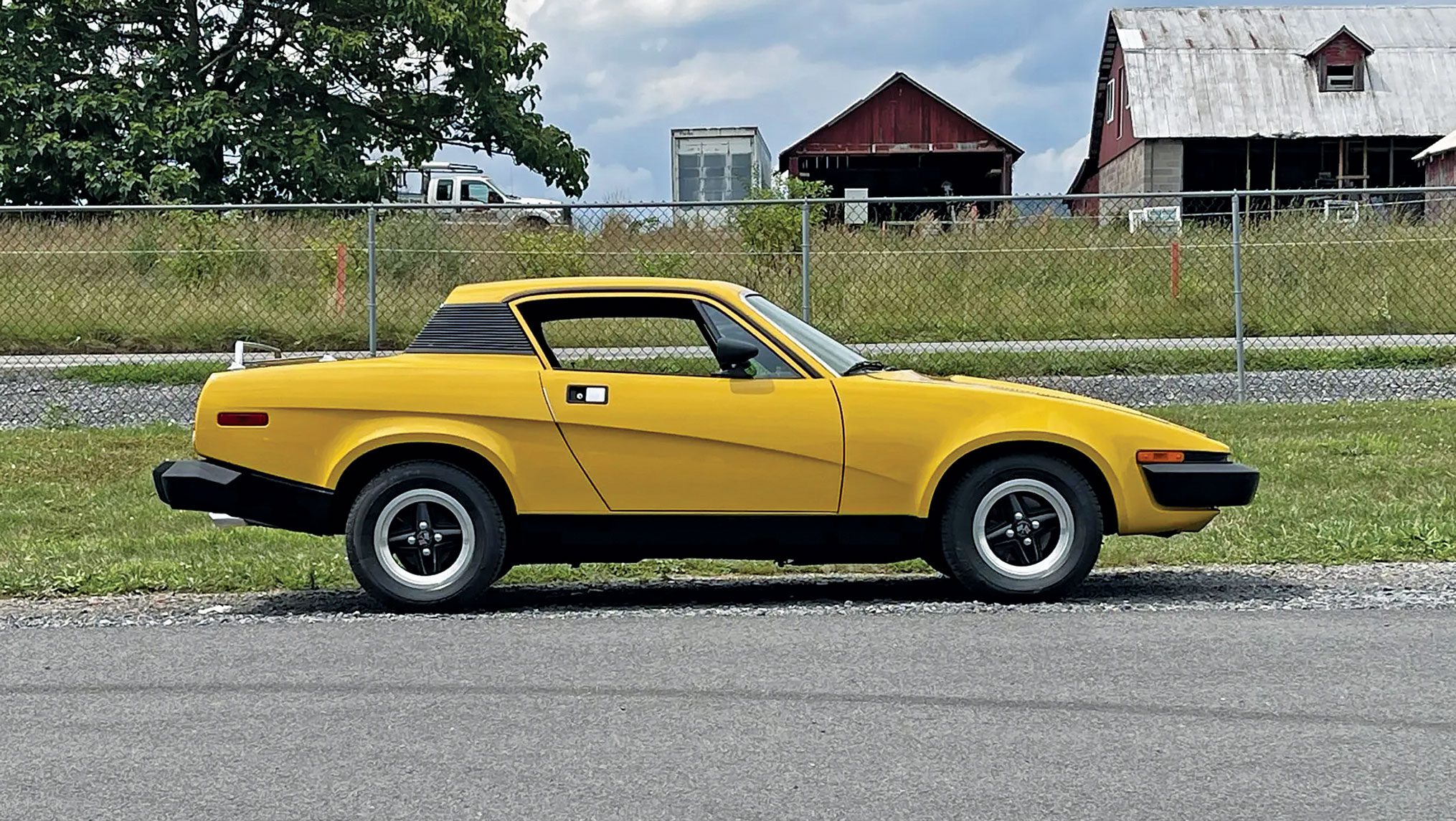

Given collector-car market trends of recent years, many vintage British cars are slowly becoming more affordable. However, even in such a target-rich environment there are still sleepers — bargains among bargains. The Triumph TR7 and its last variant, the TR8, may be prime examples. That does not mean they are sleeper investments. Triumphs are toys, not mutual funds. Big seller Launched in the U.S. in January 1975 and sold into 1981, the TR7 was marketed as “the shape of things to come.” As a drastic departure from the boxy but much-beloved TR4/TR5/TR250/TR6 series, the TR7’s distinct wedge shape quickly earned its […]
Given collector-car market trends of recent years, many vintage British cars are slowly becoming more affordable. However, even in such a target-rich environment there are still sleepers — bargains among bargains. The Triumph TR7 and its last variant, the TR8, may be prime examples. That does not mean they are sleeper investments. Triumphs are toys, not mutual funds.
Big seller
Launched in the U.S. in January 1975 and sold into 1981, the TR7 was marketed as “the shape of things to come.” As a drastic departure from the boxy but much-beloved TR4/TR5/TR250/TR6 series, the TR7’s distinct wedge shape quickly earned its “doorstop” nickname.
Triumph’s timing was not ideal, with the TR7 released into the Malaise Era’s peak slump, to coin a phrase. However, few remember now that the TR7 outsold Triumph’s preceding flagship, the TR6. Triumph made 94,619 TR6s over an eight-year period, but it made 112,368 TR7s (and later, an additional 2,487 TR8s) in just five years. We assume there were bonuses for the product-planning department.
Most of those hot-selling TR7s were coupes due to murmurings that convertibles’ days were numbered with impending U.S. safety regulations. Also, the TR7 had reverted to a 4-banger with the ordinary eight valves and 2 liters of displacement after Triumph fans had grown accustomed to the TR6’s throaty and torquey 6-cylinder, 2.5-liter motor. But let’s also recall that memories of the gas crisis and long lines at gas stations were still fresh and ever-present threats in the 1970s. Downsizing and fuel economy were the order of the day.
Improved, but short-lived
At launch, the 1,998-cc motor of the TR7 officially made 92 horsepower and 119 lb-ft of torque in smog-choked U.S. trim. While those numbers don’t sound too impressive today, they were adequate to move the TR7 coupe’s mere 2,200 pounds smartly enough. Resulting performance of 0–60 mph in 10 seconds used to be considered sporty, and the TR7 sold so well that its U.K. launch was delayed over a year due to stateside demand taking all Triumph could make.
The TR7 was initially offered with an all-synchro 4-speed, and the second year of production introduced an overdrive fifth gear, plus the first-ever automatic transmission offered in a TR. You can’t say Triumph was in a rut, although the rear drum brakes and live-rear-axle suspension didn’t exactly garner nominations for innovation. Triumph didn’t rest on its laurels. After the base coupe sold so well and fears of anti-convertible legislation subsided, they added a drophead coupe (that’s convertible to us Yanks) in 1979, over three years into the TR7’s stint.
Shortly after that, in 1980, Triumph added a more-powerful convertible version with Rover’s 3.5-liter V8 and named it the TR8. The TR8 made 133 hp with carbs, and later, 148 hp with fuel injection. That output was modest for a V8, but it was still a significant boost from the TR7 and enabled 8.1-second sprints to 60 mph — quicker than a new Mazda RX-7 or Porsche 924. With just 2,497 TR8 models produced, it was widely believed that the TR8 was “too little, too late” to save the Triumph brand.
Why buy, and what to look for
This means that the TR7 and TR8 make great entries to classic British sports cars. The usual caveats about inspecting for rust and poorly repaired accident damage apply. A mechanical inspection by a qualified mechanic is always cheap insurance.
On the 4-cylinder cars, a compression check is wise. A TR7 or TR8 that’s been running warm may warp its cylinder head, so check for oil in the coolant reservoir. Also, timing chains require regular replacement every 25,000 miles or so. The 5-speed transmissions are stronger than their 4-speed counterparts. Bear in mind these cars are now going on 50 years old, and major repairs will quickly send the balance sheet underwater. Do-it-yourselfers are prime candidates for Triumph ownership.
Which model to buy? The answer depends on your budget. The TR7 is the cheap entry ticket, and it gets you cheap thrills. There’s nothing wrong with that. The premium for a TR8 gets you a sweet V8 and possibly a longer relationship.
Always affordable
Today the number of surviving TR7s and its TR8 variant is anyone’s guess, but their numbers are relatively small. Those build-quality issues and the end of factory support meant decades of iffy repairs on a model that wasn’t all that reliable even when new. The final TR also suffered the stigma of being a cheap car and was valued accordingly. All of this means that finding a good example is not easy.
The good news is that when you do find a worthy one, it shouldn’t be expensive. Prices for these models have actually defied the overall trend for classic British sports cars, remaining steady or actually registering slight gains over the last several years. About $10,000 should buy the best TR7 you can find, and $5k should be enough for a respectable example. The TR8 is a different animal when it comes to both performance and pricing; you will likely need $25,000 to buy the best, although decent examples change hands in the mid-teens.
Certainly, there will be a premium for really exceptional examples, but with the TR7 we’re still in the price range of a modest college-commuter. The last Triumph sports car may no longer be the shape of things to come, but if it has lasted this long, it still offers the potential of classic British motoring, with all that that implies.