
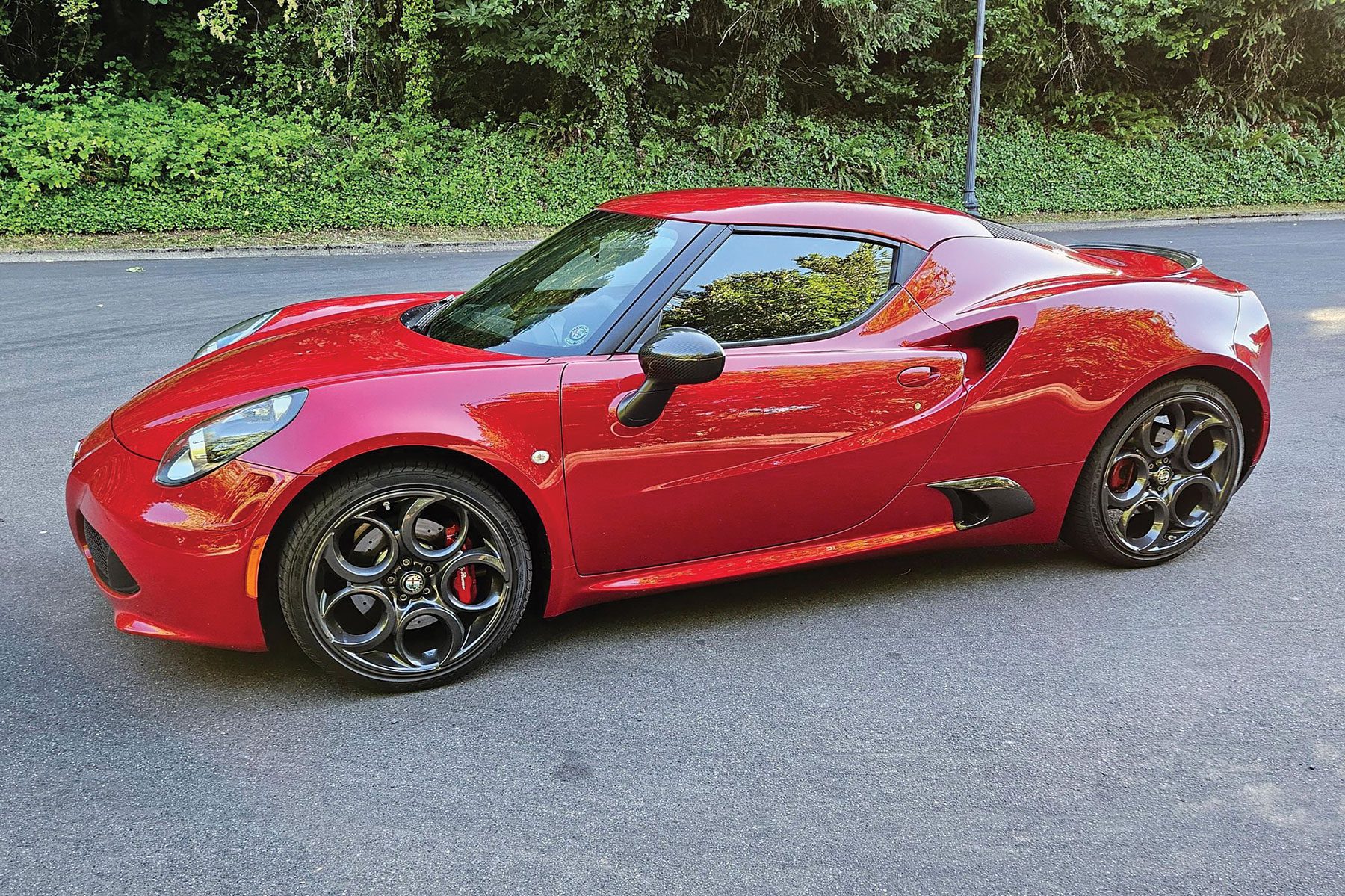

When the Alfa Romeo 4C arrived in the U.S. for 2015, the brand skipped the soft reentry. Instead of a sensible sport sedan (which would come later), it brought a mid-engine coupe with manual steering and minimal sound deadening. It was a bold, slightly defiant move — and one that immediately set the 4C apart. At the core of the new sports car was a carbon-fiber chassis weighing about 143 pounds, to which aluminum subframes are attached front and rear. There are double wishbones up front and MacPherson struts in the rear. Curb weight is roughly 2,465 pounds. For perspective, that’s […]
When the Alfa Romeo 4C arrived in the U.S. for 2015, the brand skipped the soft reentry. Instead of a sensible sport sedan (which would come later), it brought a mid-engine coupe with manual steering and minimal sound deadening. It was a bold, slightly defiant move — and one that immediately set the 4C apart.
At the core of the new sports car was a carbon-fiber chassis weighing about 143 pounds, to which aluminum subframes are attached front and rear. There are double wishbones up front and MacPherson struts in the rear. Curb weight is roughly 2,465 pounds.
For perspective, that’s about 100 pounds heavier than the current Mazda Miata, which manages to achieve that weight without carbon fiber and with a driveshaft running the length of the car. And like the Miata, the 4C was also offered as a slightly heavier convertible, called the Spider.
Turbocharged minimalism
Power comes from a 1,742-cc turbocharged inline-4 mounted transversely behind the cockpit. The aluminum engine produces 237 horsepower at 6,000 rpm and 258 lb-ft of torque at 2,200 rpm. In a car this light, that’s enough to be genuinely entertaining and the 4C feels stronger than its output suggests. Below 2,000 rpm, there’s lag. Above that, the turbo spools quickly, and the car surges forward with real urgency. Contemporary tests revealed a 0–60 mph run in as little as 4.1 seconds, with quarter-mile times in the high 12s.
A 6-speed dual-clutch automated manual was the only transmission offered. Controlled by paddles and Alfa’s DNA drive-mode selector, it shifts aggressively in Dynamic mode but can feel abrupt at low speeds. There is no traditional three-pedal manual option, an omission that inhibits the otherwise-purist nature of the 4C.
This Italian’s defining feature is its steering. There’s no electric or hydraulic assist — just a bare-bones rack-and-pinion setup. At low speeds it’s heavy, and on imperfect roads it can be something of a wrestling match. But on smooth asphalt, the feedback is vivid. It was praised by auto scribes of the day for its immediacy and similarity to the Lotus Elise.
With a 93.7-inch wheelbase and rearward weight bias, the chassis rotates eagerly. Lift at the wrong time or with too much verve, and you may regret it. Breakaway can be, well, abrupt.
The trade-offs are clear. The 4C offers its driver a glimpse into the world of speed unencumbered by “luxury” treatments such as sound deadening, or even door-to-door carpet. The cabin noise is high, and the wide carbon-fiber sills complicate entry and exit. But refinement was never the mission. This Alfa was designed to make you think about life in more basic terms.
Spiders and special editions
For wind-in-the-hair types, the 4C Spider followed later in 2015 with a removable targa-style soft top as standard and an optional carbon-fiber hard top. Though weight increased slightly and soft-top removal and refitting weren’t as easy as with other cars, the Spider benefited from a less-claustrophobic interior with its roof stowed away. That open roof also gave the cacophony of road noise a place to exit rather than bouncing around the car’s hard interior surfaces as in the coupe.
Output remained 237 horsepower throughout production, though Alfa offered a track package including stiffer anti-roll bars and more-aggressive damper tuning. For 2019, the coupe was discontinued in the U.S., leaving only the Spider. Mechanically, the formula stayed consistent, simplifying the used market and reinforcing the car’s singular focus.
The Spider 33 Stradale Tributo special-edition model was released at the end of North American production in 2020. It was built to honor the legacy of the original Alfa Romeo 33 Stradale of the late 1960s. Only 33 4C Tributos were made available in 2020, and they included a two-mode Akrapovič exhaust, unique leather and Alcantara seats, gold-finished 18- and 19-inch wheels, and other features, but no extra power.
An accessible exotic
The 4C’s desirability rests on three fundamentals: carbon-fiber construction, limited production and an increasingly rare driving experience. As sports cars grow heavier and become managed by increasing electronic oversight, the 4C’s rawness stands out.
Generally, 4Cs have relatively few trouble areas, but buyers today should be cautious about accident damage, as repairs to the carbon tub can be costly or prohibitive. Inside, the dashboard’s leather covering can lose its adhesion, creating a bubble effect or pulling away from the edges. Alfa specifies timing-belt replacement every five years, and factory service centers get a bad rap, so a good local independent specialist familiar with 4Cs would be nice to have access to.
Today, driver-quality examples with 15k–30k miles generally fall in the mid-$40k-to-low-$50k range. Low-mileage coupes often trade between $60,000 and $75,000 on auction sites, with no real bonus for Spiders. Production-ending limited-edition 4C Tributo Spiders often sell for double the price of a standard car. In all cases, original, unmodified cars with strong documentation bring the biggest money.
The Alfa Romeo 4C has moved beyond used-sports-car status and into modern-classic territory. It delivers exotic materials and unfiltered dynamics at a price that — for now — remains relatively attainable.