
Seaside, OR, is just 78 miles from Portland. The route there, out Highway 26, is a relaxing mix of 60-mph roads traversing the Coast Range and 80-mph straightaways through Tillamook Forest. It is one of my favorite “Sunday drives” and I like to make it as often as I can — although it’s even better on a Wednesday, when there’s less traffic. While my son Bradley has had some practice driving a manual and we’ve been out to Seaside numerous times together, we hadn’t yet tackled the route in our 1965 Alfa Romeo Giulia Spider Veloce. I very much wanted to […]
Seaside, OR, is just 78 miles from Portland. The route there, out Highway 26, is a relaxing mix of 60-mph roads traversing the Coast Range and 80-mph straightaways through Tillamook Forest. It is one of my favorite “Sunday drives” and I like to make it as often as I can — although it’s even better on a Wednesday, when there’s less traffic.
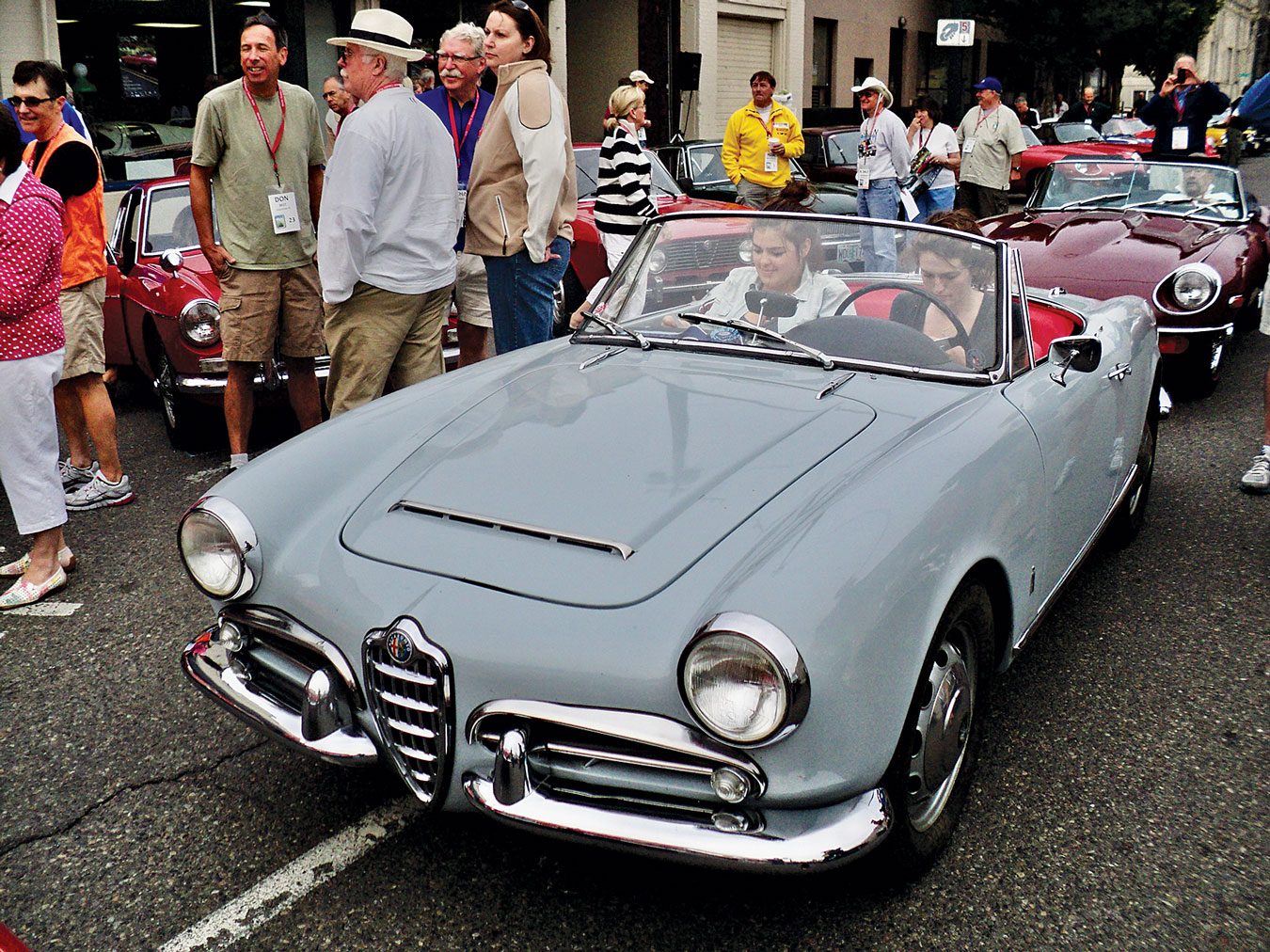
While my son Bradley has had some practice driving a manual and we’ve been out to Seaside numerous times together, we hadn’t yet tackled the route in our 1965 Alfa Romeo Giulia Spider Veloce. I very much wanted to have this experience with him before he heads off to college this summer. I’ve owned the car for 45 years, and as SCM Contributor Tom Cotter said to me, “It’s like a member of your family.”
Chasing perfection
As I mentioned last month, I am making enough progress in my stroke recovery that I’ve been experimenting with driving a manual-transmission car again. A sunny, 70-degree day gave us the perfect opportunity to test my left leg and enjoy some father-and-son bonding.
When I slid behind the wheel, the first few shifts were satisfying. Getting the car up to speed on the highway with the top down was as great a feeling as I can imagine.
But where my mind is willing, my body is lagging. My hip and ankle muscles are still weak, and I may never regain side-to-side movement of my ankle. Consequently, it is not easy to switch my left foot from pedal to pedal. I can’t really tell whether I am pressing on the clutch or the floorboard, so shifting — something that most drivers do without thinking — requires concentration. I imagine I will get better at it with more practice, but right now it is still hard work.
Memory lane
Driving this car after such a long time away from it brings back memories of all the roads I’ve traveled and places I’ve been over the past four decades.
My mantra has always been that old cars create adventures. When you drive a classic car, you are really “driving it.” All your senses are enhanced. You’re paying attention to the road, of course, but also watching all the gauges “just because.” You are listening for any strange sounds. “Is that a wheel bearing?” Even your olfactory system comes into play, ready to sniff out burning oil or a gasoline leak.
Best of all, you can have an old-car experience whether you’re just headed out for ice cream or on a 1,000-mile tour.
That said, at the height of my Alfa collecting about a decade ago, I orchestrated some pretty amazing drives. Over three consecutive years, I fulfilled a dream of driving all three of our 1967 105-series Alfas — a GTV, then our Giulia Super, and finally the Duetto — down the coast from Portland to Monterey Car Week. Being behind the wheel of these 1960s sports cars on the winding, two-lane roads where they are happiest made each trip memorable.
Most recently, we made the same trip in our 2021 Hyundai Elantra. All I remember about driving the Hyundai was our traditional stop for ice cream at the K&R Drive-Inn in Oakland, OR. The car did its job of transporting us in comfort and safety, but you can be behind the wheel of it for thousands of miles and not remember a single one of them.
In one of my Alfas, however, each up-and-down shift on those coastal drives was a joy. As the car would lean into a turn or get a little light while cresting a hill, its demeanor would change, and a little more of its personality was revealed.
I relished it then, and the little taste I got on the trip to Seaside was intoxicating.
Family affair
Yet my clumsy shifting was not treating the car well. So after 10 or so miles, I switched places with Bradley and we were off again.
I told him to use 5,000 rpm as a redline (officially it is 6,200) and sat back to enjoy watching the second of my children to pilot the GSV.
My daughter Alexandra’s first manual experience, at age 16, was driving our 1973 VW Thing on the beach at Cape Kiwanda, windshield folded down and doors removed. (Its easy torque at low rpm made it an ideal teaching machine.) However, by 18 she was driving on the 800-mile Monte Shelton Northwest Classic Rally in her preferred car, the Giulia Spider Veloce.
This Alfa has always had a raspy exhaust note that seems to double in volume above 4,500 rpm. Its dual-Weber carbureted engine puts out 106 horsepower from its 1,600-cc displacement, and the car weighs just over 2,100 pounds. Contemporary road tests recorded 0–60 mph times of 9.5 seconds.
For its time, it was a relatively fast car. Not quick, but fast. The 0.79 overdrive of fifth gear, combined with a 4.10 rear axle ratio, means it develops 20 mph of speed for every 1,000 rpm. Therefore, at 4,000 rpm, where the car is just beginning to come onto the cams, you are going 80 mph with ease. The car can easily keep up with the flow of today’s traffic.
As Bradley rowed through the gears, shifting with authority, I couldn’t help feeling like a proud dad.
I wonder whether his own kids will have the opportunity for such an experience. Of being in a nimble, small-engine sports car, where the harder you work and the more you become one with its capabilities, the more you are rewarded.
It all brought a smile to my face — and admittedly, a tear to my eye. I was happy to realize in the moment that I was having yet another great adventure.