
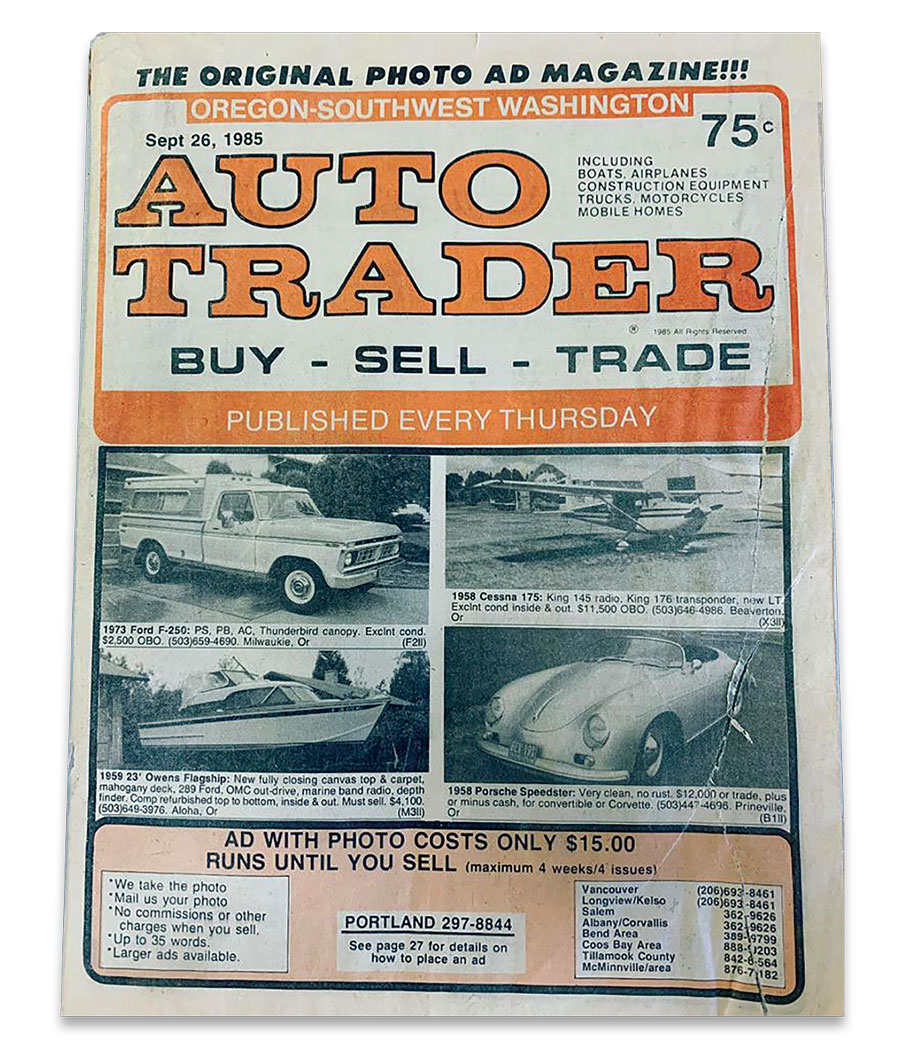

When I first started hunting cars in the ’70s, my routine was simple: I would scan the daily classifieds in my hometown paper, the San Francisco Chronicle. That’s where I found my 1959 ID 19 for $400. It was listed under the “Citroën” heading. Yes, such a category in the classifieds actually existed back then. I also acquired my Peugeot 403 that way (even more of a bargain at $300). Its clutch slipped so badly that I had to downshift from fourth to third to cross the Golden Gate Bridge. I did like its sunroof. The Nickel tour Soon the local […]
When I first started hunting cars in the ’70s, my routine was simple: I would scan the daily classifieds in my hometown paper, the San Francisco Chronicle.
That’s where I found my 1959 ID 19 for $400. It was listed under the “Citroën” heading. Yes, such a category in the classifieds actually existed back then.
I also acquired my Peugeot 403 that way (even more of a bargain at $300). Its clutch slipped so badly that I had to downshift from fourth to third to cross the Golden Gate Bridge. I did like its sunroof.
The Nickel tour
Soon the local Nickel Ads appeared. They were like that era’s Craigslist. The ads were cheap, and so were the cars that were listed.
When I was attending Reed College in Portland, I created a challenge to spice up my trips home. It was 10- to 12-hours one-way, so I would leave at 10 p.m. and drive all night. When I got to San Francisco, I would try to buy a car before noon from the Nickel Ads. I wasn’t picky.
A 1962 Ford Falcon 2-door hard top, with a 170-ci inline-6 and 3-on-the-tree became mine. I traded a battery-powered cassette radio for it. Its oil-pressure warning light came on at 50 mph. I didn’t try to find out what happened at 70.
I’d never had a big American station wagon, so for $350 a 1962 Ford Country Sedan from the “Cars Under $500” column joined my fleet. I sprayed a black racing stripe on its hood and put “352” badges on the front fenders.
It was the first car I owned where the engine was so big you could sit on it while turning wrenches. That hadn’t been the case with my MGA.
In 1992, Auto Trader arrived. (With pictures!) It offered a double thrill, as there was a regional edition and a national one.
The Seattle-area version was distributed as far south as Centralia, WA, about 90 miles from Portland. It arrived around 2 p.m. on Tuesdays, so I was there, waiting to plow through all the pages. Being among the first to see the ads gave me an advantage.
Hard work
There is a common denominator to all of this, in that I had to go hunting for these cars. I had to acquire a publication, leaf through it, place a phone call, get directions, drive to the car, arrive first with cash in hand, examine it and then decide on the spot if I wanted to buy it.
I kept a pile of “Benjamins” — $100 bills — at the ready. I also brought someone with me, in case I wanted to drive a car home. The plan worked, quite often.
I can recall an MG TD, a Volvo 1800S, a Plymouth Superbird (440-ci V8, 4-bbl, 25k original miles), and a 1963 Corvette Split-Window. A Lotus Europa and an Elan, too. Numerous Alfa GTVs as well as Giulietta and Giulia Spiders, along with two Maserati 3500 GTs, a Mistral and a Ghibli, a Ferrari 330 America and a 308 QV. Even a new-in-the-crate Hodaka Combat Wombat, all from the print classifieds. These weren’t coveted collectibles; they were just old, weird cars that nobody cared about. I got them because I got there first.
You’ve got mail
The world is different now. The most successful online auction and classified sites all have a “notify me” function. You pick out the types of cars you are looking for and notifications show up in your inbox. Just like that!
These can be a double-edged sword. SCM Editor-in-Chief Jeff Sabatini has warned me not to set up notifications for cars I have already bought or sold: “All you are doing is punishing yourself.”
Following specific makes or models is not a commitment to buy, but it is a commitment to learn (and yearn). The possibility that you could bid on a car just heightens the fun.
For instance, one week I decided to do a deep dive on Chevy Corvairs. I put them on my “notify” list, and suddenly two or three popped up in my inbox.
We also have a lot of first-hand information at our fingertips (much of it of a higher quality than that which I used to receive from the friends I took along on buying expeditions). I enjoy letting the “trolls” educate me on cars I know little about. Comments such as, “I own six of these…” or “I sold four and bought two — check my history,” cause me to take the advice offered seriously.
Part of the reason the classic-car market is so frothy is that instead of casting a hook into the deep blue ocean and seeing what bites, modern technology has the cars come swimming to us. We simply dip our nets beneath the surface and up they come.
I’ve swapped running to the corner store for the classifieds with clicking on emails in my inbox. Our car-hunting world will never be the same — and there is no going back. ♦