
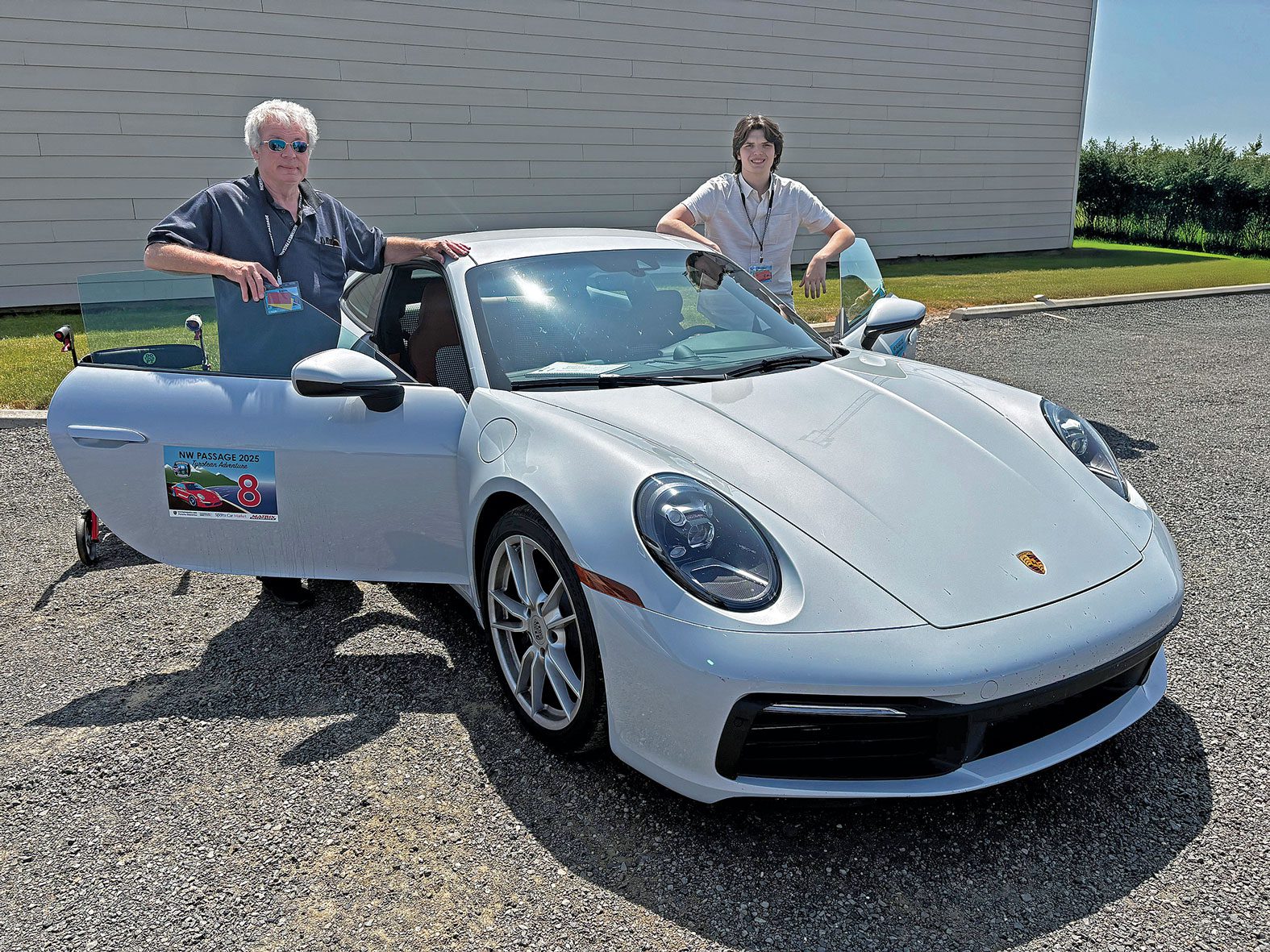
“Dad, next year let’s take the slow Porsche.” Those were my son Bradley’s first words when he hopped out of the 2024 Porsche 911 Carrera he had been driving. We had just finished a leg of the NW Passage, the biannual tour put on by the Oregon Region of the Porsche Club of America (ORPCA). The spring event covered nearly 1,500 miles over six days. There were 40 cars in the group, and another 40 will run the same route in September. Sports Car Market has been a sponsor from the beginning, and I have attended at least 20 of the […]
“Dad, next year let’s take the slow Porsche.”
Those were my son Bradley’s first words when he hopped out of the 2024 Porsche 911 Carrera he had been driving.
We had just finished a leg of the NW Passage, the biannual tour put on by the Oregon Region of the Porsche Club of America (ORPCA). The spring event covered nearly 1,500 miles over six days. There were 40 cars in the group, and another 40 will run the same route in September.
Sports Car Market has been a sponsor from the beginning, and I have attended at least 20 of the tours. Although this is a Porsche Club event, other marques are welcome. I have driven our Lotus Elise as well as several Alfas on the tour over the years.
All-inclusive or á la carte?
Car tours are becoming more expensive. We held our last SCM 1000 in 2023, and the entry price then was $9,000 per car. This past year, the flagship California Mille was at $15,000 per car.
ORPCA has found an innovative way to keep costs down on the NW Passage by skipping the all-inclusive part. There is a fairly low entry fee ($1,295 for the upcoming fall event), and then you book and pay for your own rooms at a discounted rate. Most breakfasts and lunches are on your own, with a couple of banquet dinners included. All-in, it cost me well under $5,000 per car for the event, which made it possible for me to have an entry for myself as well as one for Bradley.
This is a tour for modern cars, which simplifies everything. There is no need for a mechanical support crew or a flatbed tow rig. Everyone in attendance drove their car to the event, so nobody incurred any shipping costs. A first-rate route book is provided, along with an electronic, mobile-friendly version of the route. ORPCA uses an app called Ride with GPS that is actually designed for cyclists.
As I daydream about bringing back the SCM 1000 for the magazine’s 40th Anniversary, I think about how we could incorporate some of these cost-saving measures.
New wheels
At the NW Passage’s final dinner, I introduced the two bravest men in the room — my friends Dr. Ed Frank and Brad Miller. Ed had loaned me his brand-new 2025 Macan GTS for the event. It was showing fewer than 1,000 miles on the odometer before we left. Not to be outdone, Brad invited Bradley to drive his essentially new 500-mile 911 Carrera. My son graciously — and very quickly — accepted.
This pair of Porsches were the newest cars I have ever driven on a tour. (The oldest was the 1947 Siata that I piloted on the 1992 Mille Miglia.)
This was my first time driving a Macan, and I was impressed with it, even though it is nominally an SUV. While there was no escaping its 4,400-pound weight, the car, with its adjustable air suspension, felt tight and composed even through long curves taken at triple-digit speeds. Of its three suspension and drivetrain settings, Sport was by far the best. Comfort was a little soft and with noticeable body lean, while Sport Plus was track-oriented, with high-revving upshifts and a stiff suspension.
The 434 horsepower from the 2.9-liter twin-turbo V6 engine, paired with a 7-speed PDK transmission, turned passing on two-lane roads from terrifying into a snooze.
Similar to the Macan, the 911’s 388-hp twin-turbo flat-6 and PDK feel like they could launch the car into orbit.
Bradley said the 911 was flat with no lean through the turns, and felt like it was stuck to the ground. He described it feeling like being behind the wheel of a hovercraft.
He and his friend and co-driver Joe ran with the pack, obeying my strict instructions not to join “the fast group.” Except for the times they accidentally found themselves leading it.
Fun factor
The best part of driving a new car is you don’t have that constant feeling that the car is going to pull some dastardly trick on you, like the brake pedal going all the way to the floor or the clutch refusing to engage.
Our route took us from Oregon’s Mt. Hood to Leavenworth, WA, then on to Sand Point, ID, Walla Walla, WA, and back to Portland. They were mostly glorious miles through mountain passes and forests.
Overall, Bradley thought both the 911 and the Macan were truly amazing cars, which they were. But he missed the fun factor of driving a classic. At the end of the tour, he told me he was ready to go again in 2026, but wanted to take our 1975 911S like we did last year.
“You see, with that car, I was busy all the time just trying to keep up with the slowest modern 911. I was always looking for the best lines through the turns, and always aware that the back of the car wanted to swap ends with the front. The old car just made me work harder for every mile I put on it, and every mile I went, I liked the car more.”
I don’t disagree, but I also surprised myself in how much I enjoyed driving a new car. I always know there is a little devil lurking somewhere in my classic car, and it was nice not to spend the entire tour wondering when its head would pop up.