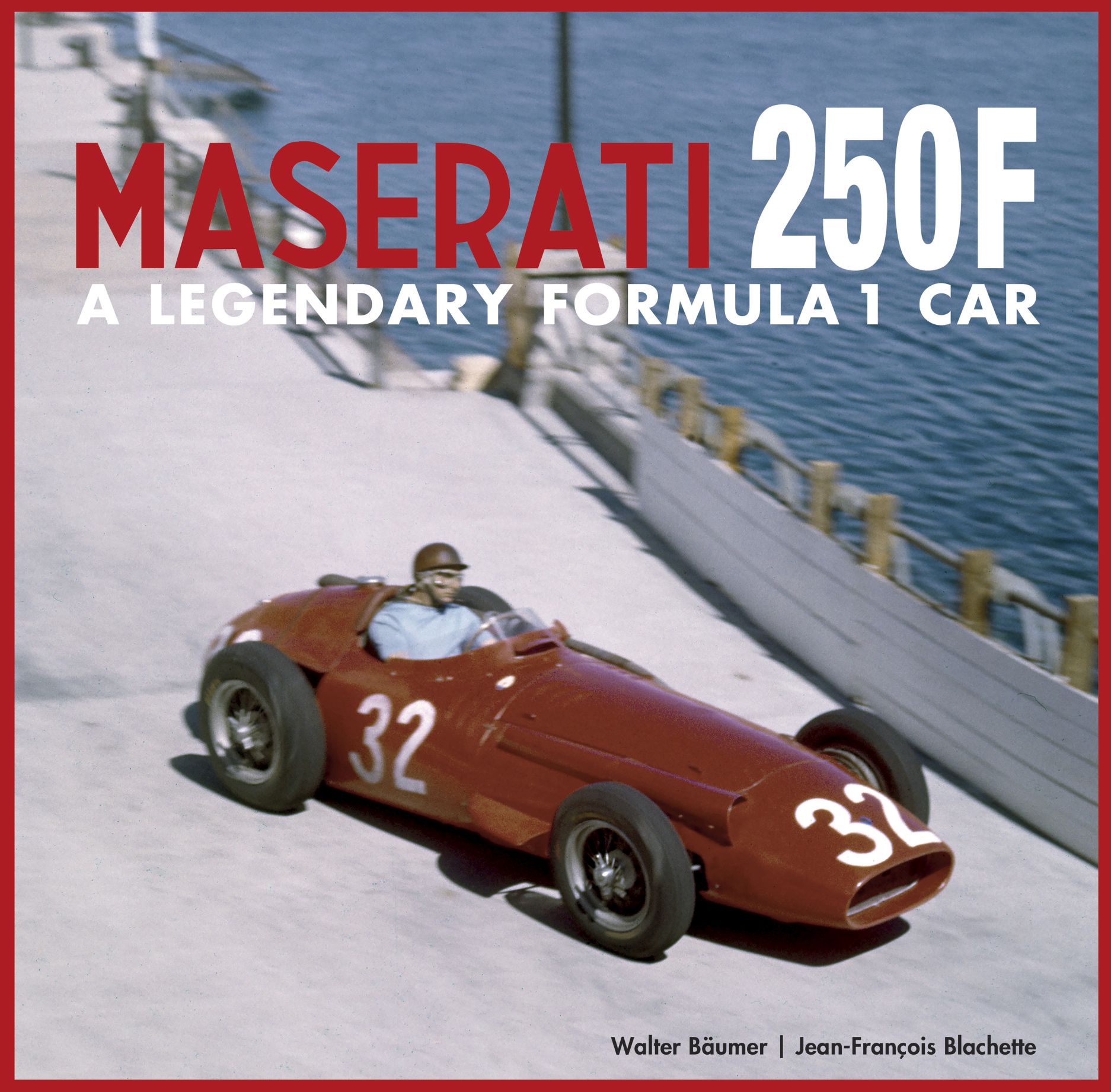
Maserati 250F: A Legendary Formula 1 Car By Walter Bäumer and Jean-Francois Blachette, 848 pages, Dalton Watson, January 2026, $395 Few racing cars have the enduring appeal of the Maserati 250F. This two-volume set, substantial in scope and presentation, is clearly intended as the definitive work on the model.Authors Walter Bäumer and Jean-François Blachette bring the kind of deep archival research and marque knowledge expected of a Dalton Watson production, and it shows throughout. The work feels carefully sourced and confidently assembled. The first volume traces the 250F’s development and competition history, from its 1954 debut through its evolution into Fangio’s […]
Maserati 250F: A Legendary Formula 1 Car
By Walter Bäumer and Jean-Francois Blachette, 848 pages, Dalton Watson, January 2026, $395
Few racing cars have the enduring appeal of the Maserati 250F. This two-volume set, substantial in scope and presentation, is clearly intended as the definitive work on the model. Authors Walter Bäumer and Jean-François Blachette bring the kind of deep archival research and marque knowledge expected of a Dalton Watson production, and it shows throughout.
The work feels carefully sourced and confidently assembled.
The first volume traces the 250F’s development and competition history, from its 1954 debut through its evolution into Fangio’s 1957 championship-winning machine. Period accounts and contemporary reporting add texture, grounding the technical narrative in the experience of the drivers and teams. The second volume shifts to a detailed chassis-by-chassis register, with ownership histories, race entries and results compiled with impressive thoroughness.
The photography is a standout, with period images and technical material reproduced on a large, high-quality scale. At $395, this is not for casual readers. For serious enthusiasts and collectors, however, it delivers depth, authority and presentation at the highest level.
Mustang Unbridled: The High-Octane History of Ford’s Legendary Pony Car
By Robert M. Kennedy, 328 pages, Motorbooks, April 2026, $32
Robert M. Kennedy’s latest tome arrives with ambitious scope, positioning itself as a cradle-to-present-day history of Ford’s defining performance icon. The book succeeds as a broad, enthusiast-friendly narrative, tracing the Mustang’s evolution from Lee Iacocca’s original vision through successive reinventions shaped as much by regulation and corporate strategy as by horsepower.
Kennedy comes to the subject not as an academic historian but as a technician-turned-enthusiast, formerly an automotive tech with experience contributing to Ford Performance media. That background informs a perspective that is engaging and accessible, and the text moves briskly, avoiding the bogged-down feel that can plague single-marque histories. The inclusion of period context, particularly around fuel crises and ever-changing market demands, adds additional dimensions beyond a simple model-by-model chronology.
While it may not break significant new ground, Kennedy’s book offers a cohesive and well-structured synthesis of the Mustang story. Serious students of the marque may find familiar territory, but the clarity of presentation is a strength.
As a highly readable and reasonably priced overview, it succeeds, appealing to both newer enthusiasts and seasoned enthusiasts looking for a consolidated take.