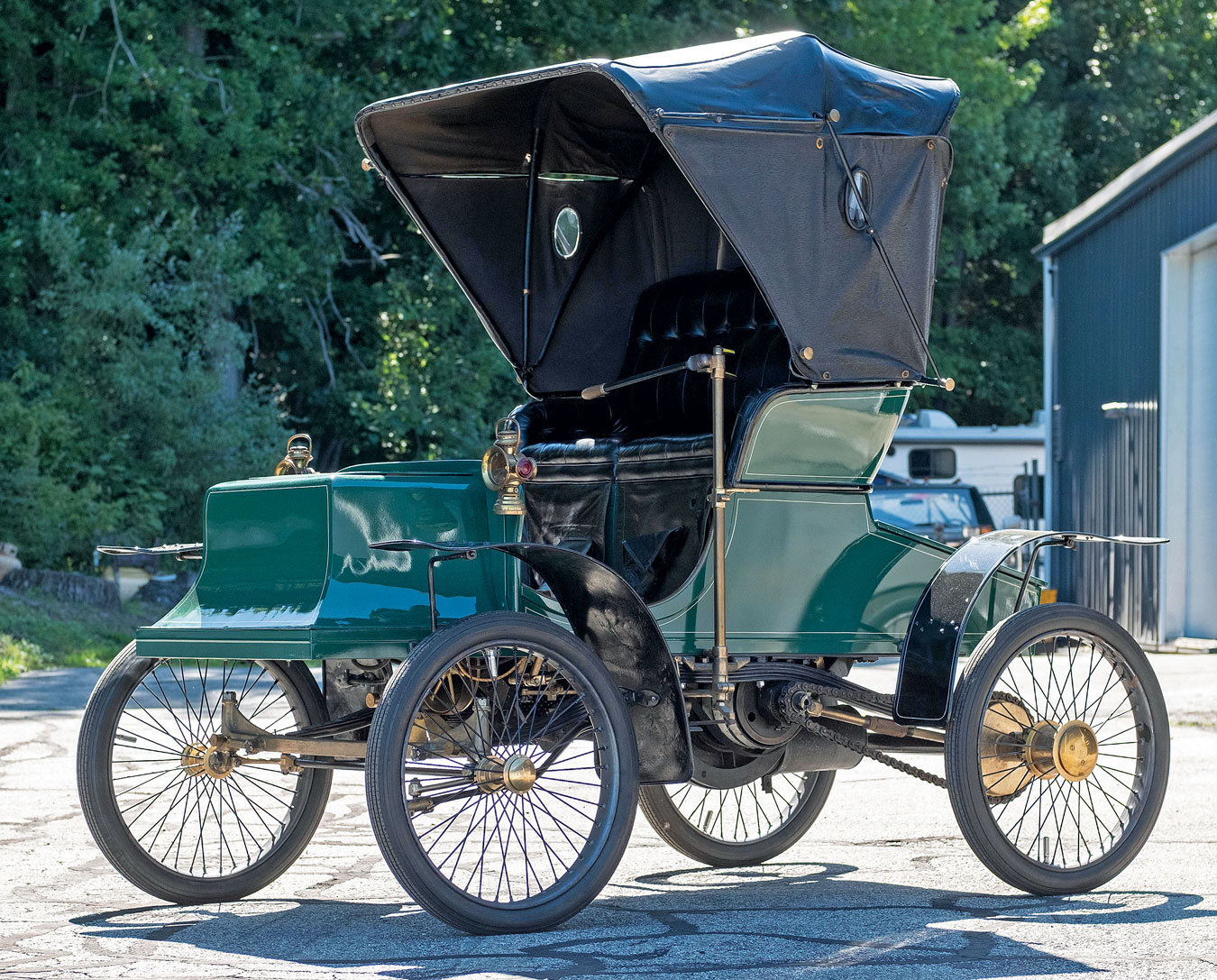
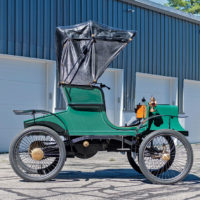
This car, Lot 142, sold for $45,920, including buyer’s premium, at Bonhams’ Newport, RI, auction on September 20, 2022.
A Knox primer
Knox originated in Massachusetts at the turn of the last century. Founder Harry A. Knox was neighbors with famed auto pioneer J. Frank Duryea, who encouraged Harry to build his own automobile. After Knox graduated from the Springfield Technical Institute, he became an apprentice with the Elektron Mfg. Company, which made Perret electric motors. In 1905, he left Elektron to work for the Overman Wheel Company in Chicopee Falls, MA, where he built three gasoline-powered cars. Knox resigned when Overman elected to manufacture a steam car instead.
Teaming up with E.H. Cutler, his former boss at Elektron, Knox built a series of 15 three-wheeled runabouts in 1900. By 1902, he’d manufactured 250 cars, and he’d started building four-wheelers. But by 1904, he had left his eponymous company over a dispute with Cutler.
An air-cooled car, the Knox was popularly promoted as the “Knox Waterless.” In lieu of cooling fins, the single cylinder that comprised its 157-cc, 10-hp engine has about 800 pins screwed into the cylinder barrel. These ¼-inch-diameter, two-inch-long protrusions reportedly led the public to call this model “Old Porcupine,” as the engine resembled the spiky rodent with its sharp quills. Another slogan was, “The car that never drinks.” This Knox has a 2-speed manual planetary gearbox, leaf-spring suspension front and rear, two-wheel rear brakes, a chain-driven rear end and handsome wire wheels.
A Knox completed the grueling Glidden Tour in 1906, without a single penalty point. Knox built its first water-cooled model in 1908; the air-cooled cars were soon discontinued, and later Knoxes included larger 4- and 5-cylinder-powered cars and limousines. Knox continued to build autos in small volumes until 1914, after which cars were discontinued and the company was reorganized. It then built commercial vehicles until 1919.
Old and improved
This example has a correct 1903 Knox chassis and running gear, but the engine is equipped with an early Ford-type carburetor, likely in the interest of better running. The car has also been fitted with a belt-driven starter-generator system, ensuring easier starts with no hand-cranking.
Although the Runabout body on this Knox is purported to be a period unit, it’s not an original Knox Stanhope. But as the catalog asserts, it’s a more desirable choice than a reproduction body. This Model C is fitted with a button-tufted black leather interior and a smart-looking folding top. There’s no steering wheel — a brass-plated tiller suffices.
Bonhams’ research noted that “Knox enjoys a fine reputation today for high quality and novel engineering. Its straightforward mechanics and lack of water cooling make maintenance and use simple. The big engine provides excellent hill-climbing power, and the planetary transmission is easy to operate.”
Horses for courses
One of the attractions of an early Brass Era car like this is its eligibility for the famed London-to-Brighton Veteran Car Run. Britain’s oldest motoring event, London-to-Brighton is held every year in early November, when about 300 Veteran Brass cars descend upon London’s Hyde Park for a roughly 54-mile trek on the old A23 road that’s a true test of driver and machine.
To be eligible, a car must be largely correct and pre-1905. European makes such as Darracq, Panhard et Levassor and Renault (and early Cadillacs) generally sell for six-figure sums. Eligible American cars like “Curved Dash” Model R Oldsmobiles, Model A Fords and Ramblers are mid-five-figure cars. The event is sponsored by Hagerty, and this year the Hagerty folk are driving — wait for it — a 1903 Knox!
Now in its 126th year, the London-to-Brighton Run was publicized in a famous 1953 British comedy film called “Genevieve,” with a 1904 Darracq in the starring role. For decades, Veteran car owners worldwide have flocked to London to make the Run. It’s always cold and it usually rains. Since these spindly old cars have low cruising speeds, it takes hours to make the trip, but finishing is considered a badge of honor among Brass-Era enthusiasts and that has driven up the prices of eligible cars.
Inexpensive and unique
We’d call this car well-bought. Despite its replacement body and incorrect carburetor, this Knox’s comparatively low price and rarity made it an attractive purchase. Comparable turn-of-the-century Brass cars have sold for considerably more. The Waterless Knox is a ticket to ride on the popular London-to-Brighton run, and its curious engineering ensures its lasting appeal. ♦
(Introductory description courtesy of Bonhams.)