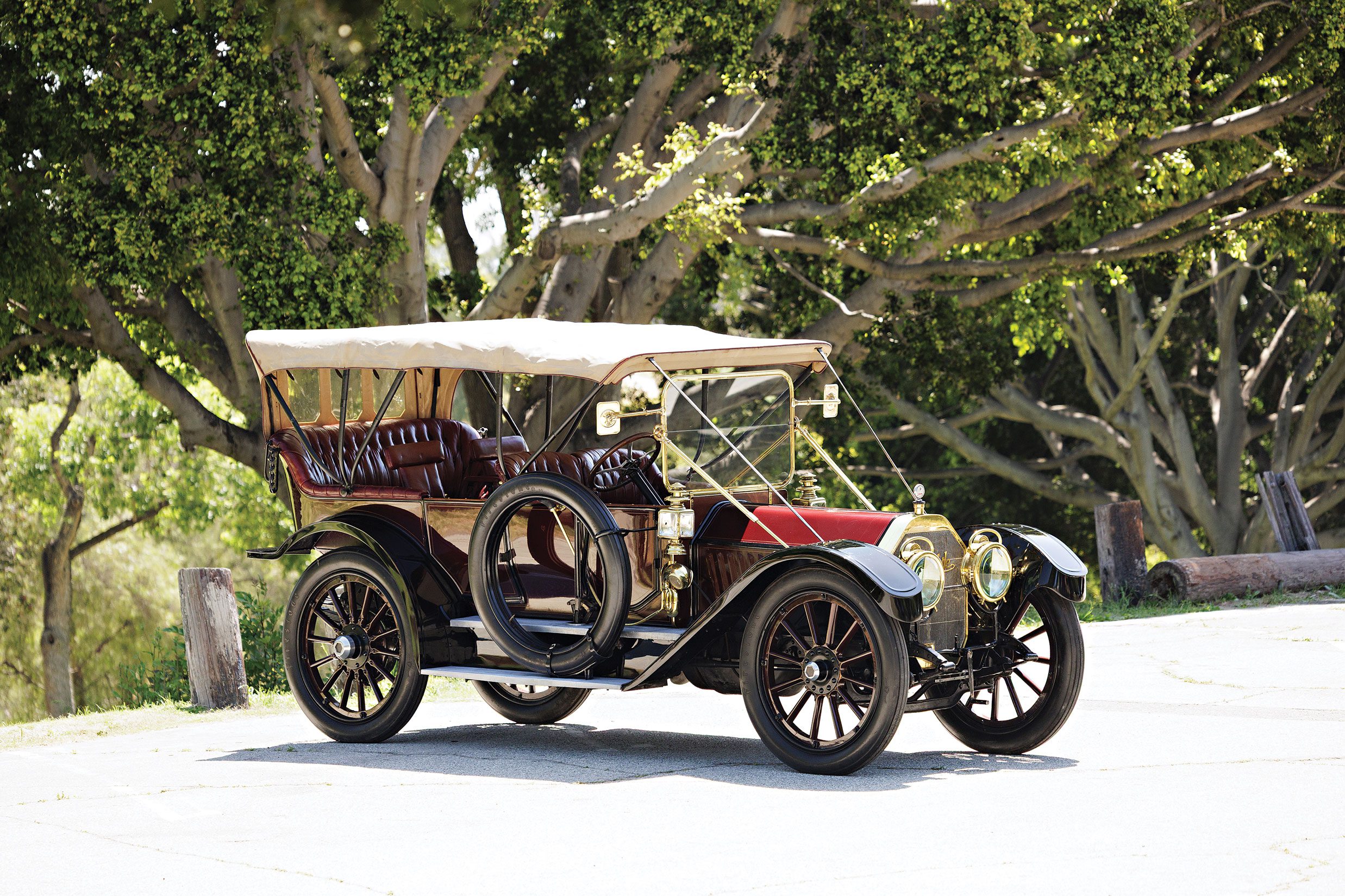
This car, Lot 38, sold for $5,065,000, including buyer’s premium, at Gooding Christie’s Long Beach, CA, auction on September 20, 2025.
This Oldsmobile Limited was once owned by James Melton, an early American antique car collector, who was the subject of many popular magazine articles. He liked to send postcards to rural postmasters, asking if they knew of any antique cars for sale, and offering a reward for tips that led to acquisitions. Melton admired pioneering automotive craftsmen like Duryea, Ford, Olds and Benz “…who struggled to bring power (and) wheels to a world ready to accept them.”
You could compare yesterday’s James Melton to today’s Jay Leno; both highly popular and visible entertainers and car collectors who promoted their fascination with old cars at every opportunity. Writing in his 1954 book, Bright Wheels Rolling, co-authored by Ken W. Purdy, James Melton enthused about this Olds Limited. “Here’s a big, big car,” Melton wrote. He’d bought it from “…the local Oldsmobile dealer…it had done less than 4,000 miles.”
Harvey Firestone wanted the car for the 1946 Parade of Progress, and Melton said if Firestone would provide the massive 43-inch tires — they still had the molds — Melton would repaint and restore the Limited in five days. “We both made it,” Melton said, “just!” This highly original (just one repaint 82 years ago) Olds Limited’s acres of brass gleam like a well-maintained fire apparatus. Magnificent is not an exaggeration here.
King of the road
In the early days of the automobile, when cars for the wealthy were the size of small houses, the Olds Limited was a mansion. Although some of the most valuable Brass Era cars are nimble lightweights, like the sporty Mercer Raceabout, true brass enthusiasts have long prized the towering behemoths of the pre-World War I era. These vaunted road locomotives were almost always open touring cars, perched on ultra-tall wheels and skinny tires, to better traverse the period’s continually rutted roads.
Equipped with enormous straight-six engines, their cylinders were bigger than coffee cans. These massive powerplants, often with redundant coil and magneto-equipped ignition systems, had larger displacements than those of today’s over-the-road trucks. The result was limitless torque and the boundless power to briskly climb any hill, though with the smoothness of a turbine. Their immense presence was guaranteed to keep the peasants in their place. Owners likely had yachts and private railway cars. Possessing a giant road car was simply de rigueur.
But the Limited represented the wrong marketing direction for Oldsmobile. Although the product itself was extraordinary, the Oldsmobile brand arguably lacked the cachet to justify this lofty model’s existence. After just three years, and miniscule sales considering what must have been a huge investment in tooling, the company changed direction to sell more-modest offerings, and the Oldsmobile brand took its logical place in the General Motors lineup, after Buick and Cadillac.
As so often happens in the collectible-car world, a marketing error becomes appealing, particularly when the car itself has merit and few examples were produced. Other examples include the short-lived Depression-era Pierce-Arrow Silver Arrow and the post-war Tucker 48.
Timeless appeal
Although some people were shocked when the late Jack Rich paid $1.6m for an unrestored 1911 Olds Limited in 2007, that sale simply underscored the inherent worth of these rare surviving antiques. In this case, with an unbroken chain of prestigious owners, the ex-Stan Lucas Limited brought nearly double its high estimate.
Think of it this way: Big brass luxury cars can be considered the “Old Masters” of the car hobby. The few wealthy collectors and museums who acquire major early brass tourers weren’t around in the 1900s, but they understand the value of these pioneer luxury cars. Comparable to the collectors who lust after 17th-century Dutch paintings, these collectors weren’t alive when Rembrandt and Vermeer were painting, but they can appreciate the timeless work. And they’re prepared to pay plenty for the privilege.
Opportunity seized
This Olds Limited ticked all the boxes. It’s a rare and desirable survivor of a small number of cars built. It has an unbroken chain of custody that includes prominent early collectors. It’s also very original, save for a quality refinish that was done eight decades ago, with factory stenciling on the underside of its running boards and period-correct brass lighting.
Enormous Brass Era cars like this one appeal to wealthy collectors who delight in taking them on backroads tours. While many Brass Era cars are mid-sized and even primitive, an Olds Limited is majestic and capable of acceptable highway performance, if you allow for their marginal two-wheel braking systems. An Oldsmobile Limited is comparable to a Rolls-Royce Silver Ghost in its size and capability. Its visual impression is stunning, with quality and specifications that are unparalleled for its era.
Our subject Oldsmobile was the top lot in the Stan Lucas estate sale — a purchase that exudes knowledge and good taste. Oldsmobile Limited Touring cars have fabulous presence. With only 10 survivors and many of those cars presently ensconced in collections and institutions, it’s unclear when the next opportunity to purchase one could arise, hence this car’s desirability. I’d call this a fair market value today, and I think a Limited could go even higher when one comes up again for sale.