1928 Mercedes-Benz 36/220 S-TypeSports Tourer

Chassis Number: 35985

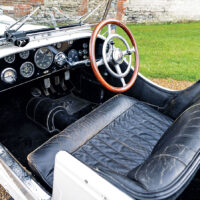
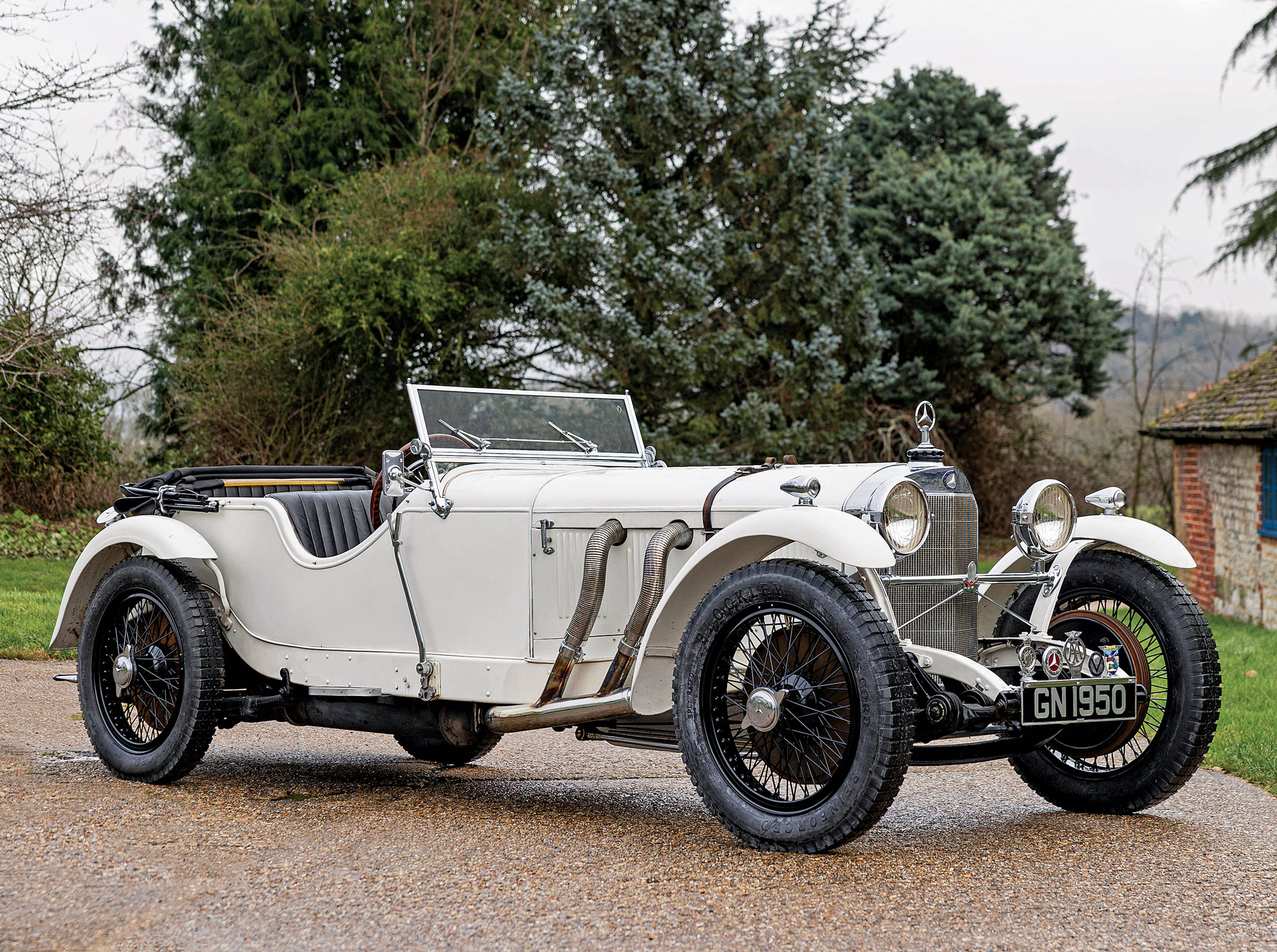
This Mercedes-Benz 36/220 S-Type Sports Tourer was delivered on December 19, 1928, to British Mercedes Ltd. London for a Mr. Cecil Harcourt-Smith of London and Cairo. According to the commission sheet, the S was delivered with a Sindelfingen 4-seater sports body, number 924 614. Recent research has established that it was anything but a standard factory body.

The second known owner was John Fitzroy, the ninth Duke of Grafton, who even while studying at Cambridge was active in motorsport. At the Inter Varsity trails in the spring of 1934, the young Duke campaigned the Mercedes in stripped-down form sans windscreen, hood and spare wheels.

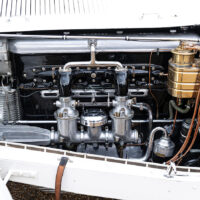
According to the notes from Ronald Johnson, founder of the English Mercedes-Benz Club, it was purchased in 1939 by Robert Arbuthnot. In 1946 it was bought by serial Mercedes fanatic Edward L. Mayer. In this period, it sadly lost its original long front wings, which were replaced with “cycle wings,” the rear ones adapted to match. Johnson adds a further interesting detail, that the “S” has the uber-rare 18-fin elephant blower installed, which he links to either Arbuthnot or Mayer, both having had access to many of these cars in their day and the ability to have procured the best performance-enhancing parts. It is also conceivable that this was supplied by the factory. By 1960, recognizing his age, Mayer looked for a suitable home for his much-loved car, whereupon it was sold to one of Britain’s pioneering collectors, C.W. Peter Hampton.

A number of Hampton’s cars were adapted due to his wartime injury. This S-type, with its central gear change, was adapted to a right-hand change, with its mechanism extended remotely to the right side of the car, and the handbrake to its outside. In doing so, he had this side of the car filled in and the door removed, although retaining the door itself, which — crucially — remains with the car to this day. Hampton died in 1991, and the subsequent sale of his cars was one of the greatest motorcar auctions of all time, with Tom Scott acquiring this car. In 33 years of Scott ownership, the “S” has been exercised with some regularity.

Although missing its typenschild (nameplate), all of its correct factory stampings remain in place, including on the chassis in two places; the engine number and the batch numbers can be found in numerous places on the engine, as well as on the gearbox and back axle. The aforementioned distinctive notched door accompanies the car, and while a plate attached to it appears to be a later replacement, it carries the correct Sindelfingen body number — a number that could only have been accessed by very few and was likely replicated during its 1960s restoration. After a few years on blocks, the Mercedes was recommissioned by the skilled technicians at Jim Stokes’ esteemed workshops.

(Introductory description courtesy of Bonhams Cars.)
Vehicle:1928 Mercedes-Benz 36/220 S-Type Sports Tourer
Years Produced:1927–33
Number Produced:146 S, 111 SS, 54 SSK, 12 SSKL
Chassis Number Location:Plate on firewall
Engine Number Location:On data plate and stamped on engine block
Club Info:Mercedes-Benz Club of America
Website:http://www.mbca.org
Alternatives:1929–30 Bentley 4½ Litre “Blower” 1932–37 Duesenberg Model SJ 1934–36 Mercedes-Benz 500K

This car, Lot 227P, sold for $3,720,761 (£2,871,000), including buyer’s premium, at Bonhams Cars’ Chichester, U.K., auction on July 12, 2024.

After the momentous 1924 merger of Daimler and Benz, the company began developing the new Mercedes-Benz S-type, with the legendary Dr. Ferdinand Porsche serving as Technical Director. From 1927 to 1933, it was one of the world’s fastest production cars, built in increasingly sporting variants such as the SS, SSK and SSKL.

Its massive 6.8-liter SOHC inline-6 saw horsepower increase from an initial 120 to 180, and later 7.1-liter versions even developed 220 hp. Models with the Roots-type supercharger enabled 250 hp when engaged. Ultimately, those cars equipped with the larger “Elephant” blower were said to produce up to 300 hp, which was a staggering amount for the era.

Unlike the temperamental Blower Bentley of 1929–31, which sported a crank-driven Amherst Villiers-designed supercharger that was fully operational at all times, the vertically mounted supercharger used by Mercedes-Benz operated on demand. At wide-open throttle, the driver depressed the accelerator pedal further, actuating a clutch that engaged the blower.

With the pedal floored, the blower kicked in for 20 to 30 seconds. The supercharger blew through the dual carburetors, resulting in an ungodly scream which surely must have frightened drivers of lesser cars when they were overtaken.

With top speeds approaching 150 mph, the S line would soon give way to a focused racing program that begat the famed Silver Arrows; none other than the 500K would supplant it in Mercedes-Benz’s road-car lineup.

A legend of its time

The S-type (alternately referred to as the W06, or Model S) quickly made its mark. In 1927, Mercedes-Benz S-type 26/120/180s, driven by Rudolf Caracciola and Adolf Rosenberger, won the inaugural race at Germany’s vaunted Nürburgring. Factory cars achieved a 1-2-3 finish at the German Grand Prix for sports cars, and privately owned cars had successes at many venues. Ralph de Palma drove an S-type in races in Atlantic City. Noted S-type owners included Sir Arthur Conan Doyle, Malcolm Campbell, Earl Howe, Barney Oldfield, Al Jolson, André Dubonnet and Harold Stirling Vanderbilt, to name a few.

The S-type chassis was available in Stuttgart for about $7,000 (roughly $126,350 in 2024 dollars). Most bodies were built by Sindelfingen, Mercedes-Benz’s captive coachbuilder. Carrosserie Jacques Saoutchik in Paris was responsible for a few custom-built bodies — many with exotic interiors — and several English coachbuilders were commissioned as well.

Just 146 examples of the S-type 26/120/180 Sports Tourer were sold, along with 111 SSs, the improved second-generation version. Only 54 rare short-wheelbase SSKs and 12 uber-rare lightweight SSKL cars rounded out the S-type production. It’s not known how many examples survive today, but they have always been held in high esteem in the classic-car community.

Peculiar patina and provenance

Our subject car’s importance was assured with a succession of six famous owners, beginning with the British ambassador to Egypt. Its long, unbroken ownership chain is an important factor in establishing the car’s value today. But there are a few issues. The low-slung touring body of this S-type has remained basically intact over the years, except for its right-side door and the relocations of the gearshift lever, as described in the catalog. The car was originally black, although decades ago, it was refinished in German racing white. While more typical, this is not as authentic.

In the post-war period, this car’s long, rakish original front fenders were replaced with abbreviated cycle fenders, like those on an SSKL, with the rear fenders modified to match. That was the real sin, as the earlier fenders were distinctive.

The car was also fitted with the “Elephant” blower, possibly supplied in-period by the factory and possibly added because of an influential owner, but ultimately, we don’t know. This is a bit of a toss-up. I’m fine with it, but it’s a minus if you’re an originality freak.

So, there are a few inconsistencies here, plus it’s an S, not a more-powerful SS. And it just doesn’t look as racy as it was when it was delivered in England, nearly 100 years ago now.

Well bought

Previous sales of similar S-types, with complete coachwork, as original, have topped $5m. We saw Bonhams sell a 1928 Mercedes-Benz 26/120/180 S-type at its Quail Lodge auction in 2021 for $5.4m. (And prices for top cars have been at this level for 20 years; Bonhams sold an SSK for $7.4m at Goodwood in September 2004.)

So how do we explain this $3.7m result? It was a fair result for the seller, as the pre-sale estimate was $2.1m–$3.2m. So I don’t think the market is tanking, but rather, this car’s condition and unique modifications held it back a bit. The cost of a full restoration on a significant Mercedes-Benz such as this one will easily exceed seven figures, and that must have been factored into the bidding.

That said, the winning bidder can drive this behemoth as purchased and be welcomed everywhere, whether on prestigious tours or for historic racing. Or step up for a major restoration, write the big check, have the missing fenders fabricated, finish it in black, and try for Best of Show at any number of concours worldwide. Given this racy S-type’s distinguished past, this was a good deal regardless of which path is taken. ♦

Ken Gross Avatar