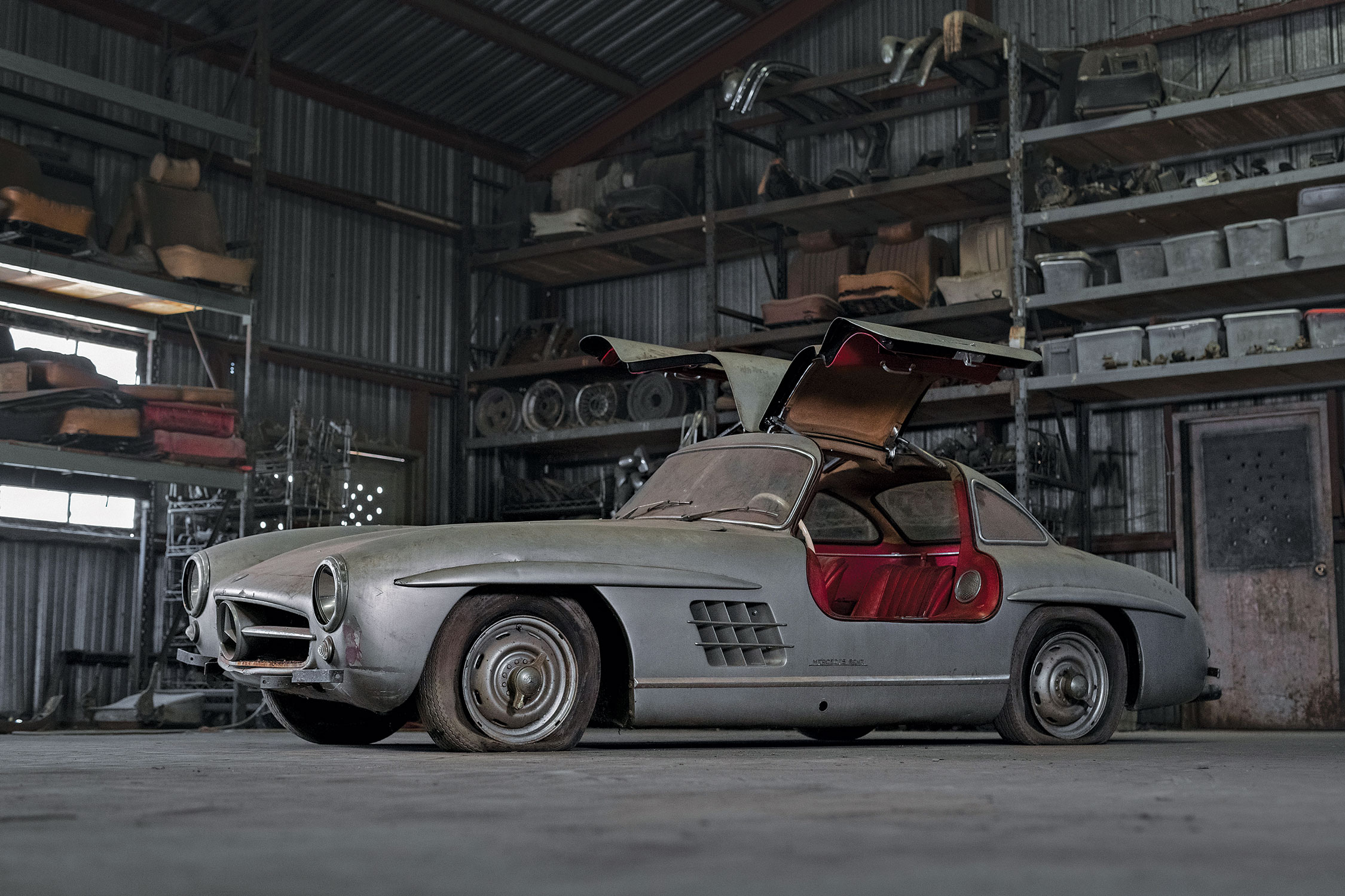
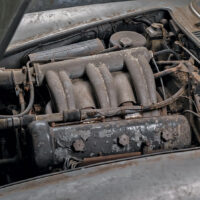
This car, Lot 290, sold for $9,355,000, including buyer’s premium, at RM Sotheby’s Los Angeles, CA, auction, on October 26, 2024.
Rudi Klein’s junkyard was a legendary place that few people got the opportunity to see. While most of the cars there were actually junk, the idea of countless Porsches, Mercedes and other wrecked classics stashed away in one of L.A.’s rougher neighborhoods was still something special. In addition to the parts cars, Klein had a small but high-quality car collection of his own. While some of these, the Gullwing included, suffered from years of neglect and unfriendly, dusty surroundings, it all made for one hell of an auction.
Junkyard treasure
While not the rarest car in the sale, the Alloy Gullwing was undoubtedly the most valuable. Just 29 were produced, of which this car was the sole example originally finished in black. While all the Alloy Gullwings remain highly sought after, and several have changed hands both publicly and privately in recent years, this one boasted an unusual level of originality, making it all the more rare. The presence of a little-known and mostly unseen Alloy Gullwing on the open market was undoubtedly an opportunity — one that bidders felt compelled to pay up for.
The car’s pre-sale estimate of $4.5m–$6m was attractive, but the no-reserve auction was arguably the most enticing feature. There was plenty of discussion about what the car would bring leading up to the sale. Barn finds, collections and estates generally overperform the market, and RM Sotheby’s had the trifecta here. While the market seems as erratic as ever, an opportunity — or even perceived opportunity — will still bring a big premium.
I often see barn finds bring far more than they deserve, proving a layer of dust can convince someone they’re buying more than just an expensive project. In the case of this car, however, the basis was truly sound and original. Rare among barn finds, the next owner has the option to either conservatively restore this car, preserving much of its originality, or endeavor a complete restoration. Though the latter is far more likely, that choice spoke to the underlying quality of this example.
A restoration, however, would cost an additional million dollars and could take years. So, if we’re to assume the buyer, a member of one of America’s wealthiest families, sends the car off for restoration, his cost basis will quickly exceed the $10m mark. That’s a level few people would have guessed an Alloy Gullwing was worth in today’s market.
Only original once
As I’ve written before, there has always been a general data-driven consensus on the appropriate premium for Alloy Gullwings over standard examples. That value difference is usually a factor of four or five; to me, a truly astonishing figure given that the two cars are virtually identical in appearance.
Up until the auction, I think many would have priced a great Alloy Gullwing in the $6m–$7m range. Subtract the cost of a restoration and the auction estimate seemed realistic. This past summer, a $7.5m offer surely would have bought you a good car. The previous high-water mark for a no-stories Alloy was just shy of $7m back in 2022, and I don’t think you’ll find a soul who feels the market has gone up since then.
So why the monster premium here? Primarily because it was a great car: good provenance, great spec, highly correct and original, and ultimately a hard thing to come by. Anyone looking for an Alloy Gullwing would be interested, so I won’t argue it wasn’t worth a bit of a premium for those factors alone. To me, the Alloy Gullwing was clearly one of the more deserving cars to sell over market value at this auction. Gullwings have performed better than most collector cars in the past couple of years, and the alloy-bodied cars are obviously the most prized.
An unrepeatable result
Interestingly, the Gullwing was the most expensive lot of the sale, but it certainly wasn’t the most shocking result. On the “overpaid” scale, I’d say the project Miura P400 for over $1.3m, or a 356 Roadster for $1.2m, rank higher. Frankly, many of the parts cars, or even parts, brought senseless money. Point being, the whole collection garnered exceedingly strong prices.
In today’s market, we’re more prone to seeing these kinds of headline-making results. Had you offered this car privately to the buyer or underbidder for substantially less, I’m not convinced it would have sold. At least, not easily. Furthermore, I don’t think the result is repeatable; auction a good Alloy Gullwing tomorrow and I’d bet it won’t make $8m.
That might sound cynical, but it’s just pragmatic. One-off results are common these days. With the perception of an opportunity at the junkyard auction, things were bound to go this way. Clearly, people aren’t afraid to pay record prices when they feel an opportunity can’t be passed up, but defining an opportunity is now harder than ever. In the case of this sale, credit goes to RM Sotheby’s marketing. A collector car junkyard is intriguing, but not a typical place for collectors to overspend. ♦