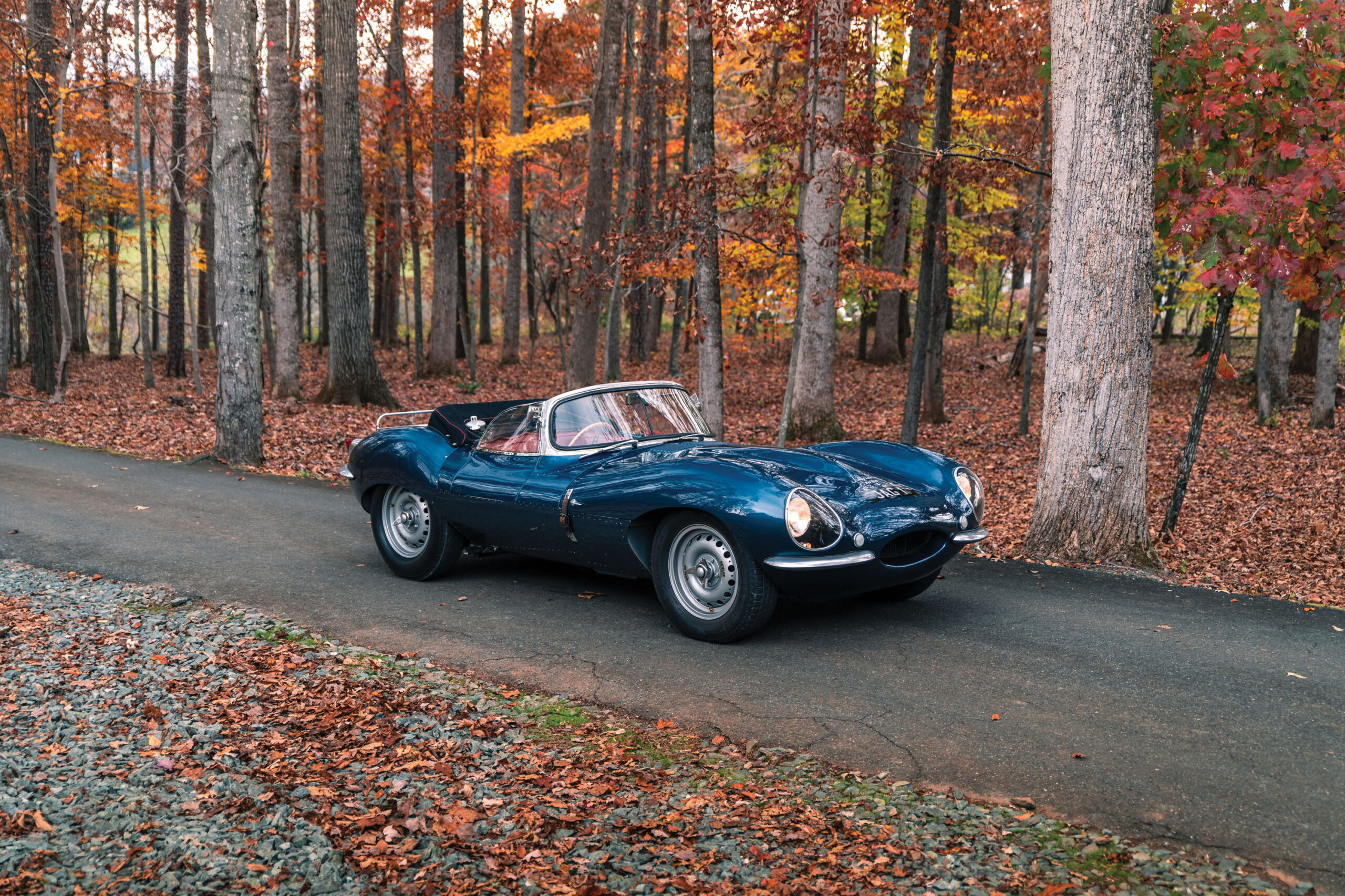
This car, Lot 351, sold for $13,205,000, including buyer’s premium, at RM Sotheby’s Monterey, CA, auction on August 19, 2023.
A couple of years ago, a colleague asked for a second opinion on an XKSS he was valuing. Going rate then was around £7m ($9.5m). Insurance value, I thought, should be £10m ($13.5m).
Why? Well, if the car was irrevocably totaled with only its chassis tag remaining, and you wanted an equivalent replacement, then first you would have to persuade one of the other 16 (or 18) owners to sell. Market forces and the bush telegraph being what they are, it would be known that you were seriously in the market for one of them, and the price would inflate accordingly.
This also helps illustrate that XKSSs are generally worth more than their D-type racing sisters, except for those with serious history such as XKD501, which sold for $22m in 2016 (SCM# 6809484). But that was the 1955 Le Mans winner. The evil forces of commerce also explain why at least one XKSS has been reconfigured as a D-type and changed back to an XKSS again, as fashions (and marketability) shift.
Before the 16 (or 18) XKSSs completed at Browns Lane, Jaguar says it built 75 genuine factory D-types in-period, though most sources count 71. (And, as the old joke goes, of those about 100 remain…). Added to these lately have been the 25 “continuation” D-types, which must have caused consternation to those enterprising owners who had already built cars around unused chassis numbers — plus the nine “missing” XKSSs, all of which will potentially cloud identity issues in coming years. But that’s another story.
One to drive
This car, luckily, appears to have a watertight history. I didn’t see it at Monterey, but my esteemed colleague Michael Leven did, and described it thus: “Overall, I rated the car itself as a Condition 3, as the paint, while well prepped and applied at some point, had a number of small chips, gouges and scuffs throughout, and a couple of larger spider cracks in the left fenders from rocks hitting the underside of the body. The gaps (variable) and the panel alignment were what I would expect for what is essentially a race car. The interior was quite sound physically, but the seat covers were soiled, cracked and drying out a bit — nothing critical. The windshield had significant wiper scratches on both sides.
“With its excellent, well-documented history, presentation and record of recent use (2022 Colorado Grand) it is clearly not a garage queen, and its condition was appropriate. I loved that the car gets used as it should and looks the part. I’d rather own it just as it is to fully restored and locked away.”
As the catalog had it, “As so frequently happens in automotive history, their legend long outlived the brief flourish of their construction, as they became recognized over time for what they are — a D-type, only a year removed from the model’s last victory at the 24 Hours of Le Mans, with a door and weather protection, sold for the street. It was a lunatic idea, born of economy, and everyone who has had the thrill of driving one since has had their lives made richer for it.”
U.S. to U.K. and back
Even this “very original” car has had a replacement bonnet (and the catalog notes that various remedial works carried out later included “adjustments to correct the shape of the headlight bezels”), that bulkhead change, and for a time the car didn’t have its original engine block. It’s been various colors and the wiring loom is new; one carburetor is not the original, possibly changed at the factory when it was new.
It was originally XKD564 and finished as an XKSS in Cream with red leather, arriving at Oxford Motors of Sacramento. They sold it in 1960 to Sidney Colberg of San Francisco. He kept it until 1975, occasionally racing it, before selling back to the U.K., to Anthony Bamford, later Lord Bamford. By this time, it was black. Interestingly, we’ve got a listing for it during this period in 1969 as a no-sale for $30,450 at Christie’s.
It was almost immediately sold on to Geoffrey Marsh of Hampshire, whose in-house shop removed the body from the chassis, replaced the bulkhead behind the seats to eliminate holes cut for roll bars, and applied new paint and upholstery. Following this, it passed to Chris Stewart of Essex and then in 1976 to noted enthusiast IG Campbell McLaren of Glasgow, Scotland. He registered the car as JAG 1 and, following a historic racing shunt had the front clamshell replaced using a new one from RS Panels, and the car refinished in Ecurie Ecosse Blue.
Campbell McLaren continued to race it, including at the first occurrence of what we now know as the Le Mans Classic, in 1978. In 1992 it was sold to Allen Lloyd of Staffordshire. During servicing with respected competition Jaguar authority Chris Keith-Lucas, it was discovered that the engine block had been replaced, probably during its early years of track time in the U.S. Fortuitously, the numbers-matching block came to light in 2015 and was reinstalled, under a freshly overhauled cylinder head. CKL Developments also fitted a new radiator and aluminum header tank, both copied from the originals, as well as a new fuel tank.
Lloyd kept it until 2021, occasionally lending it to the Jaguar Heritage Museum for exhibition at Browns Lane, as well as for a cameo in the Jaguar edition of the “Victory by Design” video series. During 2022 it was advertised with Tom Hartley Jr. (along with a claim that it had been in ownership for “30 years”), which is presumably how it wound up at auction in Monterey.
Fair market value
The JAG 1 number plate, which it could probably still legally wear if it returned the U.K., would command around $300k. The “service handbook and maintenance instructions which accompany this lot,” promised in the catalog, turned out to be digital copies, but I can’t see that minor detail affecting the value.
Almost 70 years since these cars were created, the originality of 707 is about as good as it gets. Bidding went fairly fast among a handful of interested parties from a $7m opener to settle on a realistic final figure of $12m, or $13.2m all in. Going back to my original valuation of £10m, the price looks about right. ♦
(Introductory description courtesy of RM Sotheby’s.)