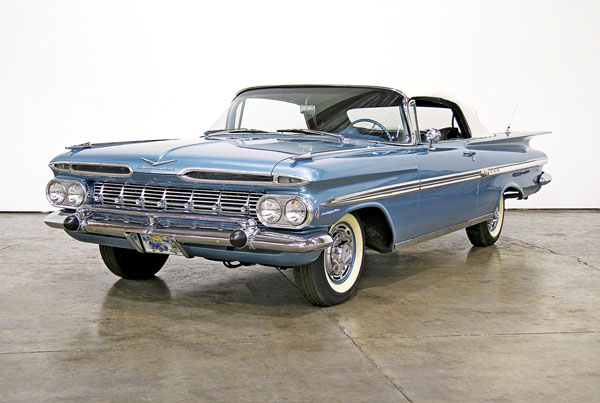
This car sold for $81,900, including buyer’s premium, at Bonhams & Butterfields’ sale of the Wally Lewis Collection in Portland, OR, on June 11, 2011.
Harley Earl’s design studio gave Chevrolet’s full-size line a complete revision for 1959. Several junior stylists (who worked hard to convince Earl that a change was needed) dropped the old, rounded body in favor of a lower, wider, and longer profile—and overstated fins—to help it compete with Chrysler’s Exner designs.
Buyers had their choice of nine engines, five transmissions, two suspension systems, and a multitude of other options, which allowed them to build pretty much whatever they wanted. 1959 was the only year a 4-speed and fuel injection were both offered on an Impala, and our subject car had both of these highly desired options.
Chevrolet advertised the Fuelie Impala in the March 1959 issue of Motor Trend as a “Chevy that handles like a sports car…for five!” Although that sports car claim may seem a little far-fetched, given the Impala’s barge-like handling, it’s hard to argue with the notion that a fuel-injected Impala was basically the CTS-V sedan of its era—using Corvette-proven technology to make a “sports” car with room for the whole family. I use the term “sports” loosely… but what other American car of the era offered better performance, style, and comfort as well as room for the kids?
A rare breed
Fuel-injected Impalas are a rare breed. GM historians disagree on just how many were built, with some claiming numbers as high as 140, and others quoting figures in the double digits. Regardless, of the 1.4 million cars of the Bel Air, Biscayne, and Impala line in 1959, only a small fraction came from the factory with Fuelie engines. That makes them hot commodities in the classic American car market today—especially if the car is properly documented.
So if injected Impalas were the hot ticket, why were so few built? The simplest answer is economics. The fuel-injection system was expensive—about $500 compared to $269 for the 348-ci engine. What did buyers get for the money? The Fuelie engine offered both low-end grunt and high-rpm power, and when set up correctly, it also provided a stable idle, easy starting, and quicker warm ups. Theoretically, it was the better mousetrap.
But although the Rochester unit was reliable when set up correctly, it did have its share of issues. It took special knowledge to tune the Rochester fuel injection system, and even when the unit was running its best, there were drivability issues in hot weather. The 348 could be had with similar horsepower and torque to the Fuelie’s output, but it wasn’t as well balanced throughout the rpm range. All else being equal, the 348 offered a better overall driving experience, so in the real world, it was the better buy—and more of them sold.
As we see with so many Fuelie Corvettes, quite a few of these Impalas probably lost their injection systems over the years in favor of a simple Holley or Carter AFB 4-bbl carburetor, and that adds to the rarity of an all-original example. Building a correct replica requires finding all the rare Impala-only pieces. Even in the Internet age, this is no easy task. And if you’re looking to do it, you’d better have your checkbook ready—rumor has it that N.O.S. fuel injection emblems, which were unique to the ’59 and which this car had, bring a four-figure price—IF you can find them.
A real-deal Fuelie?
This car was in great overall condition, with smooth paint, excellent chrome, nice top, and a tight, original-style interior. The underhood was clean as well, although several onlookers pointed out that the fuel filter setup was the earlier 1957-1958 style, rather than the later 1959 piece, which was mounted near the firewall. GM was famous for making running changes on the assembly line, so it’s tough to say whether or not that was correct for this car.
Sharp-eyed onlookers noticed a flaw in the hood paint, which suggested that there may have been an engine fire at one point in the car’s past. The flaw was one large, subsurface imperfection square in the middle of the hood, with a repaint showing metal flake in a striped pattern. The injection unit had been removed and rebuilt during Lewis’ ownership, but it’s hard to say if it was related to the hood paint issues. If I had to guess, I’d say it was.
Bonhams was careful to point out that this car had no documentation proving it to be an original Fuelie, and GM records are notoriously tough when it comes to tracking engine options. A really good 348-ci Impala convertible without the injected engine is a $65k–$70k car, depending on its condition.
A completely documented Fuelie convertible, however, should be worth well over six figures in today’s market. So for this car, something in the middle was about right, considering that building a replica requires extremely rare one-year-only Impala-specific Fuelie parts and trim.
If the new owner can prove that his new car is the real deal, then at this price, the car was a screaming deal. Otherwise, consider this well bought and sold as a hard-to-duplicate replica of one of the rarest full-size Chevrolets ever built.
(Introductory description courtesy of Bonhams & Butterfields.)