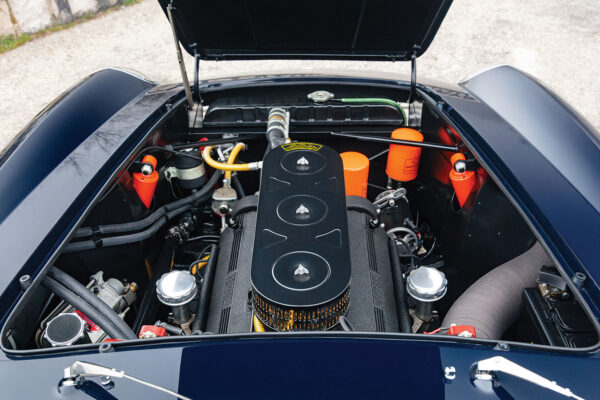
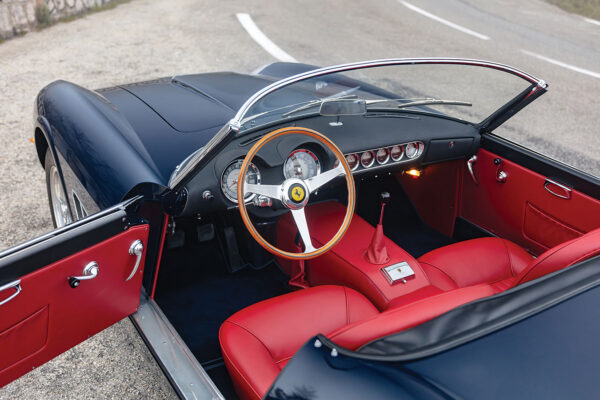
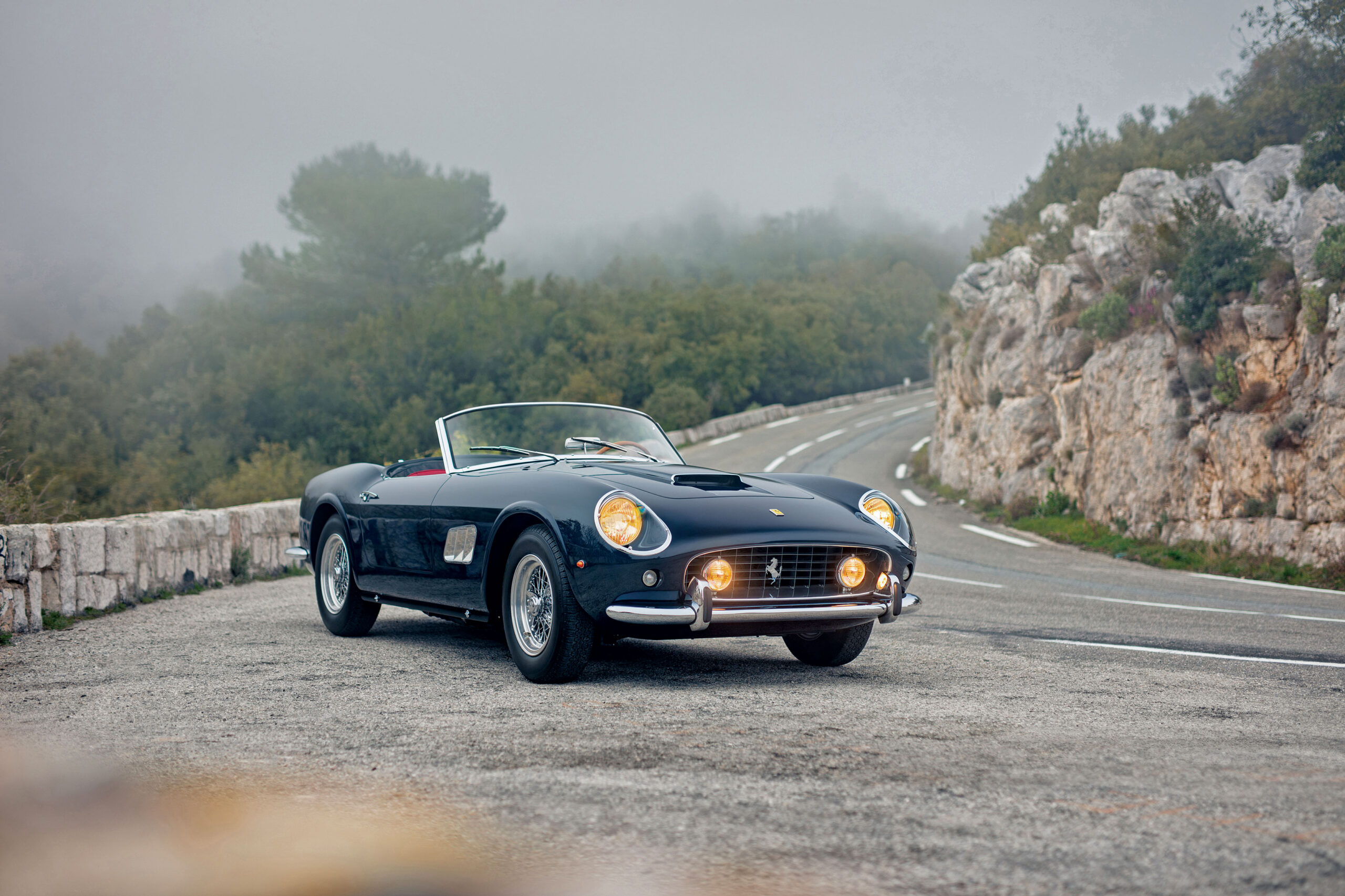
This car, Lot 164, sold for $19,506,336 (€16,655,000), including buyer’s premium, at RM Sotheby’s Monaco sale, on April 25, 2026.
“Dog Bites Man.” First-year journalism students are taught that a dog biting a man is not news. A man biting a dog, though — that’s news. Reporting that a Ferrari 250 GT California Spider sold for a record number seems about as obvious of an aphorism as a dog biting a man. California Spiders have long been the king of production Ferraris, and setting records is what they do.
Wikipedia maintains a list of the most expensive cars that have sold at auctions. The list runs some 280 cars deep. Ferrari 250 GT California Spiders occupy nearly 10% of the list, with 25 slots. No other car comes close. The highest-ranking one is an SWB Competizione version sold by Gooding Christie’s, clocking in at number 14. It took a $25,305,000 sale to get there. That sale was in 2025, which is important because the heyday of vintage-Ferrari appreciation had passed while Californias were still going strong.
California complexity
There is a hierarchy to California Spiders. First there are long- (LWB) and short-wheelbase (SWB) models. The long-wheelbase, or passo lungo, models were made from 1957 to ’60, with short-wheelbase (passo corto) models continuing from 1960 to ’63. The LWB models were built on a 2,600-mm chassis, similar to the 250 GT LWB Tour de France berlinettas. The SWB models were built on a 2,400-mm chassis, similar to the 250 GT SWB berlinettas. The SWB models have updated mechanicals, handle better and are thought to look more aggressive. Hence, SWB Californias are more valuable than the LWB Californias.
Both versions were built with either standard steel or lightweight aluminum alloy bodies. There were 41 steel and eight aluminum LWB Californias built, along with 51 steel and three aluminum SWB Californias. The aluminum versions were intended for competition and command a premium price. A couple of Californias were built specifically for competition with larger fuel tanks and outside gas fillers. An alloy SWB California Spider Competizione is the holy grail.
One signature styling trait of the California Spider is its covered headlights. Italy outlawed covered headlights for a couple of years, and during this time, Italian-market Californias went without. The open-headlight Californias are not as valuable as the covered-headlight models. Additionally, Californias cycled through maybe seven different variations of the 250 engine. Early Californias had engines with spark plugs on the inside of the cylinder heads. Later cars had engines with spark plugs on the outside of their more-efficient heads. Cars with the later, more-evolved engines sell for more money.
Moreover, early Californias had drum brakes and lever shocks. Later cars got disc brakes and tubular shocks. Some cars had leather interiors and others had vinyl. Many other updates and customer requests differentiate Californias. Buyers will have an ideal car in their mind, but these cars come up for sale infrequently and buyers cannot be too choosy.
A prime example
Our subject car, chassis 2955GT, was the 26th of 54 SWB Californias built. It is late enough that it features the final type 168/61 engine, tubular shocks and disc brakes. It is a covered-headlight model with no distinctive modifications. Originally painted white with black leather, it now is an attractive dark blue highlighted by a red leather interior. A silver factory hard top adds a touch of class.
Chassis 2955GT’s specifications leave nothing to be desired, and neither does its provenance. A Massini Report shows a good history with no blemishes. Twice the car has been restored or refurbished, both times by noted Italian Ferrari specialists. A Ferrari Classiche Red Book confirms the car retains its original mechanical components.
There is really nothing not to like about this car except that it does not have a major concours win, but that may be a good thing. Chassis 2955GT was shown at Pebble Beach in 2022, but there is no other show history reported. That means the new owner can show off their car at all the major concours, should they wish.
Enzo-era optimism
RM Sotheby’s estimate for chassis 2955GT was an optimistic $17m–$19.4m. Hitting the high estimate would make it the most valuable steel-body California to ever sell at auction. RM sealed the deal at €16,655,000, roughly $19.5m, not only claiming the steel-body record, but also making this the second-most-valuable California Spider to ever sell at auction, behind the $25.3m alloy Competizione model noted above.
The last few years have been rough on vintage Ferraris. Modern supercars and “Speciales” are taking up all the air in the room, while gold-standard models like 275s, Lussos and Daytonas are selling back of their highs. In the past two weeks, I have done a number of inspections or appraisals, including for the sale of a 288 GTO that would make the top 75 of all auction sales, as well as two Maserati MC12s, an Enzo and two LaFerraris that would all make the top 150 sales.
Once again, a Ferrari 250 GT California Spider has sold for a record price. Is that a harbinger of the future of the broader vintage Ferrari market or simply confirmation of the popularity of this particular model? I think it is foreshadowing the future. Gains in modern Ferrari values cannot run forever, and as the hot models move into the $5m–$10m range, a $2m Lusso or $3m 275 GTB starts to look appealing.
This sale’s winner is the vintage-Ferrari market. It was looking bleak for old Ferraris, but there is nothing like a record sale to prove the patient is still alive. I am happy to report that a man has bitten a dog.